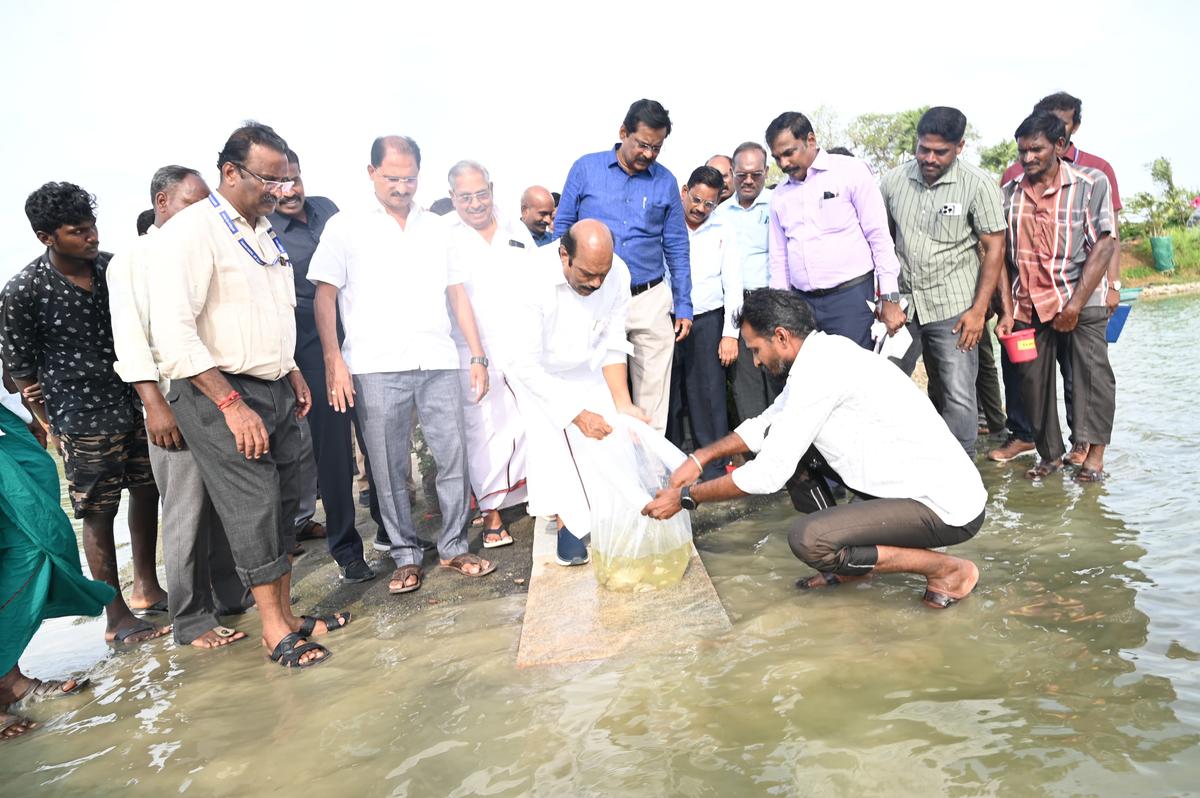
Tiruvannamalai Sees Seasonal Revival of Fish Farming in Local Irrigation Tank
Aided by recent rains, fish farming has resumed at the Melathikkan irrigation tank near Tiruvannamalai, bringing seasonal employment and nutritional benefits to the region. Maintained by the District Rural Development Agency, the tank has witnessed a significant water level rise due to the southwest monsoon, creating favourable conditions for cultivating freshwater fish. Local fishermen have now re-engaged in their annual cycle of sustainable aquaculture under the close watch of fisheries officials, ensuring both ecological balance and rural livelihood regeneration.
The Tamil Nadu Fisheries Department has revived cultivation of fast-growing species such as Catla, Roya, and Mithila, chosen for their adaptability and high local demand. Over 2,000 fingerlings are released per hectare, ensuring healthy fish density across the tank’s area. Spread over several hectares, the tank is now home to thousands of juvenile fish that can grow to over a kilogram within three months. Fish farming is concentrated from May to August, leveraging lower temperatures, adequate oxygen levels, and minimal water evaporation to maximise yield. According to officials, local expertise plays a vital role, with fishermen from neighbouring Edapalayam village forming organised units to oversee the operations. Fishing operations are conducted in two shifts daily, with 18 fishing units comprising two fishermen each using coracles to reach deeper waters. Each unit targets a daily haul of 20 kg, pushing total daily output to around 500 kg, particularly in the peak month of August.
Not only does this model ensure local food security, but a third of the catch is distributed through government-run outlets, with the remainder channelled into rural markets across Tamil Nadu. The tank thus doubles as both a biodiversity reservoir and a reliable source of fresh protein for the region, strengthening the local agri-food economy. Equally important is the social dimension. The initiative fosters a circular, locally embedded economy. Fishermen are paid daily wages and operate under close supervision, discouraging illegal fishing and ensuring safety. Such structured deployment of human resources promotes equitable work distribution while retaining traditional knowledge. The collaborative framework involving government agencies, fisheries experts, and local workers shows how rural water bodies can be purposefully repurposed for climate-resilient food production, even amidst erratic weather cycles.
As India grapples with recurring droughts and rural unemployment, projects like this provide scalable models of inclusive development. They showcase how rejuvenating natural infrastructure through scientific intervention and local participation can address multiple challenges — from nutrition and livelihoods to ecological health. With consistent rain patterns and administrative backing, Tiruvannamalai’s fish farming revival could soon inspire similar interventions across southern India.