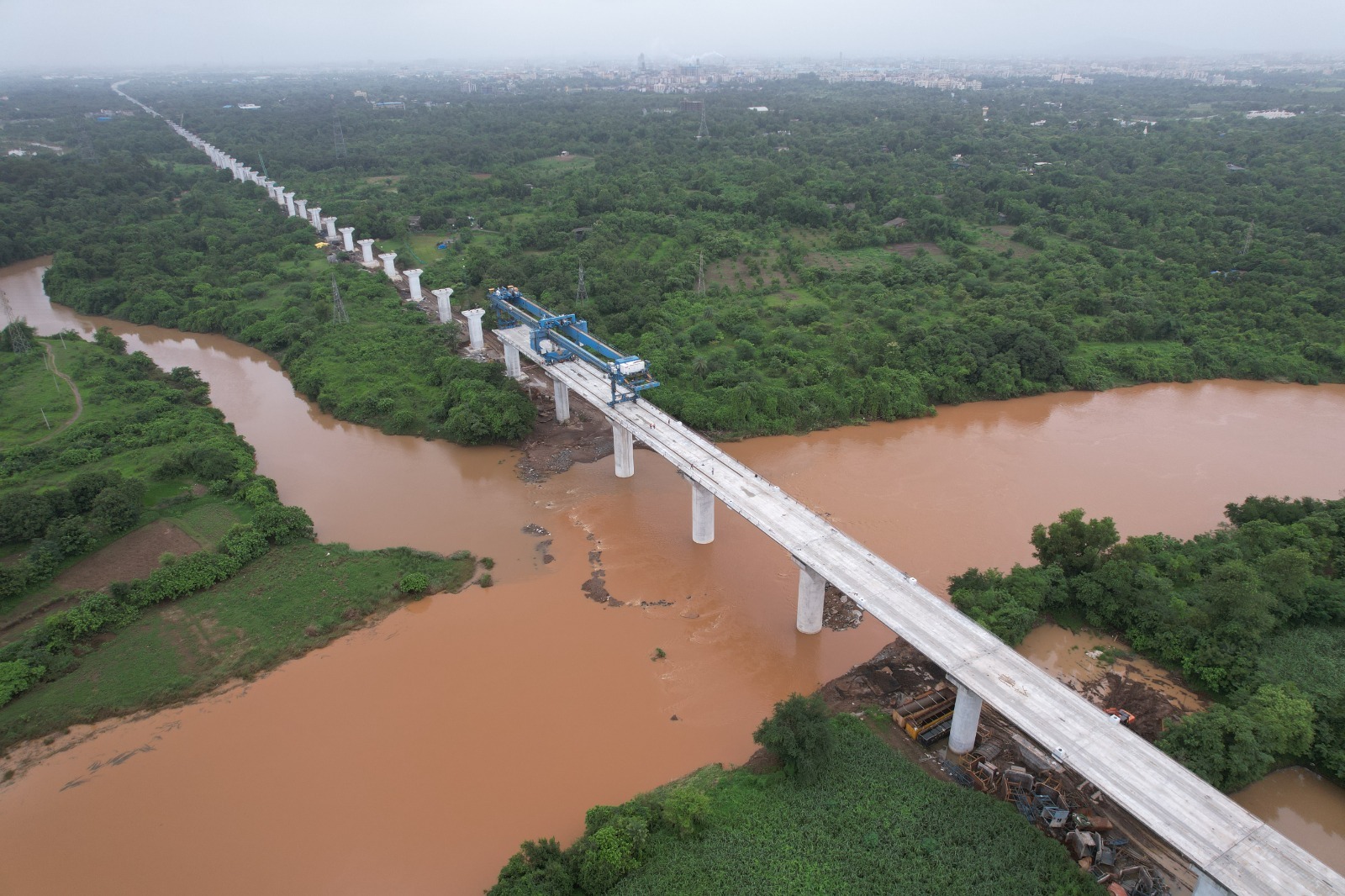
Valsad Completes Fifth and Final River Bridge for Bullet Train Project
The Mumbai-Ahmedabad High-Speed Rail (MAHSR) corridor, often dubbed the ‘Bullet Train’ project, has achieved a significant milestone with the completion of the Daman Ganga River bridge in Valsad district. This 360-meter structure marks the sixteenth river bridge finished along the 508-kilometre route and critically, the finalisation of all five planned river bridges within the Valsad district. This progress, supported by Japanese technical and financial assistance, not only accelerates the project’s timeline but also underscores India’s commitment to developing high-speed, eco-friendly transportation infrastructure, aligning with the nation’s broader vision for zero-net-carbon and equitable urban landscapes.
The Daman Ganga bridge, a critical artery in the high-speed rail network, is strategically positioned approximately one kilometre from the upcoming Vapi station and 61 kilometres from the Boisar station. Its construction involved the meticulous placement of nine full-span girders, each measuring 40 meters in length. The piers supporting these girders exhibit varying heights, ranging from 19 to 29 meters, a design necessitated by the fluctuating levels of the riverbed. The structural integrity is further reinforced by a combination of circular piers – one with a four-meter diameter, another with a five-meter diameter, and eight piers each measuring 5.5 meters in diameter. This precise engineering ensures the bridge’s resilience and longevity, a testament to the advanced construction methodologies being employed.
This achievement in Valsad follows the successful completion of other vital river crossings in the district, including the Auranga and Par River bridges (both 320 meters long), the Kolak River bridge (160 meters), and the Darotha River bridge (80 meters). These interconnected segments in Valsad district, covering approximately 56 kilometres of the MAHSR alignment and including a 4.3-kilometre stretch through the Union Territory of Dadra & Nagar Haveli, are foundational to the operationalisation of this ambitious project. The Valsad section is particularly notable for also incorporating the Vapi bullet train station, a 350-meter tunnel, and a 210-meter prestressed concrete (PSC) bridge, showcasing the diverse engineering challenges being successfully overcome.
The Daman Ganga River itself holds considerable significance for the region, originating in the Sahyadri Hills of Maharashtra and flowing approximately 131 kilometres through Maharashtra, Dadra and Nagar Haveli, and Daman before merging with the Arabian Sea. It serves as a vital water source for drinking, irrigation, and industrial purposes, supporting key industrial hubs such as Vapi, Dadra, and Silvassa. The river is also home to the Madhuban Dam, a critical water resource for irrigation, drinking water supply, and hydroelectric power generation. The careful consideration of the river’s ecological and economic importance during the bridge’s construction is paramount, ensuring minimal environmental impact while facilitating essential infrastructure development.
From a business journalistic perspective, the completion of such critical infrastructure components significantly de-risks the overall project, signalling progress and instilling greater confidence among stakeholders, including investors, technology partners, and the public. The Mumbai-Ahmedabad High-Speed Rail corridor, with its emphasis on high efficiency and reduced travel times, is poised to unlock substantial economic opportunities. It is expected to stimulate regional development by improving connectivity between two major economic hubs, facilitating faster movement of goods and services, and fostering new business corridors. The project’s adherence to stringent quality and safety standards, bolstered by Japanese expertise, positions it as a benchmark for future large-scale infrastructure undertakings in India.
Moreover, the project’s broader alignment with sustainable and eco-friendly development goals cannot be overstated. High-speed rail, inherently more energy-efficient per passenger-kilometre compared to air or road travel, contributes significantly to reducing carbon emissions in the transportation sector. The construction methodology, including the use of pre-fabricated girders, minimises on-site disruptions and construction waste, embodying principles of eco-conscious development. As India strives towards creating smarter, more livable cities, investments in green transportation suchways as high-speed rail are vital in mitigating urban congestion and air pollution, contributing to a healthier environment for its citizens. Furthermore, the project’s emphasis on local skill development and employment generation during construction phases also contributes to a more equitable economic landscape.
The ongoing progress of the Mumbai-Ahmedabad Bullet Train project, epitomised by the completion of the Daman Ganga bridge and other vital river crossings in Valsad, signifies a tangible step towards modernising India’s transportation network. It is not merely about faster travel; it is about building resilient, sustainable infrastructure that serves as a catalyst for economic growth, environmental stewardship, and improved quality of life for all. The strategic completion of these bridge structures underscores the nation’s commitment to delivering a transformative project that will redefine inter-city travel and serve as a model for future large-scale developments.