


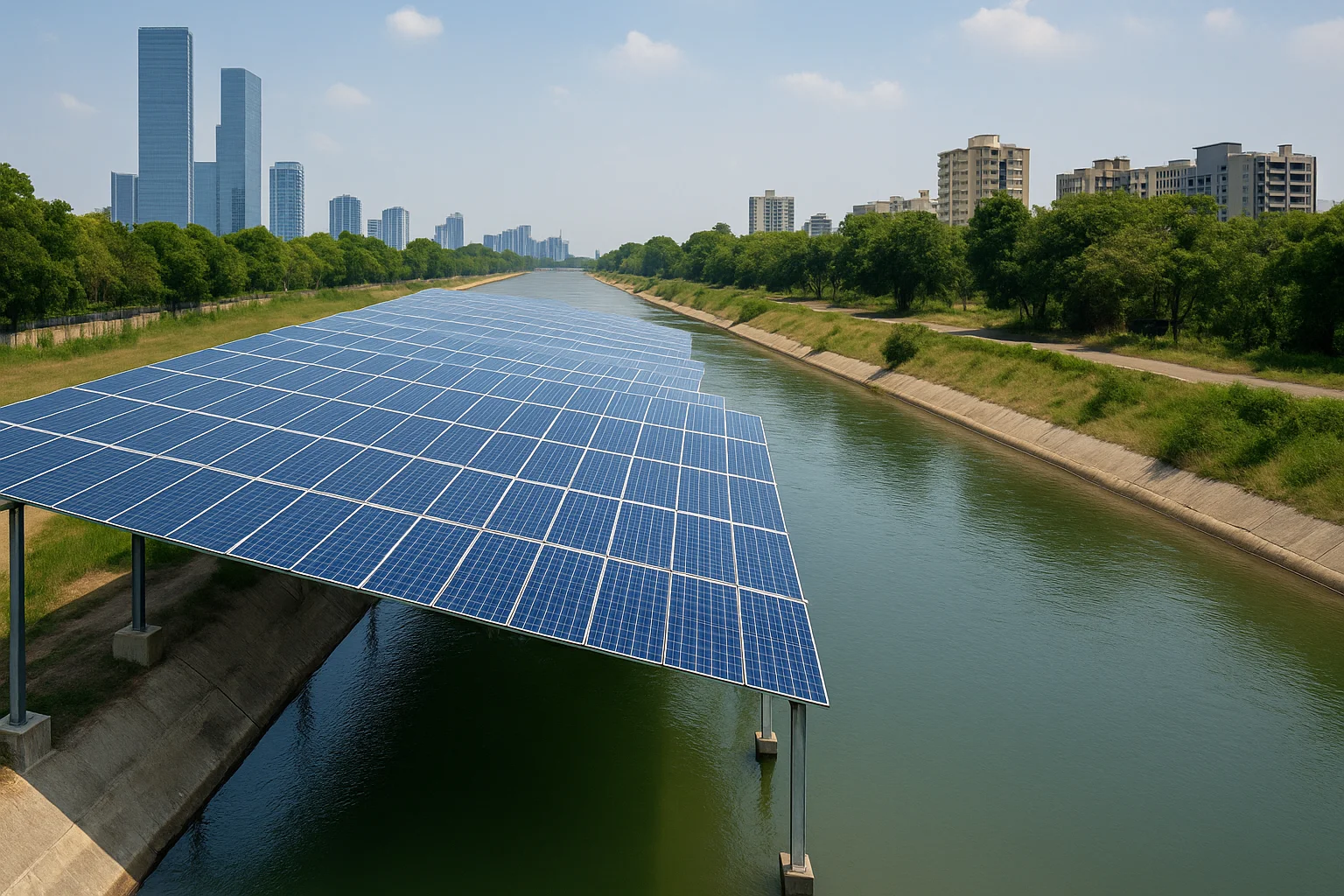
The Delhi government is drafting a visionary plan to install solar panels atop the Munak Canal’s 17 km Delhi stretch, aiming to significantly reduce water losses, generate renewable energy, and enhance public safety and cleanliness, according to Water Minister Parvesh Verma.
Nearly 30 % of the canal’s water—particularly in the Delhi Sub-Branch (DSB) and Carrier Lined Channel (CLC)—is lost to seepage and evaporation, with the CLC alone accounting for a 5 % loss in actual volume, the government’s inspection revealed . Dirt dumping and accidental drownings along exposed stretches underscore the urgent need for a comprehensive, multi-dimensional solution. The proposal sets out to construct four-foot-high embankment walls on either side of the canal, forming a sturdy base for a seamless solar canopy. These elevated photovoltaic panels would shield the water, cutting evaporation and saving vital drinking water, while simultaneously harnessing solar energy to power local water infrastructure or feed the grid. The solar over-canal model follows the successful Gujarat initiative, where canal-top panels have benefitted from cooling effects and land-efficient installation since 2014 .
Verma emphasised, “Covering the Munak Canal will help us save water, produce clean power, and make the canal safer and more secure for the people of Delhi,” championing the dual goals of environmental protection and citizen welfare . Beyond technical benefits, the proposal is expected to deter hazardous dumping, reduce accidental falls, and discourage trespassing, fostering a healthier urban ecosystem along the canal . This aligns with Delhi’s wider green infrastructure goals, including plans for canal-top solar projects like the Najafgarh Drain corridor .
The canal spans 102 km—comprising 85 km in Haryana and a 17 km stretch within Delhi. Officials are coordinating with the Haryana government to ensure seamless inter-state management and maintenance . The Delhi Jal Board is currently conducting technical and financial feasibility studies ahead of preparing a detailed project report (DPR) and blueprint . Urban environmental experts note that canal-top solar installations confer multiple sustainability dividends: reduced evaporation, increased PV efficiency through evaporative cooling, and land-use optimisation . Indeed, Reddit discussions cite panel efficiency gains of 2.5–5 % and substantial water savings—as seen in Indian pilot schemes—using precisely this dual-purpose model .
If successfully executed, Delhi could replicate and scale this model on other water bodies to centralise clean energy production and water conservation. However, project hurdles include structural engineering challenges over a linear 17 km span, maintenance logistics, and ensuring uninterrupted water flow. In addition to building climate-resilient infrastructure, this scheme reflects Delhi’s commitment to cleaner, smarter cities. Its synergy with state-level environmental goals underlines a growing national momentum that sees green infrastructure not just as a utility enhancement, but as a transformative urban lifestyle shift.
Also Read: New Delhi raises privacy alarm over IRCTC’s Aadhaar‑based Tatkal bookings
