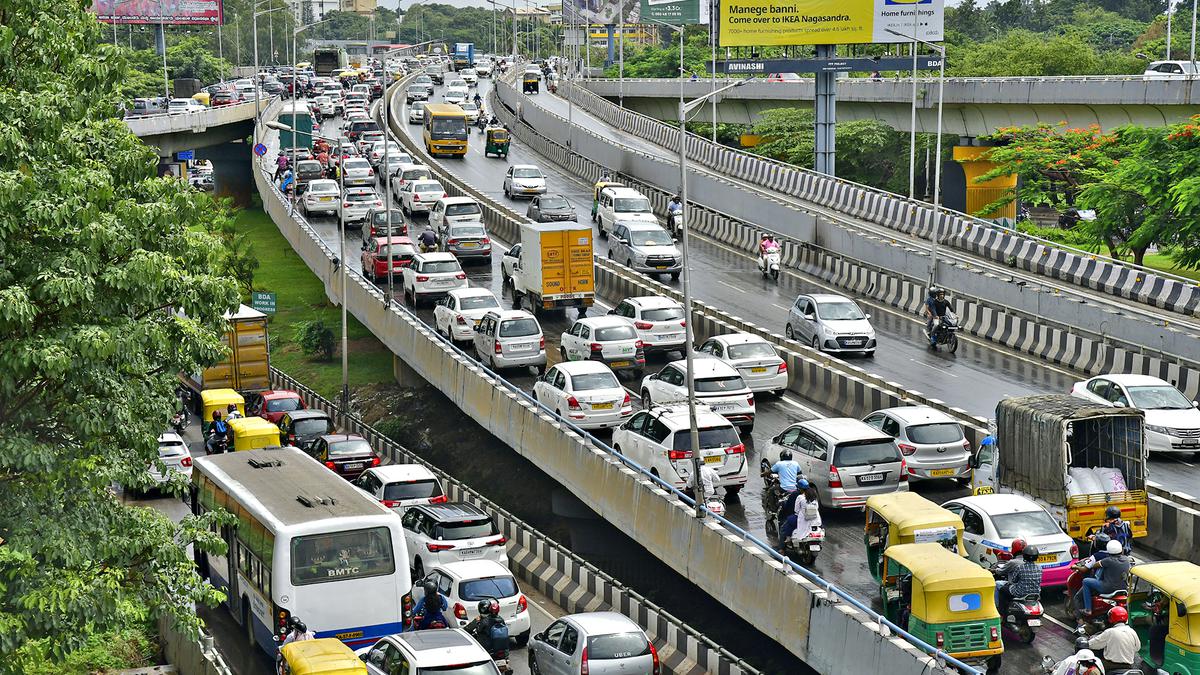
Bengaluru to ease traffic chaos with new Hebbal flyover connecting Nagawara to airport route
Bengaluru is finally taking a bold step to address one of its most notorious traffic bottlenecks. The Bangalore Development Authority (BDA) has proposed a new flyover at the Hebbal Junction, originating from the Nagawara side, aiming to streamline traffic flow toward the Kempegowda International Airport (KIA). The move comes years after persistent congestion has plagued this critical corridor, frustrating thousands of daily commuters and air travelers.
The proposed flyover, which will link Nagawara directly to the national highway leading to the airport, has already been cleared by the BDA board for the preparation of a detailed project report (DPR). For a city long suffering from delayed infrastructure responses and growing vehicle density, this is a much-needed intervention. This is not the first time the BDA has attempted to address the congestion at the Hebbal junction. In fact, the authority had previously spent ₹25 crore to erect 11 massive pillars for an earlier ramp project back in 2019. However, that project was abruptly halted after the Bangalore Metro Rail Corporation Limited (BMRCL) raised objections. The alignment of the planned ramp was said to interfere with future Metro lines, leading to a deadlock that left the pillars unused and gathering dust inside the tree park near the junction.
Now, with the green light for a new flyover plan, the BDA is exploring the possibility of repurposing those abandoned pillars to reduce costs and minimize construction disruption. This would involve a structural feasibility assessment to determine whether the existing infrastructure can be safely integrated into the new flyover’s design. The new flyover is expected to span less than a kilometre but promises to have an outsized impact on the city’s traffic flow. The key goal is to alleviate the snarling congestion that has become a daily ordeal for commuters traveling from Nagawara toward Tumakuru Road, Mehkri Circle, BEL Circle, and KIA. Presently, all vehicles heading in these directions funnel into the same narrow stretch under the Hebbal flyover, leading to long tailbacks and chaotic traffic conditions during peak hours.
One of the major pain points for motorists has been the lack of a dedicated ramp for traffic coming from the Nagawara side. With no direct access to the Hebbal flyover, many commuters are forced to take a circuitous route through Kempapura and use the service road near Esteem Mall to merge with the main flyover. This not only increases travel time but also causes a ripple effect of congestion in surrounding neighborhoods, choking the inner roads that were never meant to handle such high volumes of traffic. The new flyover aims to provide a seamless route from Nagawara to the highway, effectively bypassing the problematic choke points and cutting travel time significantly—especially for those en route to the airport. With the National Highways Authority of India (NHAI) already working on widening roads near the defence area adjacent to Hebbal Lake, BDA officials believe there is adequate space to construct the down ramp of the new flyover without land acquisition hurdles.
A senior BDA source stated, “Construction of the flyover and linking it with the national highway will provide seamless access for air passengers. The length is unlikely to be more than a kilometre. There’s enough space near the defence area to accommodate the necessary ramp infrastructure.” The timing of this proposal is also critical. Bengaluru continues to face mounting pressure on its road network, particularly in areas around major junctions and arterial roads. The Hebbal junction, which connects multiple key routes, has become emblematic of the city’s infrastructural lag—where flyovers exist but fall short of solving the core issues due to poor design integration and lack of long-term planning.
Urban mobility experts have often criticized the piecemeal approach to traffic infrastructure in Bengaluru. While flyovers are built to offer relief, they often end up pushing the bottleneck just a few hundred meters ahead. However, the Nagawara-Hebbal flyover could avoid that trap—if integrated intelligently with the existing flyover system and future-proofed to accommodate metro expansions and road widening efforts. Local residents and regular commuters have welcomed the announcement with cautious optimism. “We’ve seen announcements before, and we’ve seen them stall,” said a daily commuter who travels from Hennur to Yelahanka. “But this new flyover, if executed properly, can make a massive difference. It’s about time we had a direct connection from Nagawara to Hebbal flyover without detours and jams.”
The project is still in the early planning stages, and timelines for construction are yet to be announced. However, officials are hopeful that with the DPR in place and reuse of earlier investments like the abandoned pillars, the process could be expedited. As Bengaluru continues its rapid urban growth, infrastructure will need to play catch-up—and then leap ahead. The Hebbal flyover extension from Nagawara could serve as a much-needed template for smart, adaptive urban mobility planning in India’s tech capital.