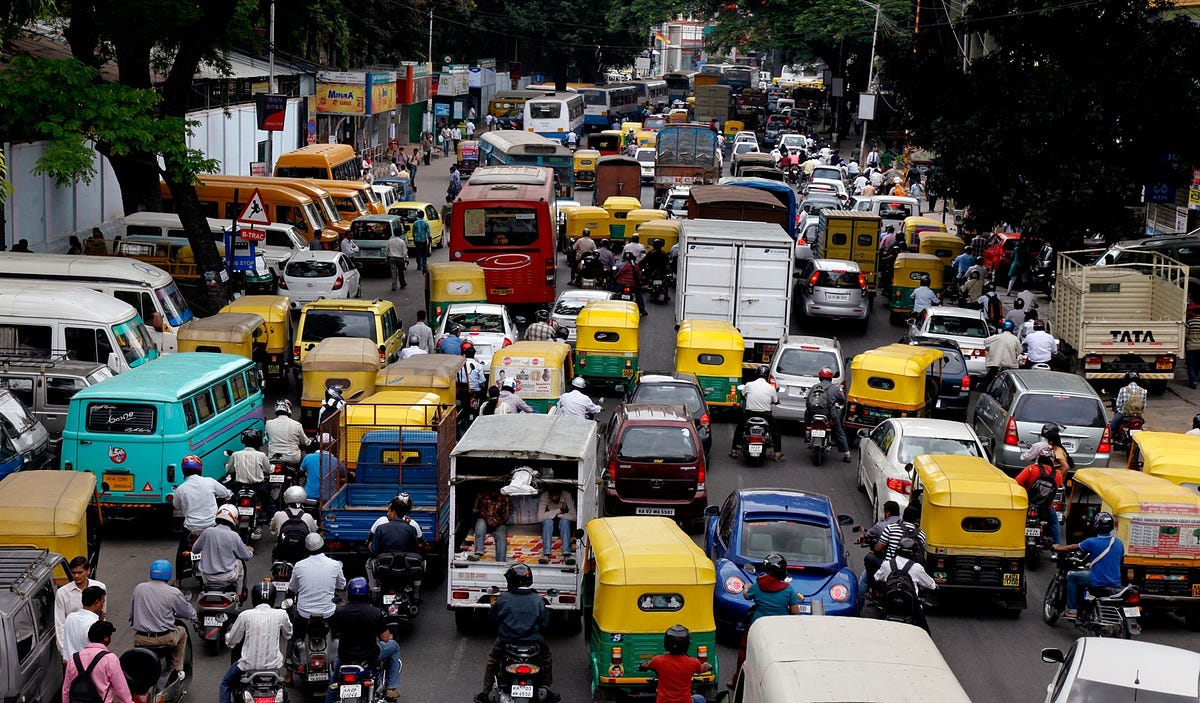
Indore Choked in 40 Hr Jam as NHAI Blames Public MP High Court Issues Notice
Indore has found itself at the centre of a national outcry after a 40-hour traffic gridlock on the Agra–Mumbai National Highway left three people dead and triggered a legal storm. The Madhya Pradesh High Court has served notices to the National Highways Authority of India (NHAI), local administration, and law enforcement, demanding answers on unfinished roadwork and delayed diversions. Public outrage grew as NHAI’s lawyer blamed early-morning travellers, deflecting from the authority’s failure.
The incident, which took place on the Indore–Dewas stretch of the Agra–Mumbai National Highway (NH-52), has now prompted the Madhya Pradesh High Court to issue formal notices to the National Highways Authority of India (NHAI), the Central Government, local administration, and state police. The jam, which unfolded in June’s stifling summer heat, affected thousands and has reignited concerns about poor roadwork planning, lack of emergency response systems, and bureaucratic negligence. Among the deceased were Kamal Panchal, 62, who reportedly died of a heart attack induced by suffocating heat, Balram Patel, 55, who passed away en route to hospital care stuck in traffic, and Sandeep Patel, 32, whose death is also attributed to the extreme conditions during the standstill.
At the core of the crisis lies a diversion road that NHAI had committed to completing by September 2024. Despite having nearly ten months and requesting a further buffer of 3–4 months, the authority failed to deliver. The legal justification offered by NHAI—citing a 10-day crusher unit strike—was swiftly dismissed by the court as unconvincing. The High Court has demanded comprehensive explanations from all parties by July 7, 2025. Public anger boiled over not just because of the tragedy itself, but due to a statement by NHAI’s legal representative during court proceedings: “Why do people even leave home so early without any work?” The callous remark went viral, appearing to deflect responsibility away from the agency and instead blame citizens for travelling during morning hours.
What followed on the highway was not just logistical chaos but a collapse of human dignity. With vehicles stalled for over 20 kilometres in both directions, families were stranded without water, food, or medical access. Passengers—including the elderly, children, and sick—remained trapped in oven-like vehicles as authorities failed to provide any crisis management. Experts note this isn’t a one-off lapse, but a systemic failure of India’s infrastructure development narrative. “Highway projects are prioritised for political optics and capital expenditure metrics. Operational readiness and public safety are afterthoughts,” said a transport policy researcher from a Delhi-based think tank.
The Agra–Mumbai highway, a crucial component of India’s freight corridor, plays a pivotal role in moving goods between major industrial centres. Prolonged shutdowns on such corridors don’t just impact human lives—they damage supply chains, delay perishable freight, and spike operational costs across sectors. The fact that this occurred in Indore—one of Madhya Pradesh’s most prominent economic hubs—only amplifies the magnitude of this failure. Eyewitnesses recount disturbing scenes: ambulances stuck, children crying, people collapsing from exhaustion. Videos from the incident circulated widely on social media, painting a grim picture of apathy and disorder. Yet, even as the pressure mounted, there was no central command to direct relief, no local coordination to distribute essentials, and certainly no accountability from the very authority tasked with maintaining the route.
The legal notice issued by the Madhya Pradesh High Court has been viewed as a positive step, but civil society groups are demanding that heads roll. “This isn’t just incompetence—it’s negligence with fatal consequences,” said a spokesperson from a citizen rights group in Indore. “If NHAI and its contractors cannot meet deadlines, people shouldn’t have to pay with their lives.” In the backdrop of India’s much-publicised infrastructure push—bolstered by campaigns like Gati Shakti and Bharatmala—the Indore incident poses uncomfortable questions about implementation versus intent. Grand announcements mean little if basic planning isn’t in place to protect the lives of ordinary commuters.
It’s also a chilling reminder that India lacks a real-time emergency protocol for highway disasters. There are no rapid-response units equipped to handle massive jams, no digital dashboards updating citizens about delays, and no contingency plans for rerouting traffic effectively when primary lanes fail. As the deadline looms for government departments to submit their explanations, the story of Indore serves as a haunting case study in administrative breakdown. More than just a traffic jam, it was a chokehold on public trust, faith in governance, and the fundamental right to safe passage.
Whether this tragedy will galvanise meaningful reform or be buried in bureaucratic paperwork remains uncertain. But for now, Indore is mourning, not just its dead, but a system that watched them die—and then asked why they were on the road at all.