


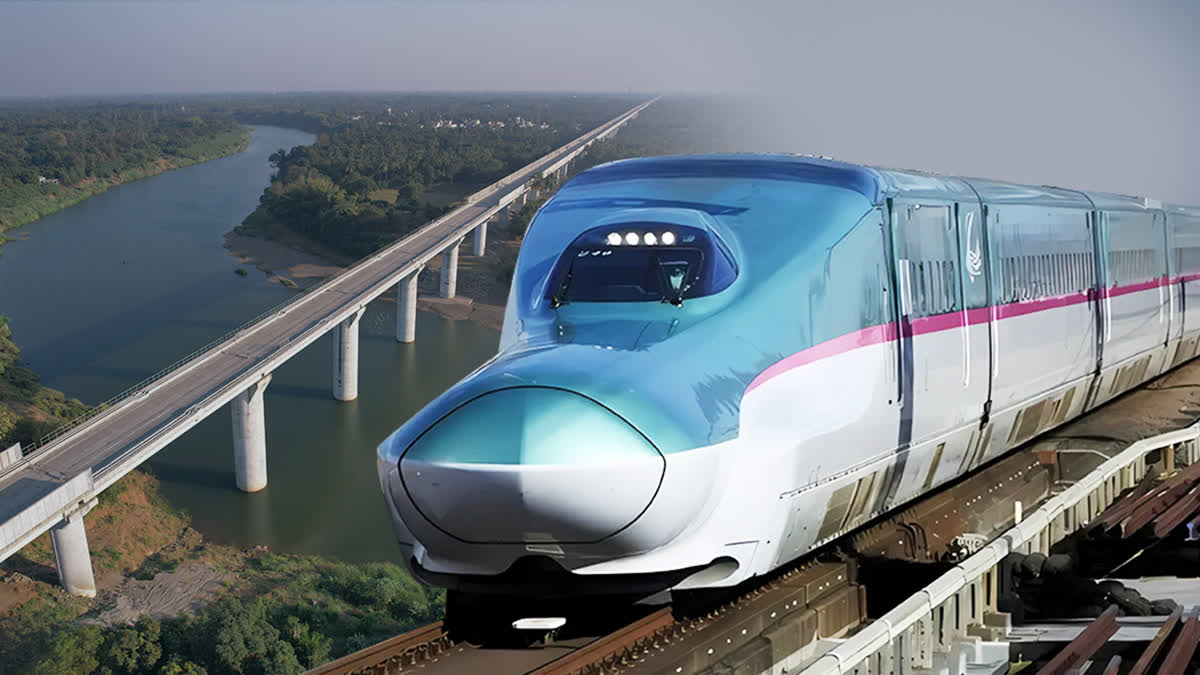
Steel masts are climbing along the Navsari segment of the Mumbai–Ahmedabad bullet train corridor, marking a key milestone in powering India’s first high‑speed rail line. Over 1 000 overhead equipment (OHE) masts have been affixed across 25 km of viaduct in Navsari—part of a planned 20 000‑mast network that will energise the corridor for trains travelling up to 320 km/h.
These precision‑engineered structures will carry the high‑tension catenary wires essential for the bullet train’s electrification. Overall, civil works are advancing rapidly. Of the 508 km corridor, NHSRCL has completed over 300 km of viaducts, 372–386 km of pier foundations, and around 305–326 km of girder casting. A 210‑metre pre‑stressed concrete bridge over NH‑48 near Dabhan has just been finished, alongside twelve major river bridges—one notably spanning the Kharera in Navsari. Track‑bed preparation is progressing with approximately 157 km of reinforced concrete slabs in Gujarat, while construction advances in Maharashtra, including a 21‑km tunnel—7 km of which will pass under Thane Creek—are underway.
Electrification kicked off in January 2025 with initial mast installations between Surat and Bilimora. These OHE masts are locally manufactured to Japanese standards under the “Make in India” initiative, supporting a 2×25 kV system. On the technological front, Siemens has secured a Rs 4 100 crore contract for ETCS Level 2 signalling—a safety‑critical upgrade ensuring real‑time train control for high‑speed operations. Despite outstanding tunnel‑boring machines pending clearance at a Chinese port, authorities say this will not impact the timeline for Navsari and other civil contracts. Preparatory shaft construction continues apace. From an eco‑friendly standpoint, elevated viaducts reduce land disruption, river‑bridge designs maintain ecological balance, and noise barriers span over 300 km to limit community impact.
Strategically, the corridor traverses major economic centres—Mumbai, Surat, Vadodara, Ahmedabad—positioning itself as a backbone of India’s future sustainable mobility. Speeds of 320 km/h will compress travel time to under three hours, fostering gender‑neutral and inclusive transit with economic and environmental dividends. Challenges remain: synchronising high‑precision mast installation, managing heavy‑work seasons, and ensuring seamless electrification aligned with viaduct progress. The undersea tunnel delivery and OHE commissioning in hilly zones will test engineering vigilance. Yet the sight of OHE masts rising in Navsari denotes tangible progress. It signals a convergence of construction, electrification, signalling build‑out, and environmental planning—all steering the Mumbai–Ahmedabad bullet train corridor toward a 2027–28 launch across Gujarat, with full connectivity expected by 2030. If this momentum holds, India’s inaugural bullet train will not only redefine inter‑city travel but also set a benchmark in green, high‑speed infrastructure development.
Also Read :Mumbai-Ahmedabad Bullet Train Project Advances with 100m Steel Bridge
