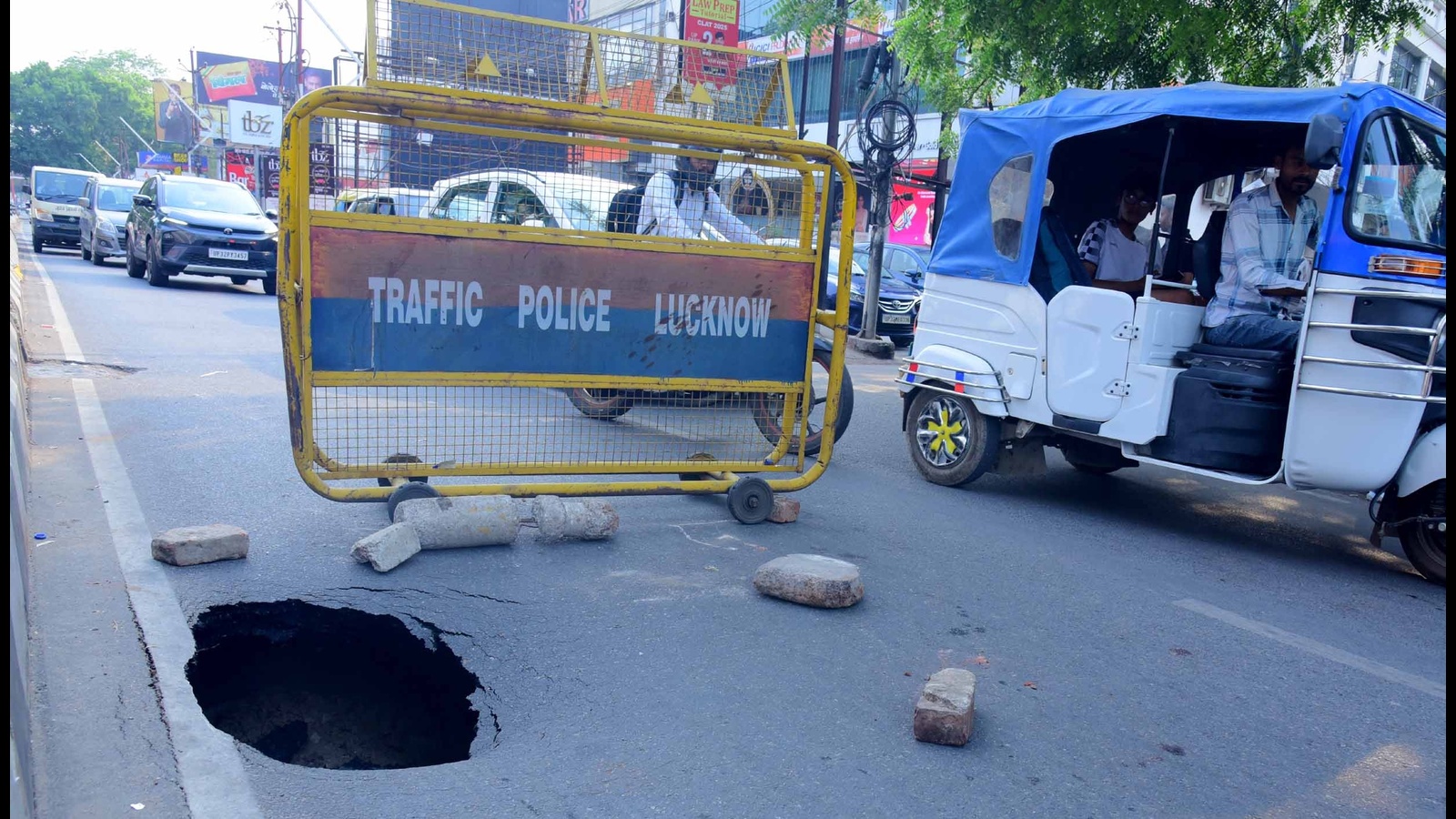
The first rain of the season in Lucknow has exposed severe gaps in the city’s civic preparedness. A 15-foot-wide crater on Ring Road, widespread waterlogging, and jurisdictional confusion among agencies reflect the recurring chaos that follows every downpour. The damage, centred around Indiranagar and Smart City zones, raises serious questions about pre-monsoon planning and inter-agency coordination.
On Friday, a 15-foot-wide crater opened up on the Ring Road service lane near Indiranagar Sector 18 after a night of rainfall. The public works department quickly barricaded the area and filled the sinkhole temporarily with debris to avoid accidents. However, repair work has only just begun, while residents and officials engage in blame-shifting rather than providing solutions.
PWD sources claimed that underground cable work recently undertaken by Lesa might have destabilised the road surface. Meanwhile, confusion over the jurisdiction of the road has deepened. Zone-7 Zonal Officer stated that the stretch falls under the National Highways Authority of India (NHAI), while sewer and drainage maintenance lies with Lucknow Municipal Corporation (LMC). The result: no single agency is taking responsibility.
In several neighbourhoods such as Vijayant Khand-3, Sushant Golf City, and Daliganj Crossing, waterlogging became a common complaint. In Sushant Golf City, even a short spell of rain is enough to flood roads. Residents say that pre-monsoon drain cleaning was incomplete — sludge was left roadside and got washed back into the drains. Craters and road subsidence were also reported on G-20 Road and near Ram Manohar Lohia Park.
The Smart City Control Room was activated to monitor real-time flood and drainage issues. Municipal Commissioner Gaurav Kumar visited the centre and instructed teams to remain on high alert. He also urged prompt follow-up with citizens post complaint resolution. However, despite digital infrastructure, the lived experience of residents suggests that ground-level coordination remains poor and largely reactive.
Lucknow’s first encounter with the monsoon has laid bare its civic fault lines—crumbling roads, poor coordination, and unaddressed vulnerabilities in low-lying areas. While control rooms and helplines offer a digital veneer of preparedness, the physical breakdown of infrastructure tells another story. Unless inter-agency coordination is strengthened and accountability enforced, the city will continue to lurch from crisis to crisis with every spell of rain.