


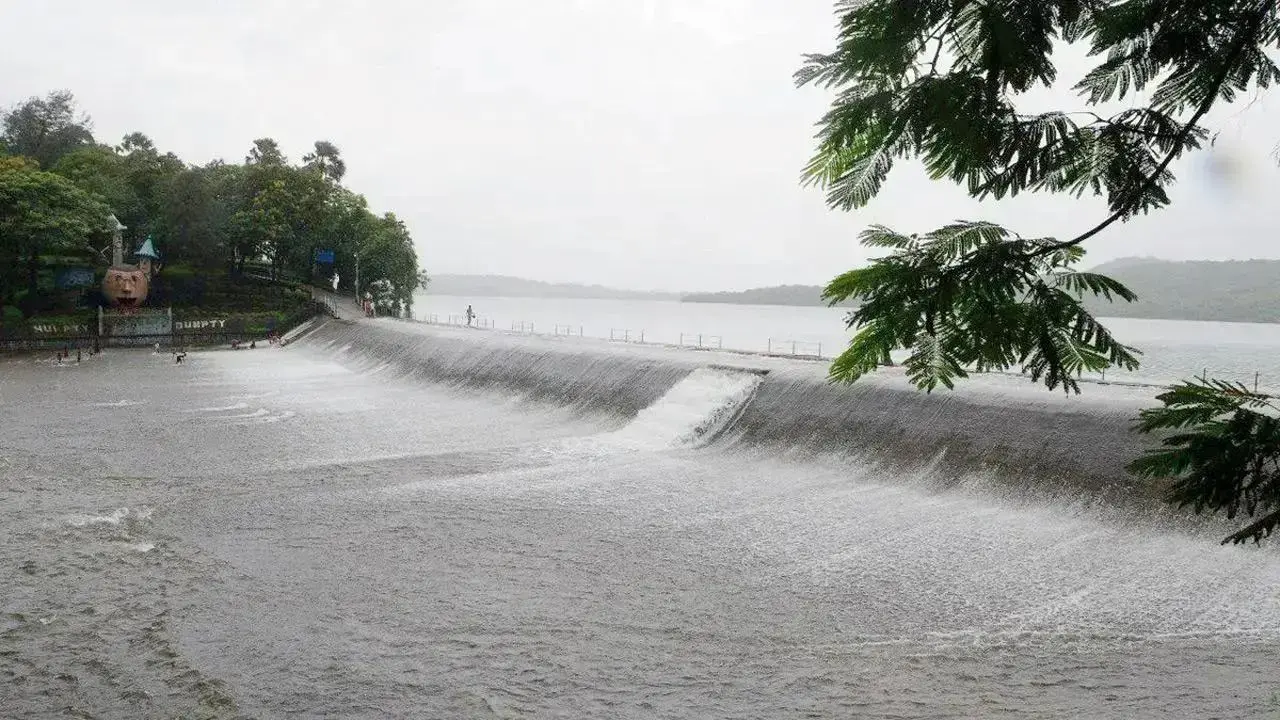
Mumbai’s seven reservoirs have recorded a measurable rise in storage, reaching 26.84 per cent of their collective capacity. Officials managing the city’s water supply confirmed that this uptick could provide temporary relief amid growing concerns over water security during a delayed monsoon season.
According to fresh data released by the municipal water management department on Sunday, the cumulative live storage across all seven lakes stood at 3,88,523 million litres. This comes after intermittent but effective downpours over the past few days, especially in regions feeding Modak Sagar, Upper Vaitarna, and Tulsi — some of the city’s key freshwater sources. The seven reservoirs that cater to Mumbai’s daily drinking water demand include Upper Vaitarna, Middle Vaitarna, Modak Sagar, Tansa, Bhatsa, Vihar, and Tulsi. These reservoirs are strategically located across Maharashtra’s western ghats and adjoining hill systems, ensuring gravity-assisted supply flows toward the metropolis.
At present, Modak Sagar holds the highest percentage of water stock at 44.22 per cent, followed by Vihar at 39.71 per cent and Tulsi at 38.33 per cent. Bhatsa and Upper Vaitarna — both large reservoirs — currently stand at 21.79 per cent and 31.04 per cent respectively. Tansa, despite being one of the oldest sources, shows just 9.99 per cent active storage, highlighting regional disparity in rainfall distribution even within the same hydro zone. Municipal engineers said that while the 26.84 per cent figure is well below the safety threshold needed to meet the city’s needs until the end of the monsoon, it is a positive sign considering the monsoon’s staggered arrival this year. Mumbai requires approximately 14.47 lakh million litres of water annually, with the lakes needing to reach 100 per cent capacity by mid-October to ensure uninterrupted supply throughout the dry months.
“Rainfall activity in the catchment zones has improved marginally over the past week,” an official from the city’s hydraulic engineering department said. “However, sustained inflow is critical over the next four to six weeks to reduce the risk of pre-monsoon water cuts later this year.” Water from the Bhatsa system — comprising Bhatsa, Vihar, and Tulsi lakes — is routed through the Panjarpur Treatment Plant and serves the city’s eastern suburbs from Mulund to Sion and further into South Mumbai. Western suburbs, from Dahisar Check Naka to Bandra and up to Malabar Hill, receive their supply from Modak Sagar, Tansa, and both Vaitarna reservoirs.
Rain-fed lakes have historically played a foundational role in Mumbai’s water architecture, and their health is now even more vital amid rising urbanisation and climate-linked weather volatility. Experts warn that a delayed or deficient monsoon could easily tilt the city toward emergency rationing, with ripple effects across households, hospitals, and industries. A climate analyst at a Mumbai-based policy think tank noted, “Even though the rise in storage appears modest, it’s a signal of how even a few well-distributed spells of rain can begin to stabilise urban water systems. That said, we must not confuse temporary relief with long-term sustainability.”
Environmental planners argue that Mumbai’s over-reliance on distant reservoirs must be recalibrated in favour of decentralised, rain-fed, and recycled water solutions. “The city still loses nearly 25 per cent of its treated water to leakages and unauthorised tapping,” said a senior water policy expert. “Unless we plug those infrastructural gaps and diversify sources, every monsoon becomes a high-stakes gamble.” Meanwhile, the India Meteorological Department (IMD) has forecast a generally cloudy sky for Mumbai, with the possibility of intermittent moderate rain over the next few days. According to the IMD’s Santacruz observatory, the maximum temperature on Sunday touched 32.9°C, while the minimum hovered around 25°C. The Colaba station recorded a high of 31.6°C and a low of 26°C.
Tidal activity, a key element of Mumbai’s monsoon response planning, remains high. On Sunday, the city recorded a high tide of 4.09 metres at 9:28 AM and another at 3.74 metres at 8:52 PM. A low tide is expected early Monday morning at 3:25 AM, where the sea will recede to 0.59 metres — an important window for stormwater drainage in flood-prone zones. City authorities remain cautious in their optimism. While rains have helped raise reservoir levels marginally , a consistent pattern of downpour is still needed across upstream regions, especially in the Nashik and Thane districts that form the source basin for lakes like Bhatsa and Vaitarna.
In the interim, civic officials have urged residents to use water judiciously, avoid wastage, and report leaks or illegal connections that may exacerbate the current supply-demand imbalance. Ward offices have also been asked to intensify monitoring of community-level storage and issue water-saving advisories to housing societies. The city’s broader water resilience strategy, according to senior officials, includes micro-catchment recharge projects, better urban landscaping to trap rainwater, and tapping into decentralised greywater recycling systems in new developments. These plans are part of Mumbai’s larger goal to build an equitable, climate-resilient and zero-waste water ecosystem by the end of this decade.
As the city awaits stronger monsoon systems to fully restore its reservoir levels, the present improvement — modest as it may be — offers a reminder that nature and infrastructure must be harmonised to secure the everyday essentials of a city as vast and dynamic as Mumbai.
Also Read : Mumbai to See Water Cuts for One Week
