


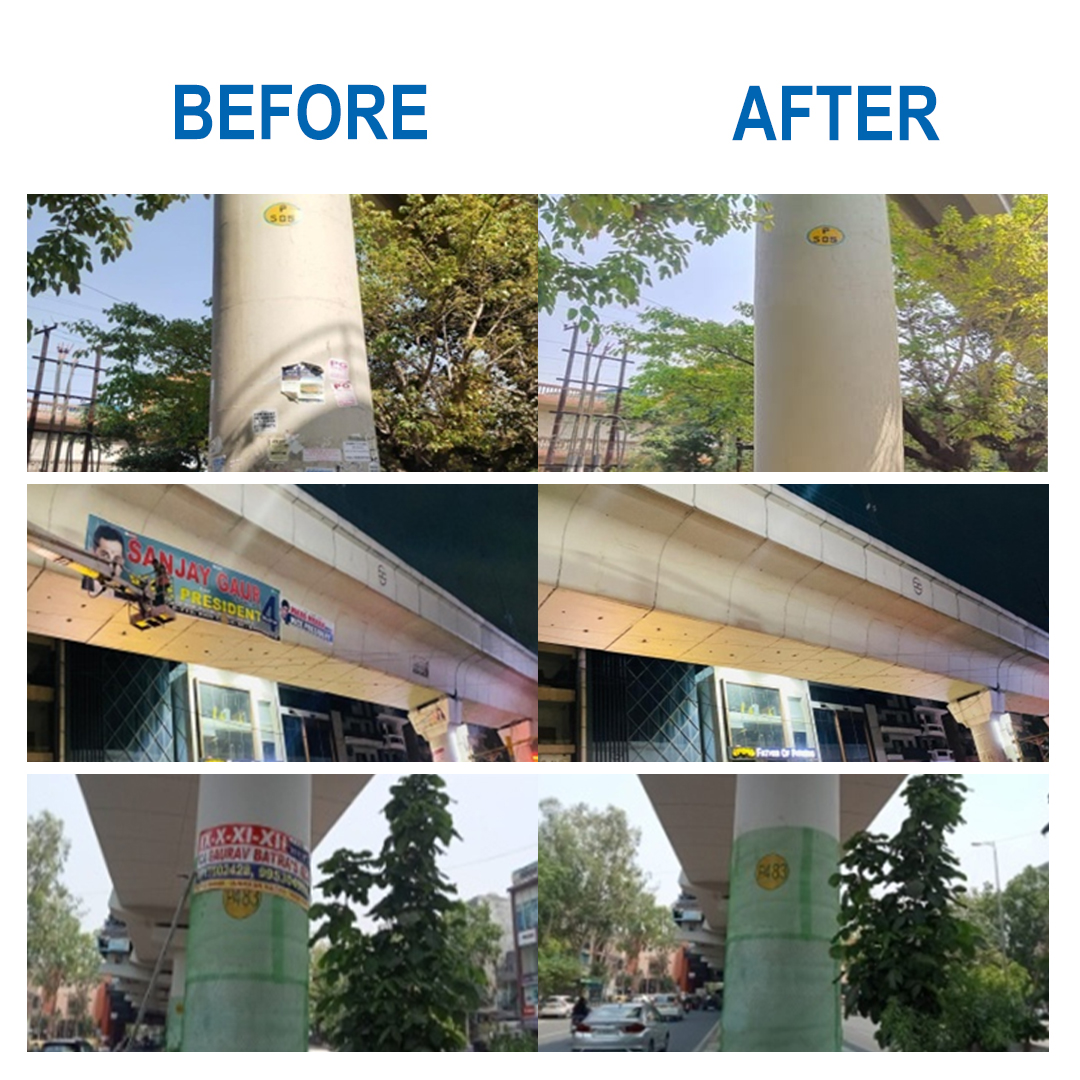
Delhi Metro has removed unauthorised posters and banners from 327 locations and filed 53 FIRs under anti‑defacement law following government directives, while deploying a beautification initiative across its network to restore civic pride. The action reflects the capital’s heightened focus on transforming public infrastructure into engaging, eco‑friendly urban landmarks
Delhi’s metro network has taken decisive action against wall defacement by removing posters and banners from 327 metro structures and filing FIRs against 53 agencies and individuals under the Delhi Prevention of Defacement of Property Act, 2007. Behind this initiative is a zero‑tolerance legal framework established by state leadership, mandating accountability across civic agencies to reclaim city spaces under a shared vision of a dignified, clean capital. A special monitoring team has been constituted by the metro rail authority to oversee stations and adjoining infrastructure. They are applying anti‑carbonation paints to deter future damage and planning to embellish selected pillars and walls with artistic installations, thereby turning neglected spaces into visual landmarks.
Government officials emphasise that the metro’s transformation is symbolic of broader urban change. Public messaging around “shared responsibility” is gaining traction as authorities prompt citizens to view Delhi Metro not just as transportation, but as civic showcase. The installation of murals and protected structures aims to foster emotional ownership, discouraging future vandalism . Defacement of public infrastructure undermines civic equity, perpetuating a sense of neglect. Delhi Metro’s initiative reframes public transport as inclusive infrastructure that should reflect dignity, sustainability, and community values rather than neglect or decay. This aligns with a growing push in global cities to integrate art within transit, promoting commuter wellbeing and social cohesion .
The drive also echoes environmental and carbon neutrality objectives. Cleaning and preserving infrastructure extends asset life, minimises repainting cycles, and reduces construction‑related waste—small steps towards eco‑sensitive city management. Officials highlight that anti‑carbonation coatings will protect structures from pollution‑induced deterioration, embedding resilience ahead of future climate stresses. Accountability measures are sweeping: high‑level directives ensure departments like PWD, MCD, and NDMC share responsibility to prevent blame‑shifting. Officers are now answerable for visible upkeep, with performance reviewed under new metrics. A civic architect commented that such frameworks can recalibrate public‑private accountability, turning shared spaces into collective assets.
Citizens appear receptive: early responses cite appreciation of cleaner surroundings and interest in community engagement around artwork. Urban planners suggest that contests for community‑led murals can embed a sense of ownership and discourage vandalism, extending the metro’s role from transit hub to civic campus. This initiative follows similar drives at universities and heritage precincts, but Delhi Metro’s scale—nearly 400 km network—makes it uniquely impactful. Experts believe it may serve as replicable model for public utilities in other Indian cities, fostering beautification through legal enforcement and participatory design. Yet challenges lie ahead. Legal action is resource‑intensive, and ongoing monitoring requires sustained funding and inter‑agency coordination. The success of the beautification campaign depends on deeper civic engagement and transparent metrics to evaluate impact. Analysts note that without citizen buy‑in, murals risk becoming mere visual backdrops rather than drivers of behavioural change.
Additionally, integrating green infrastructure alongside aesthetic improvements could compound benefits. A public policy expert urges authorities to include vertical gardens, air‑purifying plant panels, and sustainable materials alongside artistic themes, deepening the climate‑resilience footprint. As the drive unfolds, authorities will likely monitor a range of indicators: reduction in defacement incidents, maintenance cost variations, commuter satisfaction levels, and artwork preservation rates. If maintained, the metro’s network can symbolise what inclusive, sustainable, and gender‑neutral urban design can achieve at scale.
Delhi Metro’s initiative marks a shift from reactive clean‑ups to proactive urban design—transforming stations from neglected conduits into civic galleries. In doing so, the city charts a course towards transport systems that are robust, carbon‑aware, and human‑centred.
Also Read : Mumbai to Lucknow Air India Flight Cancelled Over Operational Disruptions
