


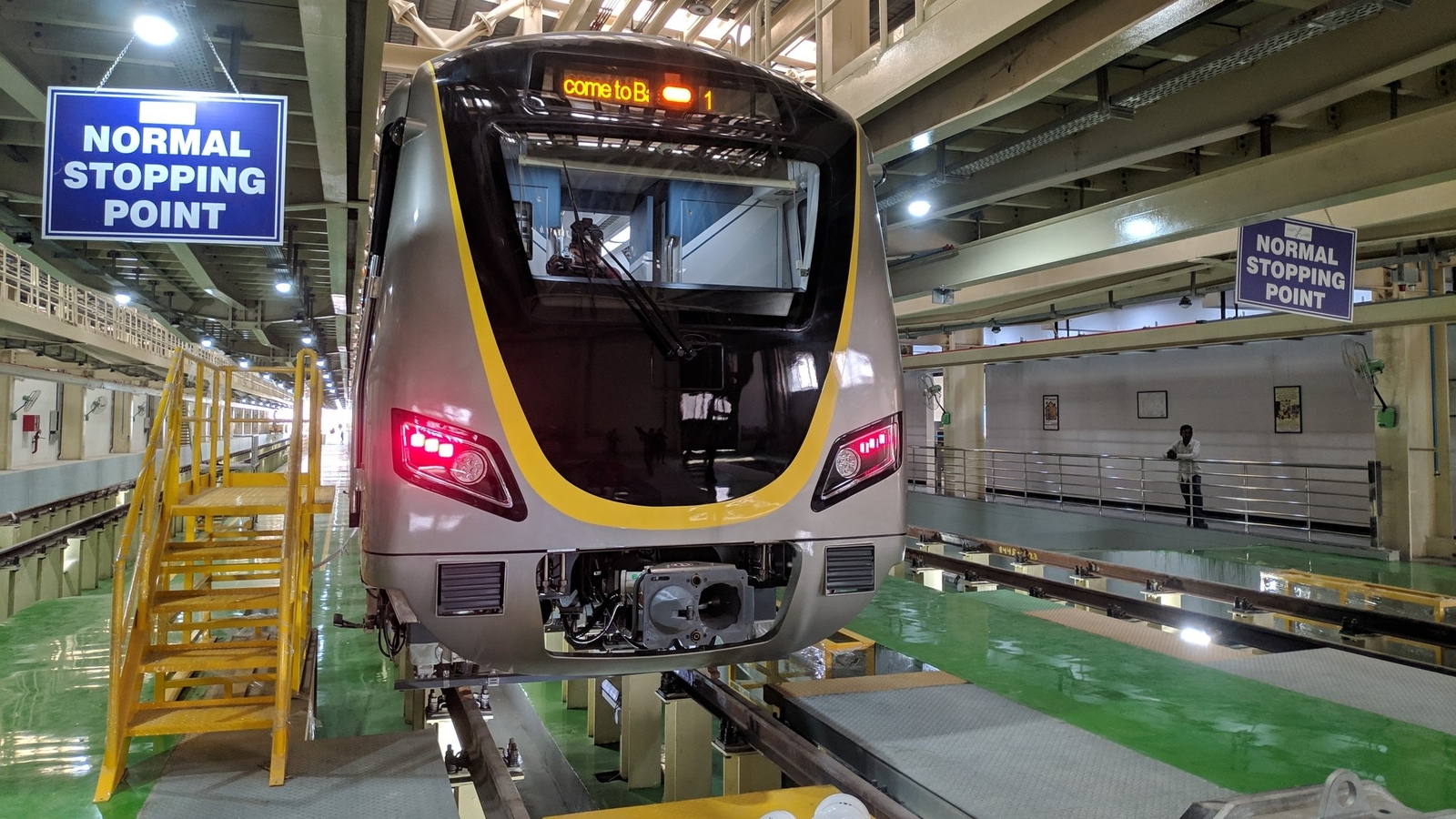
Yellow Line of Bengaluru’s Namma Metro, stretching 19.15 km from RV Road to Bommasandra, faces further delays, now projected to open by late July or August 2025.
This setback is primarily due to unresolved issues with the train signalling system, specifically the pending Independent Safety Assessment (ISA) certification required for operational clearance. The Bangalore Metro Rail Corporation Limited (BMRCL) had previously submitted documents to the Commissioner of Metro Railway Safety (CMRS) to initiate the statutory safety inspection. However, a critical component—the ISA certification for the train signalling tests—is still pending. Siemens India Ltd, the signalling contractor for the Yellow Line, identified glitches during a review of the datasets, necessitating software corrections. These corrections are essential as the software controls all aspects of train operations, including acceleration, braking, speed, routing, and maintaining safe distances between trains.
The Yellow Line is set to be India’s first metro corridor equipped with Siemens’ Communications-Based Train Control (CBTC) system at Grade of Automation 4 (GoA 4), enabling driverless operations. This advanced system promises enhanced safety and efficiency but also requires rigorous testing and certification. The CBTC system allows trains to operate with a minimum headway of 90 seconds, significantly improving service frequency and capacity. In addition to signalling issues, the Yellow Line’s launch has been hampered by a shortage of trains. Titagarh Rail Systems Limited (TRSL), responsible for supplying the trains, has faced delays in delivery. While the first train and the carbody shells for the second and third trains were imported from China, TRSL is now manufacturing the carbody shells in-house under the supervision of engineers from the main contractor, CRRC. Production has been streamlined, and TRSL is expected to start delivering one train per month after July.
The Yellow Line’s delay is part of a broader pattern affecting Namma Metro’s Phase II expansion. Sanctioned in 2014 and launched in 2016, the project aimed to add 75 km of new lines but has seen only partial completion. As of now, over 40 km remain non-operational, with full completion unlikely before 2026. The project’s estimated cost has ballooned from ₹26,405 crore to ₹40,614 crore, reflecting significant cost overruns due to delays, land acquisition challenges, and design changes. Despite these setbacks, the Yellow Line holds promise for improving Bengaluru’s public transportation, particularly by connecting key areas like Electronic City, a major IT hub. Once operational, the line is expected to serve over 2.5 lakh commuters daily, easing traffic congestion and contributing to the city’s sustainable urban development.
Also Read : Mumbai Metro Line 14 promises faster Badlapur travel
