


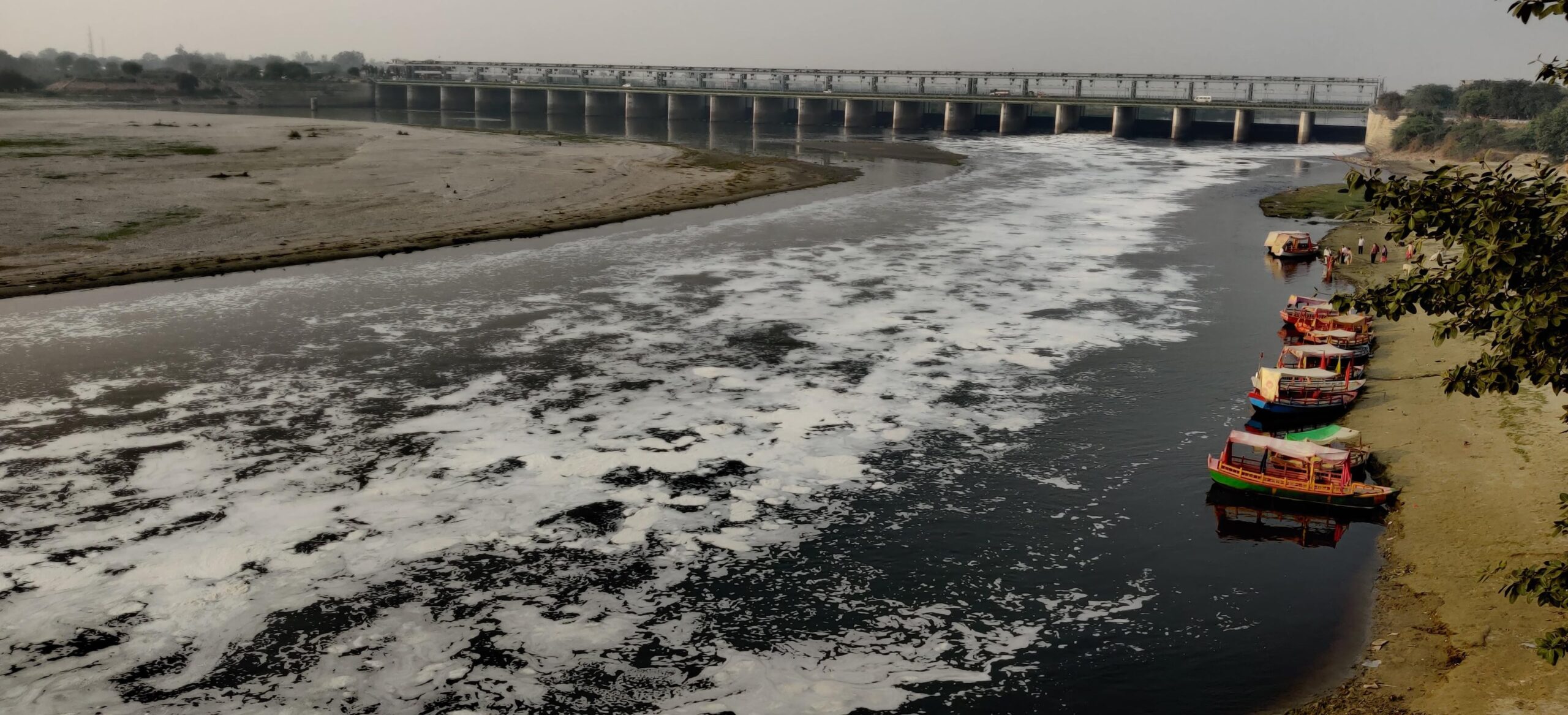
Yamuna River in Delhi is now exhibiting dangerous levels of pollution, threatening the city’s water security and exposing deep failures in urban ecological governance.
A recent report by the Delhi Pollution Control Committee (DPCC) has revealed that faecal contamination and chemical pollutants in the river are far above safe limits, especially at the Wazirabad barrage, the point from which the city draws its drinking water.The findings, released in April 2025, show a 115% surge in faecal coliform bacteria at Wazirabad—5,400 MPN/100 ml against the Central Pollution Control Board’s permissible limit of 2,500. This spike in contamination points to the widespread discharge of untreated sewage and industrial waste into the Yamuna, making the water unfit for consumption and hazardous for aquatic life.
The Biochemical Oxygen Demand (BOD), a key indicator of organic pollution, was also alarmingly high at 6 mg/l, double the acceptable threshold. This suggests substantial quantities of organic waste are depleting oxygen levels in the water, endangering biodiversity. Health experts warn that these conditions could expose millions to gastrointestinal diseases, skin infections, and long-term exposure to toxic metals.Environmentalists are now calling for urgent and structural reforms. Activist Varun Gulati has blamed the situation on upstream discharges from Haryana, highlighting that untreated effluents from Panipat and other districts are being funnelled directly into the river via drains like Khojkipur and Palla. He alleged that illegal waste dumping using private tankers is rampant and remains largely unregulated.
“What we are witnessing is not just river pollution, but a complete breakdown of ecological governance,” Gulati said. He added that desilting operations remain incomplete and enforcement against industrial polluters has been weak.Experts argue that Delhi’s clean-up efforts are fundamentally misaligned with the scale of the crisis. Bhim Singh Rawat from the South Asia Network on Dams, Rivers and People (SANDRP) criticised the policy approach as fragmented and cosmetic. “Authorities are treating Yamuna as a drain rather than a living river. Restoration, not just treatment, must be the central focus,” he said.
Rawat pointed to three major failings—dwindling environmental flow, unchecked abstraction by Delhi and Haryana, and industrial-scale sand mining upstream—as root causes that need urgent rectification. “The river’s natural hydrology has been severely damaged. Without reviving its ecological flow, no clean-up effort will yield results,” he warned.Public health professionals are also raising the alarm. Dr Tushar Tayal from CK Birla Hospital, Gurugram, explained that the contamination is not only bacterial but also chemical. “Industrial effluents carry heavy metals like lead and mercury which pose severe long-term health risks including cancer and organ damage,” he said. He added that ammonia levels and microplastics further complicate the situation, with antibiotic-resistant bacteria making treatment of infections more difficult.
Despite the gravity of the crisis, a new 30-point inter-agency action plan was recently launched by the Centre and Delhi government after a high-level meeting chaired by Prime Minister Narendra Modi. The plan sets deadlines from June 2025 to March 2029 and includes interventions ranging from STP upgrades, floodplain restoration, unauthorised colony connectivity, and environmental flow enhancement.By 2026, treated water from key Delhi STPs will be released to augment river flow. Drain tapping, especially at Barapullah and Delhi Gate, will be expedited. The plan also envisions solid waste removal, septage treatment using biogas, and a Sabarmati-style riverfront development funded through a proposed “Yamuna Kosh”.
However, many observers remain sceptical. “Deadlines and riverfront beautification cannot replace scientific restoration and enforcement,” said Rawat. With no binding ecological flow targets or industrial compliance audits in the public domain, critics argue that the plan may fall short of delivering systemic change.
As Delhi residents continue to rely on the Yamuna for their daily water needs, the stakes have never been higher. The river, once revered and life-giving, now poses a stark threat to public health and urban sustainability. Whether the renewed clean-up will move beyond optics remains to be seen, but failure is no longer an option in a city already battling water scarcity and environmental degradation.
Also Read : Delhi mandates dust control registration for all construction projects

