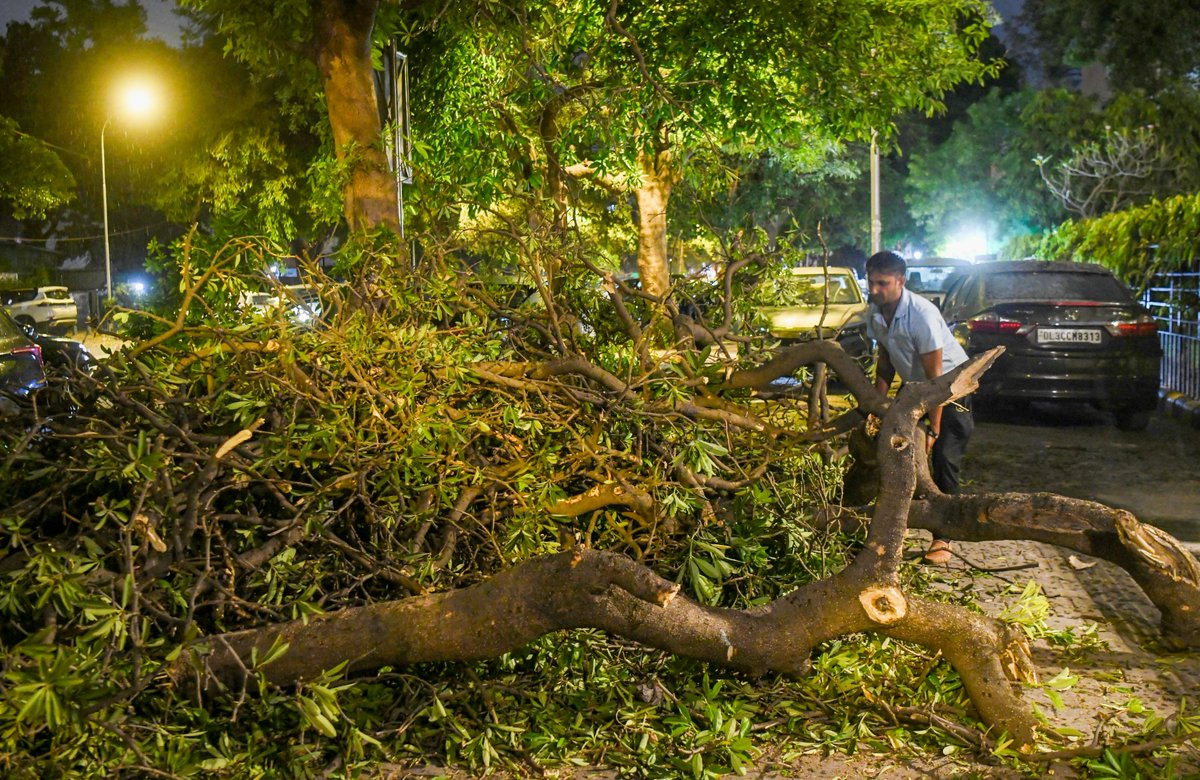
A powerful dust storm swept through Noida and Greater Noida on Friday night and Saturday afternoon, disrupting daily life and leaving a trail of damage that exposed the fragility of urban infrastructure in one of India’s fastest-growing districts.
With surface winds clocking up to 50 kmph, the storm caused widespread power failures, road obstructions, and construction-related hazards—highlighting urgent gaps in weather resilience across the cityscape. The storm, accompanied by brief showers and sudden gusts, battered critical infrastructure, including the Paschimanchal Vidyut Vitran Nigam Limited (PVVNL) grid. Officials confirmed that nearly 400 electric poles and over 40 transformers were either damaged or uprooted in Greater Noida alone, resulting in blackout-like conditions in multiple residential pockets and villages. Power supply was severely disrupted in sectors under the 33/11 kV substations across Dankaur, Rabupura, Bhata, and Salarpur. Maintenance crews were deployed overnight to repair damaged lines, but delays in full restoration left thousands of residents without electricity for prolonged periods.
In Shahberi’s Balaji Enclave, residents reported six-hour power cuts with minimal communication from authorities. “We are already used to frequent tripping, but the storm made things worse. This isn’t sustainable,” said Amit Chauhan, a local resident echoing sentiments shared widely across housing colonies. In a more alarming development, high-speed winds tore off window panes and doors in a high-rise building at JP Aman Society in Sector 151, drawing flak for apparent lapses in construction standards. A video showing the aftermath went viral, sparking public outrage over safety in high-rise apartments that often escape regular structural audits.
Elsewhere, in Jewar and other peripheral regions, fallen trees and snapped electric lines slowed traffic and blocked access to key roads. Residents welcomed the respite from the heat but expressed frustration over delayed clearances and poor response coordination. In central Noida, a traffic signal pole collapsed in Sector 27 near DM Chowk, crushing a parked vehicle. Fortunately, no injuries were reported. Simultaneously, a car caught fire on Film City Road, choking movement along the Noida-Greater Noida Expressway, although police confirmed the driver escaped unharmed. According to the India Meteorological Department (IMD), the region witnessed light to moderate rainfall, accompanied by dust-laden gusts and a sudden drop in visibility. With temperatures swinging between 26.2°C and 42°C, weather forecasts indicate continued instability, with cloudy skies, gusty winds, and the possibility of more thunderstorms until at least May 23.
As cities like Noida rapidly expand, this episode underscores the urgent need for sustainable infrastructure planning, robust utility systems, and climate-resilient construction. While electricity teams race to restore normalcy, the larger concern remains whether cities are truly prepared for the environmental volatility of an increasingly unpredictable climate.