


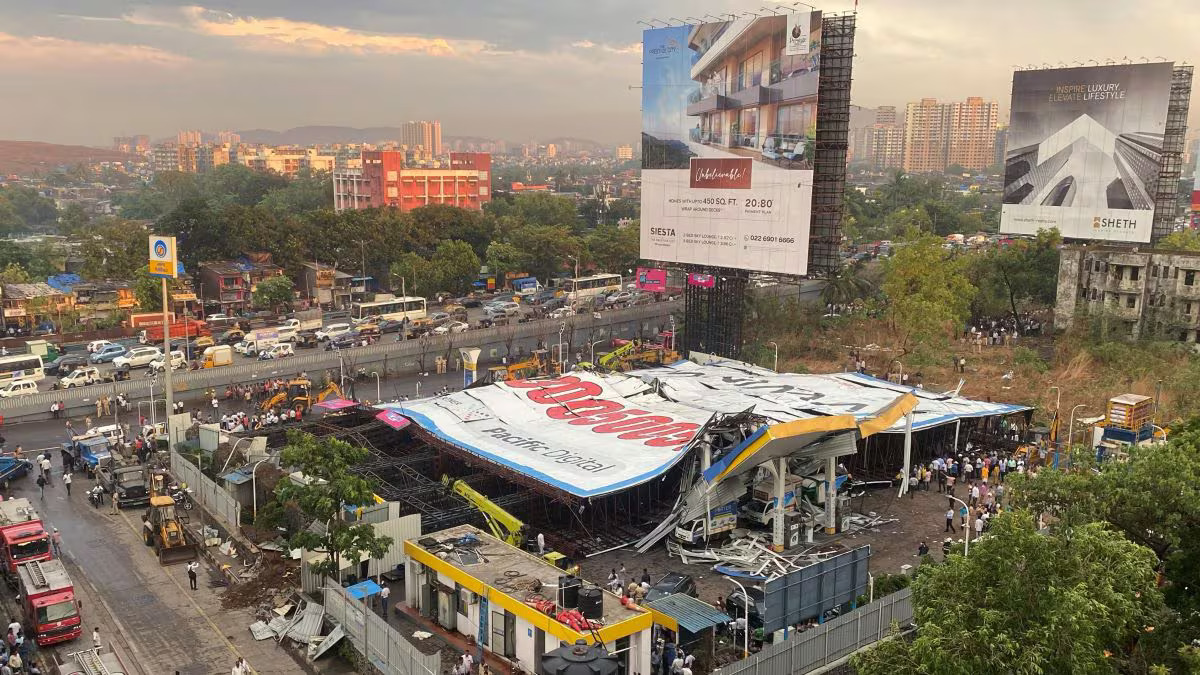
Two large advertising hoardings collapsed in Bhukum during a severe rain and windstorm, causing significant damage to parked vehicles and reigniting widespread concerns over the safety and regulation of outdoor advertising infrastructure across Pune’s growing peri-urban zones.
The incident occurred early evening near a busy marketplace, a time when traffic had thinned due to monsoon showers. Eyewitnesses recounted that both billboards gave way almost simultaneously, likely due to the impact of heavy gusts and water saturation weakening structural supports. The large metallic frames and display panels came crashing down on four motorcycles parked close to the hoardings, reportedly by local commuters seeking temporary shelter from the rain. Fortunately, there were no casualties, thanks to quick-thinking bystanders who raised alerts and cleared the area moments before the structures collapsed. Emergency response teams from the Pune Rural Police and disaster management cell reached the site swiftly. The vicinity was cordoned off to prevent further risks as emergency personnel began clearing debris. Officials from the Pune Metropolitan Region Development Authority (PMRDA) also arrived shortly thereafter to conduct an initial assessment and launch a technical inquiry into the failure.
Damage to the two-wheelers is reported to be extensive, with owners stating that repairs could run into several tens of thousands of rupees. Yet, amid the financial setbacks, relief prevailed that the incident had not resulted in injuries or fatalities. Civic authorities have acknowledged that the structural integrity of the collapsed hoardings had likely been compromised, with preliminary findings indicating corrosion and insufficient anchoring as possible causes. What is raising the most public concern, however, is that the incident was not entirely unforeseen. Local residents and market traders have long warned about deteriorating billboard infrastructure in Bhukum and similar rapidly urbanising pockets outside Pune. Many of these hoardings, often installed on private plots or above low-rise commercial units, are either ageing, unauthorised, or maintained with minimal oversight. Inconsistent enforcement of safety audits, combined with seasonal wind shear and increasing urban clutter, has created the conditions for such collapses to become an annual hazard during the monsoon.
Urban planning experts point out that outdoor advertising structures are supposed to undergo periodic structural inspections under civic and state-level regulations. However, gaps in implementation, including coordination failures between local governing bodies and advertising agencies, have allowed a proliferation of unsafe hoardings. In some cases, these installations are set up without rigorous engineering assessments or adherence to the National Building Code. An official from PMRDA confirmed that a comprehensive safety audit is now underway across Bhukum and other urban growth nodes in the Pune Metropolitan Region. Notices have been issued to advertising firms and private property owners, requiring submission of structural stability certificates. Any billboards found to be unsafe or in violation of guidelines will be subject to immediate removal.
This latest collapse adds to growing scrutiny of urban safety in India’s expanding metropolitan peripheries, where infrastructure development has often outpaced regulatory enforcement. In the wake of similar incidents in recent years—some of which have caused fatalities in cities like Mumbai and Bengaluru—civic bodies across the country are being urged to adopt stricter licensing norms, ensure public accessibility to hoarding registries, and penalise repeat offenders with heavier fines and criminal liability. The incident has also sparked renewed public discourse around the visual and physical impact of hoardings in urban landscapes. Advertising experts note that while outdoor media remains a powerful marketing tool, there is an urgent need to evolve towards more sustainable and less intrusive formats. Many cities globally are now transitioning to digital street furniture, wall murals, and zoned advertising clusters that minimise structural footprint and energy consumption.
For Bhukum, the collapse has become a flashpoint that underscores larger questions about urban governance, climate resilience, and public accountability. Monsoon variability in the region—characterised by sudden high-intensity rain and wind bursts—makes it imperative that even minor infrastructure like signboards, poles, and hoardings are re-evaluated through the lens of safety and sustainability. Environmental advocates argue that this is also a wake-up call to integrate climate risk into urban design and land-use planning frameworks. Stronger winds, increasingly common during early monsoon transitions, pose new challenges to infrastructure long considered passive or benign. While smart city frameworks have been adopted in many Indian metros, peri-urban belts such as Bhukum, which are seeing rapid residential and commercial densification, often fall through the cracks.
Civic authorities have promised that action will follow the current audit and that future approvals for hoardings will be made more stringent. However, local citizens’ groups insist that unless there is continuous monitoring and independent third-party verification of safety standards, such assurances may not result in systemic change. As urban India grapples with the dual imperatives of economic growth and environmental resilience, Bhukum’s hoarding collapse stands as a stark reminder: sustainable cities cannot be built on unstable foundations—literally or otherwise.
Also Read : Pune to Implement Metered Water Billing in 2026
