


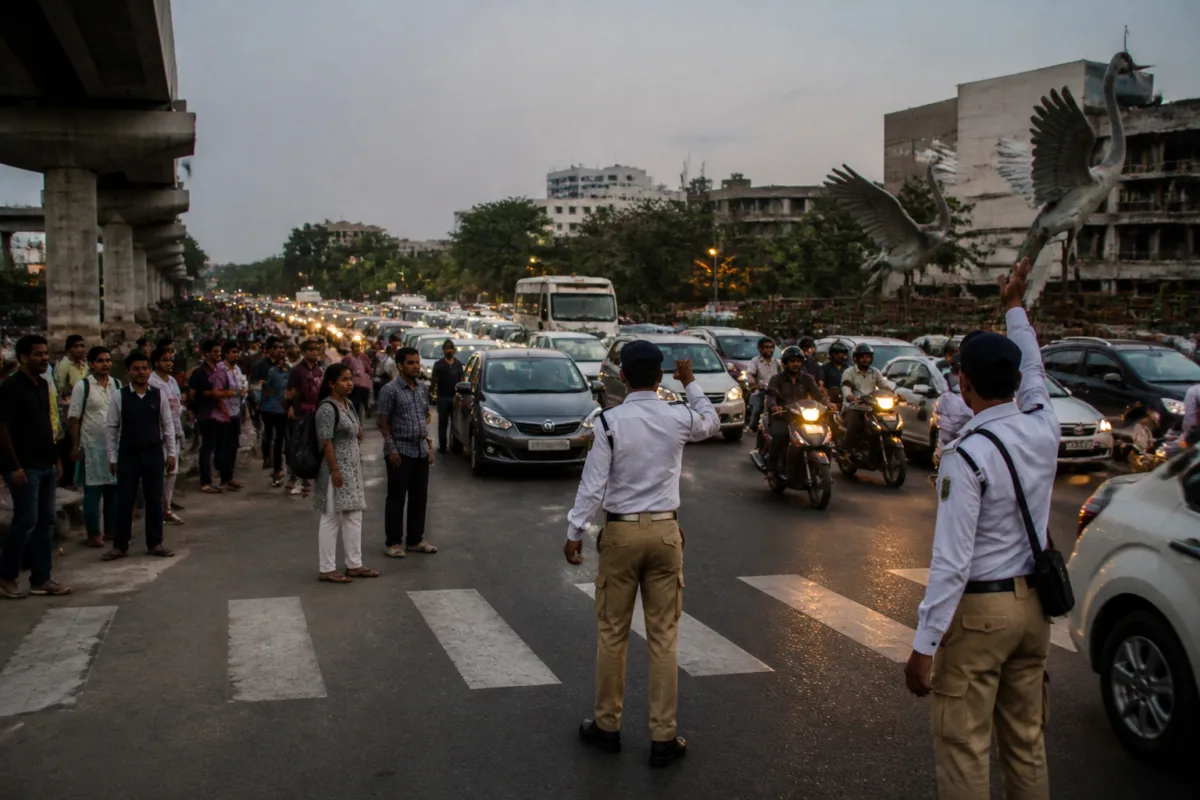
Ahmedabad’s experiment with a traffic “capsule system” at Pakwan Cross Road on SG Highway was withdrawn within about 12 hours after heavy evening congestion, according to a report by Gujarat Samachar. The episode has drawn attention to how junction design, pedestrian space and roadside structures can affect the success of traffic-management measures.
The traffic police introduced the system in the morning, but removed it in the evening as traffic increased. The report said the move prompted discussion among road users and on social media. A deputy commissioner of police, as cited by the publication, attributed the situation to VIP movement rather than a failure of the system.
Gujarat Samachar Digital’s analysis identified large bird sculptures placed at the beginnings of both carriageways leading towards and from Sindhu Bhavan Road as a major obstruction. It reported that the zebra crossing ends between the sculptures, forcing pedestrians using the Sindhu Bhavan Road approach to pass from the side.
The report also said the traffic police had written to the Ahmedabad Municipal Corporation five or six times about removing the sculptures, but alleged that the civic body had not acted. This claim has not been supported in the supplied report by copies of the letters. The chairman of the AMC Standing Committee was quoted as saying that he was not aware of the correspondence and would have the matter investigated after the holiday. He also said the corporation would consider the request if the traffic department had formally made it.
The capsule arrangement was described as an effort to keep vehicles moving rather than requiring them to wait at a signal. According to the publication’s analysis, vehicles may avoid signal delays of about five to 15 minutes during peak periods and two to five minutes during normal periods. It also estimated that a conventional signal operation requires two police personnel and seven to eight Traffic Brigade personnel during peak hours, while the capsule arrangement can operate with one police officer and three to four Traffic Brigade personnel.
These figures are reported estimates and were not accompanied by a traffic study or publicly released before-and-after counts in the supplied material. The same analysis warned that traffic could build up significantly during morning and evening peaks under the arrangement. It also raised a pedestrian-safety concern because people crossing the road may face greater exposure when vehicle movement is kept continuous.
The report listed several physical changes proposed for the junction. These include removing the bird sculptures on both sides of the Sindhu Bhavan Road approach, reducing the size of a pedestrian waiting zone built by the AMC near the turn from Pakwan towards SG Highway, paving unsealed road sections on both sides of the U-turn, and widening the road between Rajpath and Pakwan.
The proposed changes point to a basic implementation issue: traffic control cannot be separated from the geometry and allocation of space at the junction. A system designed to reduce stopping may still underperform if turning lanes are narrowed by roadside installations, pedestrian waiting areas or unfinished surfaces. At the same time, reducing obstacles for vehicles must not eliminate safe, legible crossing space for pedestrians.
The AMC Standing Committee chairman was also quoted as saying that the corporation would examine difficulties involving a Ganpati idol and the pedestrian waiting zone while taking a free-left turn. The supplied report does not record a completed decision, work order or implementation timeline for any of these changes.
For Pakwan Cross Road, the immediate public-interest question is therefore not only whether the capsule system can move traffic faster. It is whether the junction can be redesigned to provide adequate turning space, predictable pedestrian crossings and safe operations during peak demand. Until the reported correspondence, traffic measurements and proposed physical changes are publicly verified, the system’s performance remains an operational claim rather than an established improvement.

