


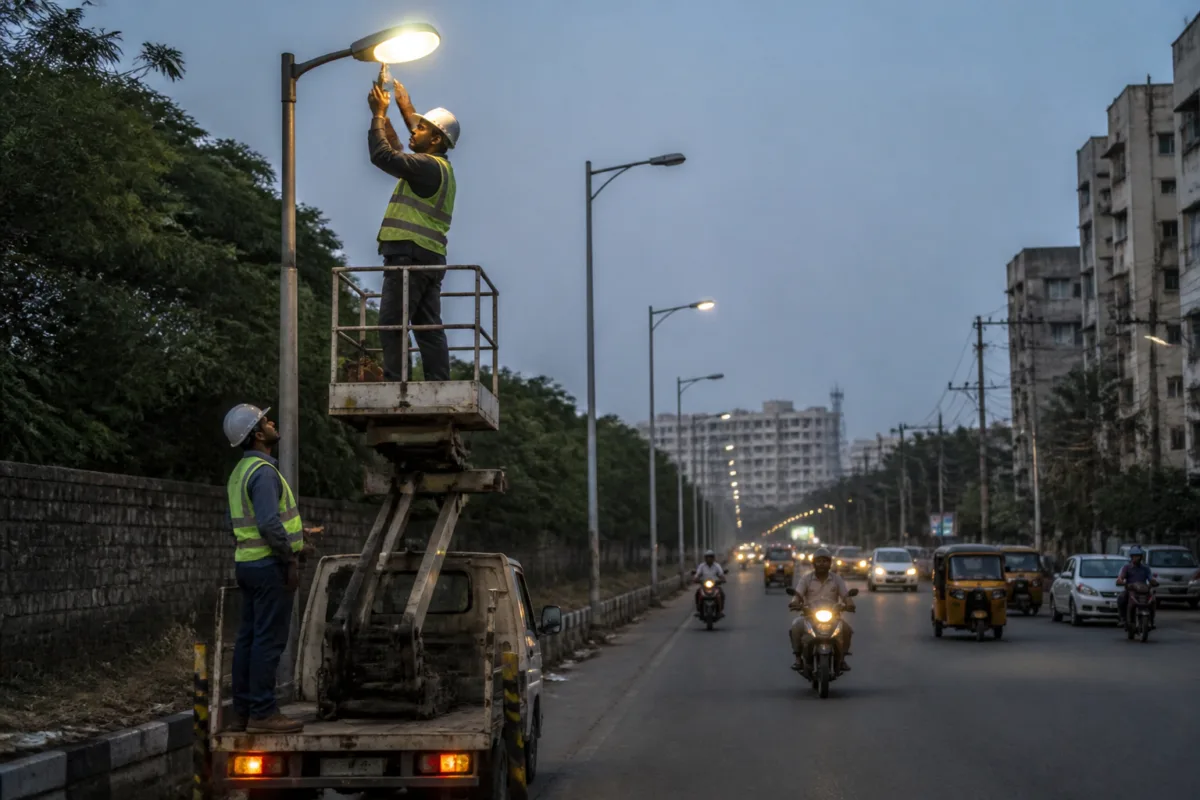
Hyderabad streetlight complaints have risen to 150-200 a day across the Hyderabad Core Urban Region (CURE), as a staffing shortage, an expired maintenance contract and a dysfunctional Centralised Control and Monitoring System (CCMS) delay repairs, according to a report cited by Siasat from The New Indian Express.
The complaints concern faulty streetlights across Hyderabad, with some reportedly taking days or weeks to resolve. The delays point to a service gap in maintaining a large municipal lighting network, where response time depends on field staff, workforce records, materials and the functioning of the central monitoring system.
Energy Efficiency Services Limited (EESL) had been responsible for maintaining 5.42 lakh LED streetlights. After its contract ended, authorities began relying on temporary staff and private subcontractors, the report said. The resulting arrangement has been affected by a shortage of field engineers, inadequate workforce records and delays in procuring materials.
The CCMS is intended to support centralised monitoring of streetlight faults and maintenance responses. Its reported dysfunction reduces the ability of authorities to track complaints and coordinate repairs across the city. Without reliable monitoring and updated workforce information, complaints can remain unresolved even when they are formally recorded.
A longer-term maintenance arrangement is now proposed. The Greater Hyderabad Municipal Corporation (GHMC) has issued a Letter of Agreement to BAC Infratech Private Limited and Vinci Global Private Limited for a 10-year contract valued at Rs 1,720.83 crore, according to the report. The proposed contract would cover 7.60 lakh LED streetlights across three jurisdictions.
Of the lights included in the proposed arrangement, 3,30,487 are under the GHMC, 1,85,258 are under Cyberabad and 2,44,846 are under Malkajgiri. The figures indicate that the planned contract is intended to consolidate maintenance across a network larger than the 5.42 lakh lights previously handled by EESL.
However, the Letter of Agreement has not yet been followed by a formal contract, and work has not started. Officials expect the maintenance operation to begin by January 2027. Until then, the city’s interim dependence on temporary personnel and subcontractors remains central to how faults are attended to.
The transition therefore involves more than appointing a new contractor. It will require the authorities to restore a functioning complaint-monitoring system, establish accurate workforce records, ensure the availability of replacement materials and provide sufficient field engineering capacity. The current complaint volume shows the scale of the service backlog, while the proposed contract sets out the institutional route being considered to address it.

