


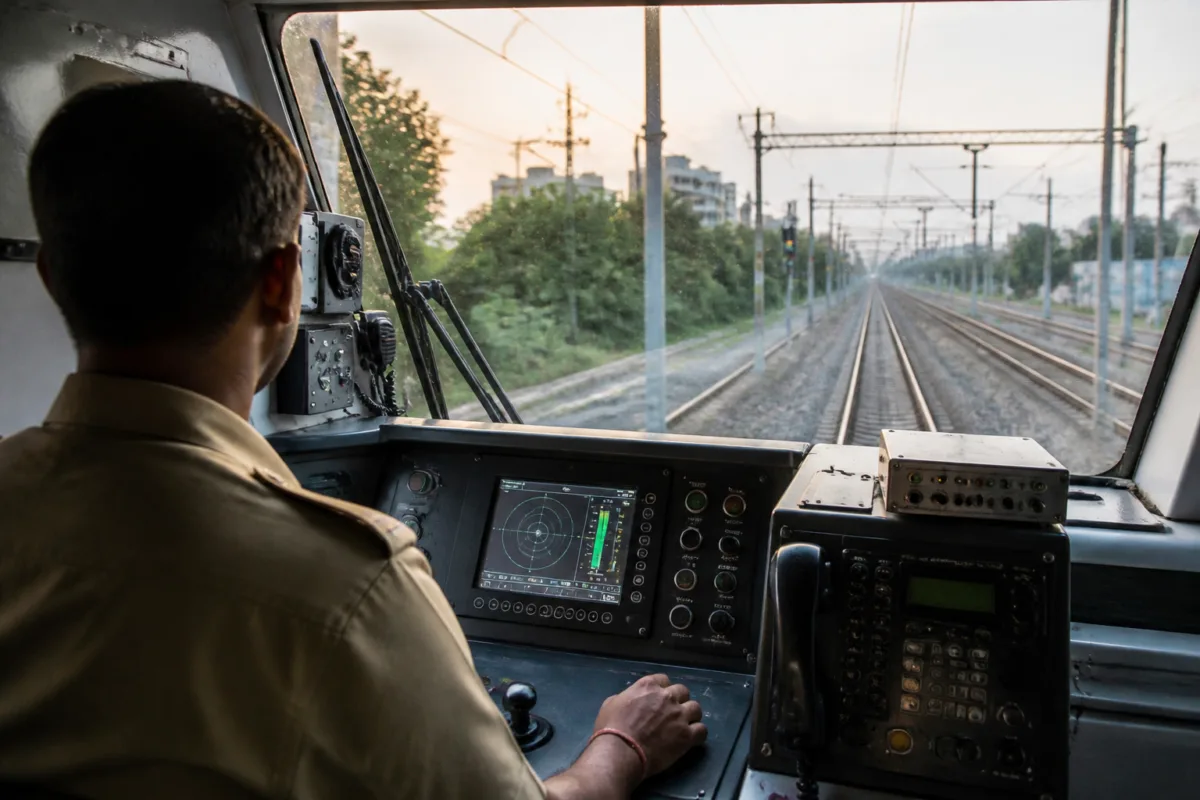
Western Railway tested the indigenous Kavach train-protection system on the 50-km Virar–Mumbai Central suburban corridor over two consecutive nights in November 2021, conducting simulations intended to assess how the system responds to dangerous operating conditions.
According to Western Railway chief spokesperson Arun Kumar Meena, the trials covered six lines: the up and down through lines, the fifth and sixth lines, and both Harbour lines. The railway said all designated test cases were completed successfully.
The exercise examined situations including a locomotive approaching a red signal, a potential rear-end collision, an unexpected stoppage between stations and a train exceeding the permissible speed. The tests also covered emergency SOS communication, automatic speed regulation, sudden changes in signal indications and the prevention of signal-passing-at-danger violations.
The system displayed signal aspects on the locomotive’s Driver Machine Interface across all six lines, while permanent speed-restriction verification was also conducted. Loop-line speed control was tested at Goregaon, Andheri and Borivali, with speeds of 30 and 15 kmph specified for the relevant locations. Calling-on procedures were tested at Andheri Fast and Goregaon Harbour line, while station SOS functions were examined at Borivali and Andheri.
Other scenarios included an unusual-stoppage SOS across all six lines, signal-passing-at-danger prevention at Vasai Fast and Andheri Harbour, and a signal changing to danger at Kandivli station. A rear-end collision was simulated using a virtual locomotive, and the sequence for reading radio-frequency identification tags was verified across the lines.
The report said railway teams later addressed minor radio-frequency and communication-related issues identified during testing. Western Railway described the exercise as a step towards safer suburban operations and said the system would strengthen protection against certain human errors and operational lapses once commissioned.
The trials demonstrate the range of functions expected from a train-protection system in a dense suburban environment, where multiple lines, frequent services and changing signal conditions require continuous coordination between signalling, communications and locomotive operations. However, the report does not state when Kavach was to be commissioned on the corridor, nor does it provide subsequent operating data showing how the system performed in regular passenger service.
For commuters, the significance of the exercise is therefore tied to implementation beyond the test phase. The trial established that the specified scenarios could be simulated and assessed across the corridor, but regular-service benefits would depend on commissioning, equipment reliability, communication coverage and consistent operating procedures.

