


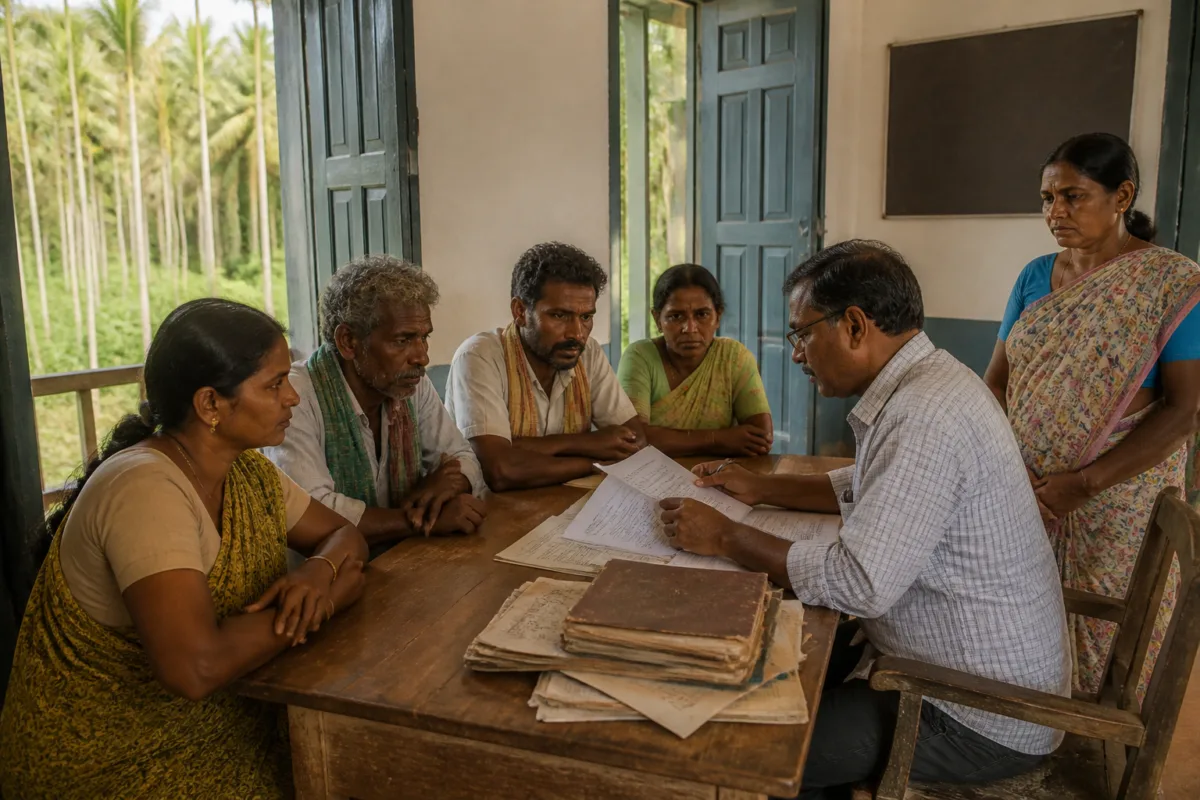
Forest Rights Act claims in Koppa taluk of Karnataka’s Chikkamagaluru district are being re-examined, but applicants from traditional forest-dwelling communities say notices seeking two records dating to before 1930 could exclude families who have lived on and cultivated the land for generations.
Prajavani reported that gram panchayats have issued notices to applicants seeking documents within three days. The notices relate to claims filed by members of the Forest Dwelling Scheduled Tribes and Other Traditional Forest Dwellers categories under the Forest Rights Act.
Applications from Scheduled Tribe claimants have largely been examined, while thousands of applications from Other Traditional Forest Dwellers, including members of Scheduled Castes, remain pending, according to the report.
One notice issued by the Narasipur gram panchayat to applicant N.L. Manjunath of Devarakodige asked him to submit two records from before 1930, along with an income certificate, photograph, certified copies of any earlier land grant records, a landholding certificate and the pahani, or land record extract, for the survey number under claim. The notice said the application could be rejected if the documents were not submitted within three days.
Applicants told the newspaper that producing records from 75 years ago at such short notice was practically impossible. Manjunath said the notice had caused anxiety among claimants and questioned whether ordinary farming families could be expected to possess such old documents.
The Forest Rights Act claims process begins with scrutiny by a village-level Forest Rights Committee. Applications are considered in the gram sabha before recommendations are sent to the sub-divisional and district-level authorities. The district-level body takes the decision to grant or reject titles, and applications may also be reconsidered at that stage.
The documentary dispute is therefore significant because the notices have become an immediate filter in a process that determines whether families receive formal recognition of their land rights. Without a title, households may face continuing uncertainty over cultivation, housing and access to government services linked to recognised landholding, although the report does not quantify those consequences in Koppa.
A Social Welfare Department official cited by Prajavani said 3,084 applications in the taluk had been rejected between 2010 and 2019. The official said 515 Scheduled Tribe applicants had received land after 15 years of records were sought. The official also said that the two forms of evidence need not be limited to paper documents and could include houses, buildings, temples and coconut trees.
That explanation contrasts with the concern raised by applicants over the three-day deadline and the reference to pre-1930 records in the notices. The report does not establish whether the notices were issued under a new taluk-wide instruction, whether the documentary requirement has been applied uniformly, or how applicants without written records can present physical evidence for consideration.
The Narasipur gram panchayat said notices had been issued to 200 applicants from Kunchur, Narve and Belagola villages. Panchayat Development Officer Krishnappa told Prajavani that no applicant had submitted documents so far. He said a meeting had been held and that joint site inspections with forest officials and village accountants would be conducted after the following Monday. Recommendations would be made after the records and site evidence were examined, followed by a spot inspection report.
The proposed inspections could bring the process closer to the realities described by applicants, who say their homes, coconut trees and areca palms should be considered alongside written records. At the same time, the report leaves unresolved how the authorities will reconcile field evidence with the documentary requirements cited in the notices.
The issue has also drawn political criticism. H.K. Dinesh Hosur, president of the local BJP mandal, called for the notices to be stopped and for eligible applicants to receive titles. His remarks are a political demand, not an independent confirmation of the claims made by applicants.
For Koppa’s pending claimants, the next stage will depend on whether the planned joint inspections provide a workable route for documenting long-term residence and cultivation. The district-level authorities will ultimately decide whether the applications are approved or rejected, but the notices have already exposed a central governance challenge: land-rights administration must assess historical occupation in communities where formal records may be limited, while giving applicants a practical opportunity to present evidence.

