


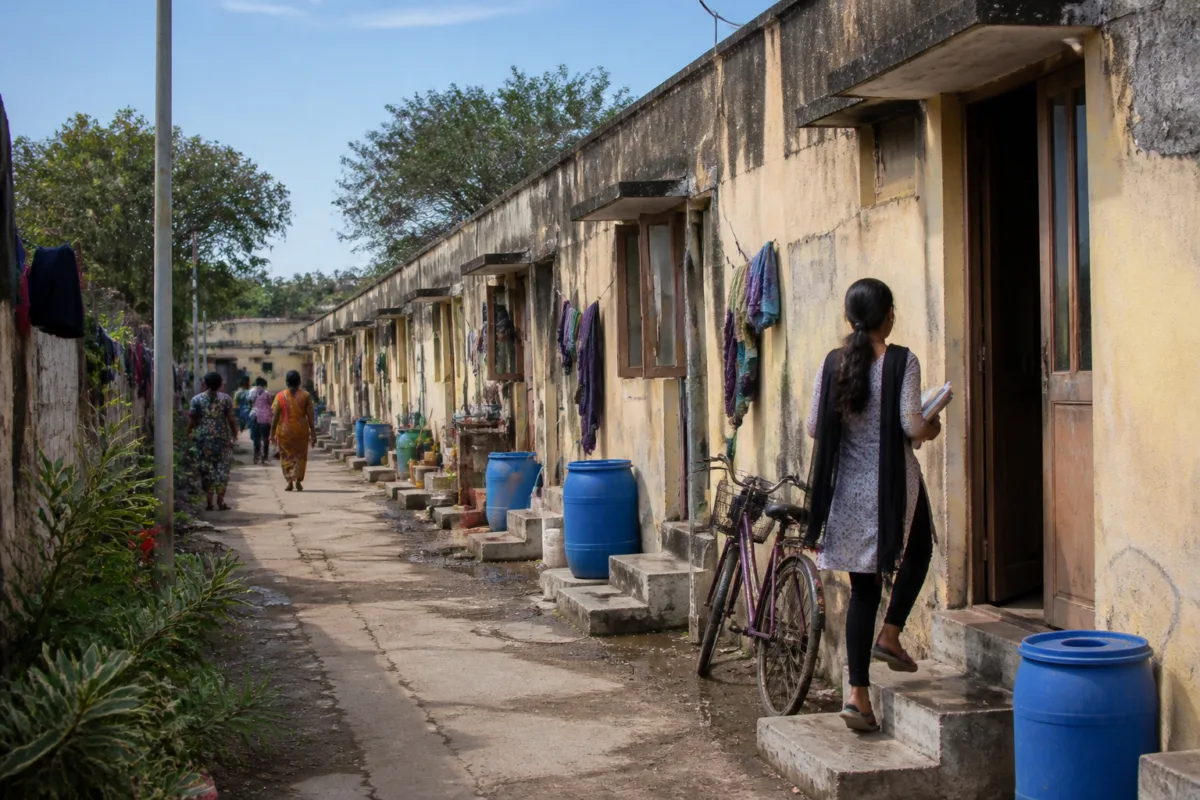
Tamil Nadu’s refugee camps continue to shape the education, employment and housing prospects of Sri Lankan Tamil residents who arrived in India as children or were born in the camps, according to accounts published by The New Indian Express.
The experiences of young residents point to how prolonged displacement extends beyond the loss of a homeland. It also affects access to higher education, formal employment, mobility and the ability to move into independent housing. For many, uncertain citizenship status remains a defining constraint even after completing school or college.
Saieesan S arrived at Mandapam Camp in Ramanathapuram carrying his Class 8 textbooks after his family’s life in Jaffna was disrupted by war. He told the newspaper that his mother, who had worked as a government school teacher in Sri Lanka, took up jobs at construction sites and fisheries in Tamil Nadu, earning Rs 100-Rs 150 a day.
He said education became the route through which his family hoped to achieve a dignified life. Although he performed strongly in his Class 12 examinations, he could not secure an engineering seat through counselling and had to seek scholarship support. He eventually joined VIT, Vellore, through the STARS scheme and later secured employment with Tata Consultancy Services.
However, Saieesan said his employment documentation required him to declare that he was a refugee without a work permit or passport and could not travel abroad. The requirement illustrates how educational achievement does not necessarily remove the administrative barriers associated with refugee status.
Sharmilan Vipokan, another camp resident, told the newspaper that multinational companies had offered him jobs, but his onboarding was delayed during document verification because he did not possess a passport or formal work permit. He said he had to approach the Taluk office and Ezhilagam, the Commissionerate of Rehabilitation & Welfare, for reference or recommendation letters and other supporting documents.
According to Sharmilan, the process is repeated whenever he considers changing jobs. He said his profile had been placed on hold during final recruitment rounds and that he had been rejected several times because of his nationality. He arrived in Tamil Nadu at the age of six in 2006 and grew up in Puzhal Camp.
His access to higher education was eventually supported by Loyola College, which had a provision for refugee students and offered fee concessions. But his account also describes the social consequences of being identified as a refugee. He recalled being warned by a professor during his first-day introduction that he would be expelled if he got into trouble, an experience that stayed with him throughout college.
For residents born in the camps, the question of belonging takes a different form. Nansika was born at Thenpallipattu Camp in Tiruvannamalai district and has no personal memory of Sri Lanka. Her connection to the country comes through her parents’ accounts of the land they once owned and visits from maternal relatives.
Nansika, a national-level karate player, began teaching the sport at schools after graduation and later found work in the human resources department of a clothing store. She told the newspaper that uncertainty over her citizenship status has not ended her ambitions of preparing for the UPSC examinations and becoming an IPS officer.
At the same time, she is required to return to the camp for periodic verification. Her parents, who work as a painting contractor in Ooty and a caretaker in Dharmapuri, also return for these checks. Nansika said they fear their names could be removed from the camp register if they fail to report.
The continuing role of the camps in residents’ lives is also reflected in their housing. V Nikitha, who was born at Thenpallipattu Camp, described the government-built homes as small 10 x 10 feet structures that can accommodate only two or three people. She said she wanted to move out of the camp and live independently after completing her education.
Nikitha, who is pursuing a B.Com at VELS University through a scholarship, said many of her peers had dropped out of school. She cited the case of a classmate who lost his mother and had to support two siblings because his father was dealing with alcoholism. He eventually entered painting work and became willing to take up any job to make ends meet.
Her account links housing and education to labour-market outcomes. When families have limited space, insecure documentation and few resources, young people may enter informal work before completing their education. The report does not establish how widespread this pattern is, but the individual accounts show how camp-based living can continue to influence choices long after childhood.
The stories also show the role of scholarships, institutional concessions and individual effort in helping some residents enter college and formal employment. Yet these pathways do not resolve the underlying questions around documentation, citizenship, work permissions, periodic verification and the physical limitations of camp housing.
For the young residents profiled, the camps are simultaneously homes, administrative checkpoints and reminders of displacement. Their aspirations—to pursue engineering, technology, civil services, fashion design and independent livelihoods—are not limited by a lack of ambition. They are shaped by the practical consequences of remaining in a prolonged state of uncertainty.

