


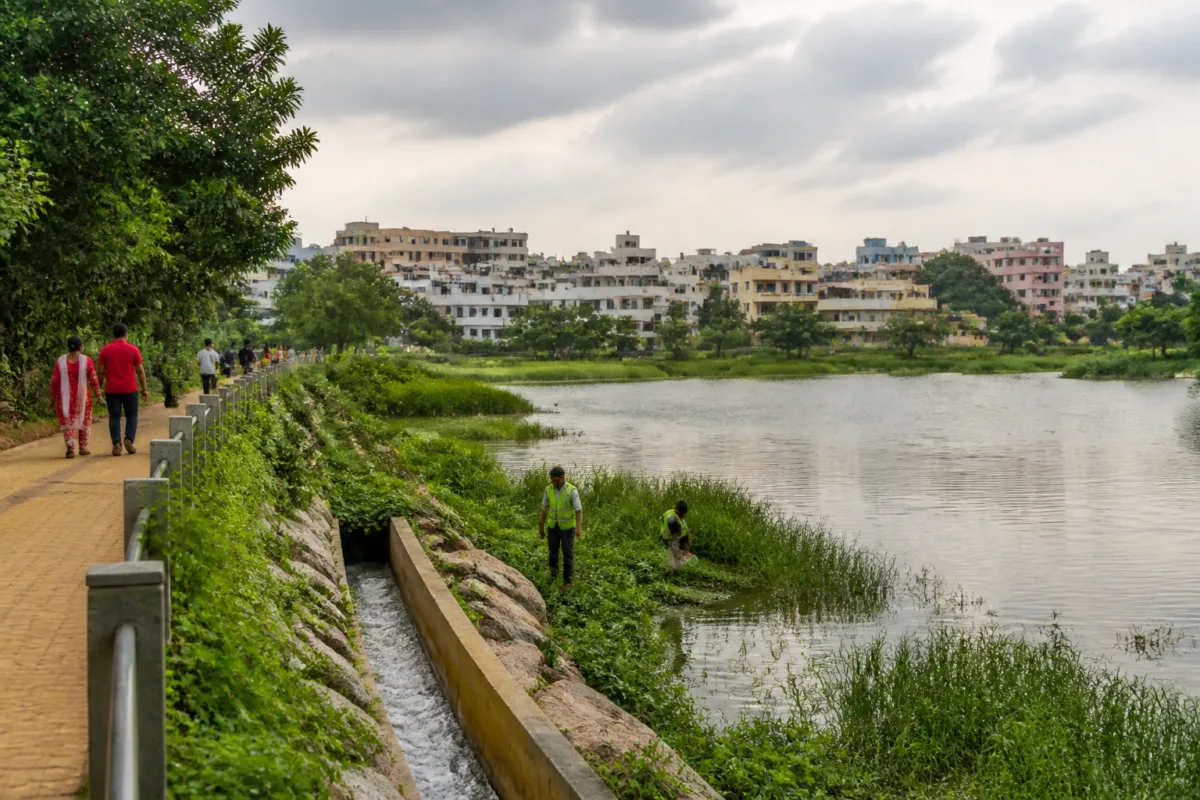
Telangana will not replicate the Sabarmati riverfront or the Gujarat development model, Chief Minister A. Revanth Reddy said at the curtain-raiser of the Telangana Climate Conclave 2026 in Hyderabad. Instead, he said the state would draw on the interconnected lakes and traditional water-management systems developed under the Kakatiya rulers.
The approach places water-body protection at the centre of Telangana’s stated response to urban growth and climate risk. Revanth Reddy said nearly 700 lakes had disappeared over the years because of encroachments and urban and corporate development, and that the government was trying to identify them.
He defended the government’s action against encroachments on water bodies, saying that influential people would not be spared despite criticism and legal challenges. He said houses, function halls and other structures belonging to legislators, parliamentarians or celebrities would be removed in accordance with the law.
The chief minister cited the restoration of Bathukammakunta as one example. He said women had celebrated Bathukamma around the lake this year and that encroachments had been removed from water bodies across the city. The report did not provide details of the number of sites covered, the legal status of individual cases or the extent of water-storage capacity restored.
The enforcement drive also has a housing and rehabilitation dimension. Revanth Reddy said families from economically weaker sections affected by lake-restoration work were being rehabilitated under the Indiramma housing scheme. He added that families living near polluted water bodies would be provided houses because pollution had made their living conditions difficult.
That combination of restoration, enforcement and rehabilitation is important for urban governance. Removing structures from lake catchments or water edges can address drainage and water-storage concerns, but it can also displace households. The chief minister’s remarks indicate that the state intends to pair the action with housing support, although the report does not specify eligibility criteria, relocation sites, schedules or the number of families involved.
The climate-planning concerns extend beyond lakes. Revanth Reddy questioned how cities could withstand cloudbursts when drainage and road infrastructure designed for 2 cm of rainfall could be overwhelmed by 40 cm in two hours. He called for climate considerations to be incorporated into urban planning, linking extreme rainfall risks to the capacity of roads and storm-water systems.
The figures were presented by the chief minister at the conclave; the report does not identify the drainage designs or locations to which they refer. Even so, the comparison highlights a basic planning challenge: infrastructure standards based on historical or limited rainfall assumptions may be inadequate during intense short-duration storms. The statement points to the need for climate risk to be considered in the design and maintenance of urban drainage and roads.
Revanth Reddy also described a planning framework comprising the Core Urban Region Economy, Peri-Urban Region Economy and Rural Agriculture Region Economy, referred to as CURE, PURE and RARE. He presented the framework as part of the state’s development approach, alongside a call for industrial growth and environmental protection to advance together.
The government’s wider initiatives mentioned at the event included HYDRAA for encroachment-related action, TG SAFE for food-adulteration concerns and EAGLE for drug-abuse enforcement. In the water and climate context, the chief minister invited environmentalists and experts to contribute to policymaking and said the government wanted to consult people affected by its decisions.
He also urged farmers to consider less water-intensive crops. Revanth Reddy said the state had food reserves sufficient for two years but that available water resources had to be managed until the next monsoon. He suggested that farmers might have to forgo one crop rather than exhaust available water.
The policy direction outlined at the conclave therefore connects three scales of planning: protecting urban lakes, managing peri-urban growth and conserving water in rural agriculture. Its implementation will depend on how accurately lost or encroached water bodies are mapped, how restoration affects existing residents, whether rehabilitation is delivered before displacement and whether drainage and road systems are upgraded for intense rainfall. The speech established these priorities, but the report contains no implementation timetable or independently verified progress data.

