


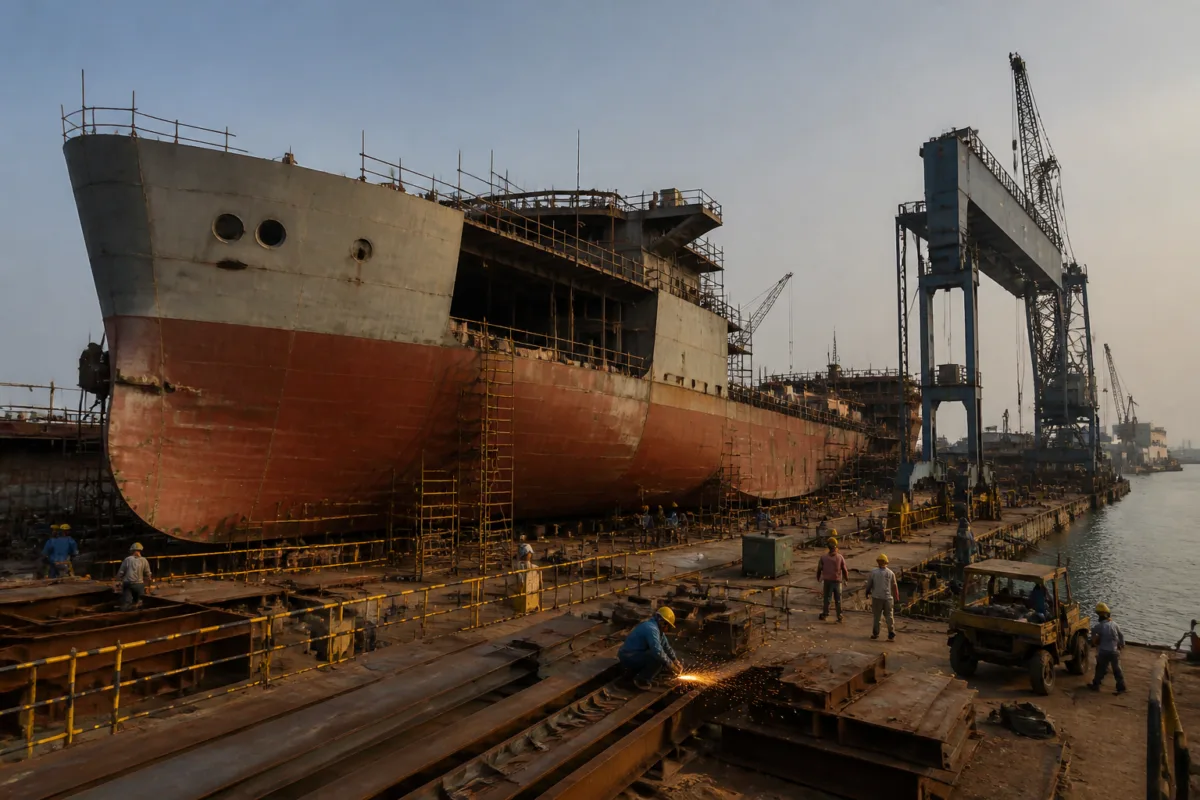
India is expecting a substantial increase in shipbuilding output in 2026, supported by government financial assistance, new shipyard registrations and planned greenfield clusters, according to a report by the Economic Times. However, the report’s stated 2026 capacity figure requires clarification because its text gives the number as 120,000 lakh gross tonnage (GT), while the headline describes this as more than double the 58,000 GT delivered in 2025.
Annual capacity additions rose 41.5%, from 41,000 GT in 2024 to 58,000 GT in 2025, the report said. Official data cited by the publication put India’s shipping fleet at 14.02 million GT across 1,592 vessels as of December 31, 2025.
The expansion is being supported through the Ship Building Financial Assistance Scheme (SBFAS). According to the report, 82 shipyards had registered under the scheme. Applications for in-principle approval covered 159 vessels and involved Rs 17,204 crore, with 66 contracts covering 122 vessels processed for such approval.
The report also said that 52 applications worth Rs 6,571 crore had reached the keel-laying stage, while 13 applications involving Rs 2,706 crore had reached the launch stage. Three new shipyards were registered during the month, and three applications worth around Rs 2,282 crore were processed for in-principle approval.
Commitments under the scheme stood at Rs 429 crore, with a further Rs 342 crore estimated for fiscal 2026-27, the report said. The SBFAS has a stated value of Rs 24,736 crore.
Five greenfield shipbuilding clusters are under development in Tamil Nadu, Andhra Pradesh, Gujarat, Maharashtra and Odisha. Special purpose vehicles have reportedly been formed for all five projects, which have received conditional in-principle approval. Their average capacity is expected to be 150,000 GT, with individual projects ranging from 120,000 GT to 250,000 GT, according to the Economic Times.
The proposed clusters could strengthen India’s industrial and port-linked manufacturing base if the projects secure financing, land, utilities, environmental approvals and construction milestones. The report, however, does not provide project-level locations, completion schedules or details of the infrastructure commitments for each cluster.
An investor outreach exercise identified seven active global leads, including Fincantieri, a Norwegian consortium, Royal IHC, Drydocks World Dubai, Damen Shipyards Group, a Dutch consortium and South Korea’s Hyundai, the report said.
The 2026 national output projection should be confirmed against official data because the source text’s use of “120,000 lakh GT” is inconsistent with the comparison to 2025 production. Verification is also needed to establish whether the intended figure is 120,000 GT and to clarify the status of the reported scheme applications and cluster approvals.

