


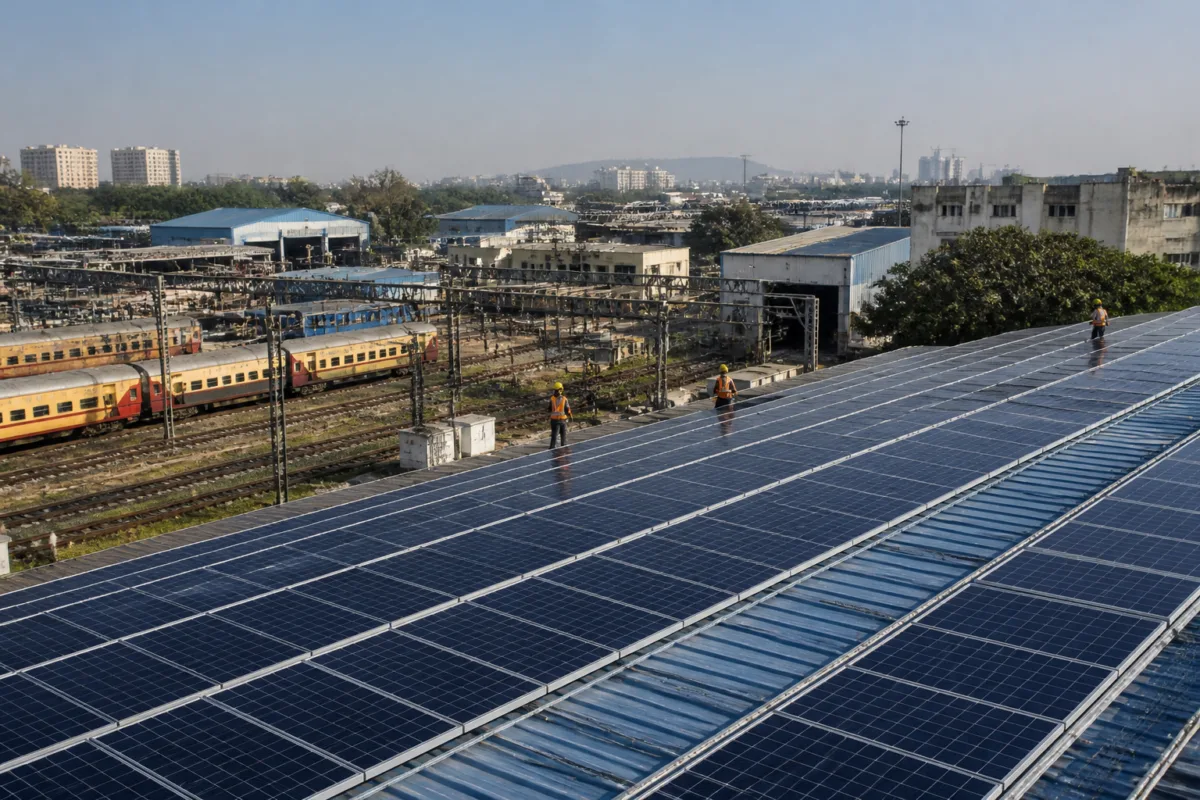
South Central Railway has commissioned rooftop solar plants with a combined capacity of 6.9 MW across railway establishments in its jurisdiction, generating 7.32 million units of electricity over the 31 months to October 31, 2026, according to a report by Deccan Chronicle.
The installations were developed at railway facilities in the Secunderabad, Hyderabad and Nanded divisions, as well as at the Lallaguda workshop. The commissioned capacity comprises 2.93 MW in the Secunderabad division, 2.60 MW in the Hyderabad division, 0.50 MW in the Nanded division and 0.87 MW at the Lallaguda workshop.
Railway officials estimate that the solar generation has reduced carbon dioxide emissions by around 4,963 tonnes. The programme is also expected to lower electricity expenditure for railway establishments, although the report does not provide the installations’ capital cost, tariff arrangements or a quantified saving.
South Central Railway said the 6.9 MW capacity exceeds the 4.8 MW target set by the Railway Board. Work is underway to establish additional solar plants with a capacity of 2.5 MW, taking the reported planned and commissioned capacity to 9.4 MW if the expansion is completed.
The programme was implemented under the central government’s Pradhan Mantri Surya Ghar Yojana, as reported by Deccan Chronicle. The railway zone’s rooftop approach uses available building surfaces at operational facilities, allowing existing establishments to generate electricity without requiring separate land parcels, although the report does not detail the technical configuration, commissioning dates for individual plants or arrangements for storage and grid export.
The installations form part of Indian Railways’ stated objective of becoming a net-zero carbon emitter by 2030. South Central Railway general manager Sanjay Kumar Srivastava congratulated the electrical department officials and staff involved in the programme and cited their role in securing the PM Surya Ghar excellence award presented to Indian Railways in 2026.
The reported output provides a measure of the railway zone’s renewable-energy deployment, but a fuller assessment would require project-level information on generation performance, maintenance, electricity displacement and costs. The expansion will determine whether the reported capacity can be replicated across more railway buildings while maintaining reliable operations.

