


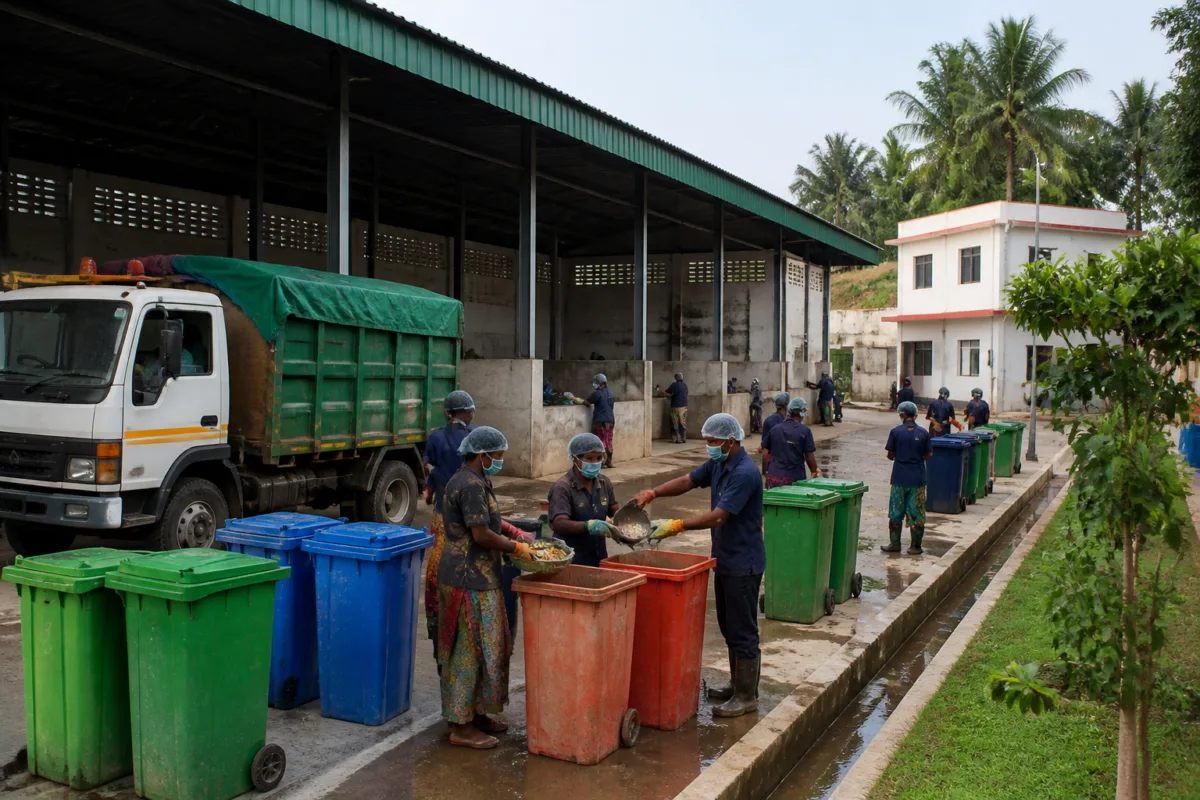
The Tripura High Court has ordered the state government to submit compliance and action-taken reports every three months on the implementation of the Solid Waste Management Rules, 2026, across the state. The first report is due on March 2, 2027.
A Division Bench comprising Chief Justice M S Ramachandra Rao and Justice S Datta Purkayastha issued the direction on November 25 while hearing a public interest litigation, W.P.(C) (PIL) No. 2 of 2019, filed by Ankan Tilak Paul against the state government and other parties.
The Bench took note of an affidavit dated November 23 filed by the Deputy Secretary of the Animal Resource Development Department. According to the affidavit, Tripura constituted a State Level Committee headed by the Chief Secretary on July 24, 2026, to monitor and support implementation of the rules.
A State Level Steering Committee, chaired by the Secretary-in-Charge of the Environment Department, was also constituted to promote a circular economy in solid-waste processing and coordinate work among departments and implementing agencies. The government informed the court that the rules had been circulated to stakeholder departments, district magistrates and collectors, urban local bodies and rural development blocks.
The affidavit further stated that the rules had been translated into the local language and circulated for wider dissemination. Action-taken reports from stakeholder departments had been submitted to the Tripura State Pollution Control Board, while a separate monitoring committee empowered by the Supreme Court had also been constituted for implementation of the rules.
The state government also informed the court that powers under Section 5 of the Environment (Protection) Act, 1986, had been delegated to district collectors for one year through a notification issued on May 18, 2026. The delegation allows district collectors to supervise and ensure implementation of the waste-management rules in their respective jurisdictions.
According to the affidavit, regular action-taken reports were being submitted to the Union Ministry of Environment, Forest and Climate Change and the Central Pollution Control Board. The latest such report was submitted on September 30, 2026.
The court’s direction places a recurring reporting obligation over this existing administrative structure. Compliance will need to be documented across state departments, districts, urban local bodies and rural development blocks before being presented to the High Court every quarter. The order therefore links local implementation with continuing judicial review rather than treating the rules as a one-time administrative notification.
The Bench also took note of a State Committee for Slaughter House constituted on November 12, 2026, under the chairmanship of the Secretary of the Urban Development Department. The committee is intended to review implementation, identify deficiencies and ensure corrective measures by the concerned authorities.
The government told the court that construction of the slaughterhouse at Durga Chowmuhani Bazar had been completed by the District Legal Services Authority, West Tripura, Agartala. Mechanical and electrical works were still pending and were expected to be completed shortly. The facility is to begin operations in compliance with applicable rules after the remaining works are completed.
The case has been listed for further hearing on March 2, 2027, when the state’s first quarterly compliance and action-taken report is due to be placed before the court.

