


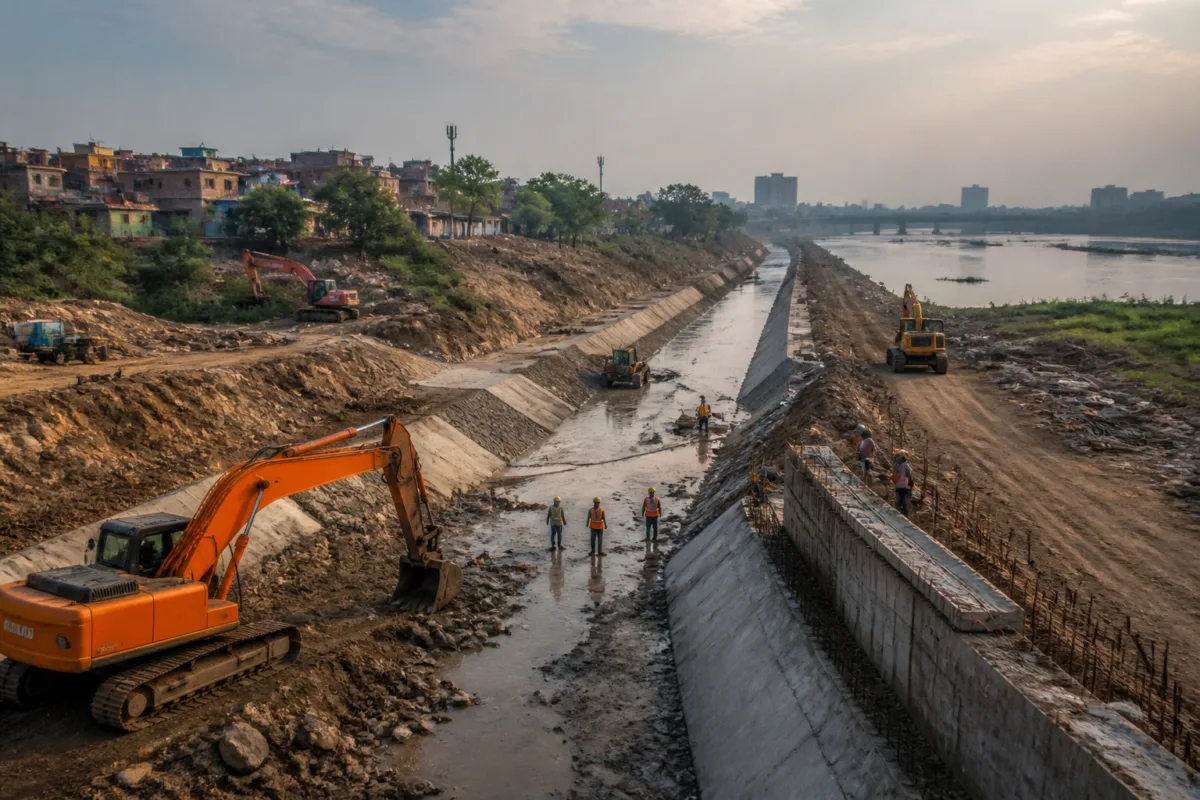
The Delhi and Uttar Pradesh governments are remodelling the Abul Fazal drain to carry more than 200 cusecs of treated wastewater from the Okhla sewage treatment plant (STP) into the Yamuna near Kalindi Kunj, an intervention intended to improve environmental flow and dilute pollutants.
The 2.8-km drain, which is being widened to more than 27 feet, will carry the treated water downstream of the Okhla Barrage. The work includes remodelling and desilting and is being undertaken by the Uttar Pradesh irrigation department with funding from the National Mission for Clean Ganga (NMCG), according to a senior government official cited by Hindustan Times.
The Delhi government has provided approximately ₹14 crore for the redesign. Once completed, the drain is expected to be among the widest in Delhi, comparable in scale to the Najafgarh drain, the report said.
The project is also intended to change how wastewater from more than a dozen residential areas reaches the river. These areas include Shaheen Bagh, Zakir Nagar, Noor Nagar, Okhla Vihar, Jamia Nagar, Jasola Village and Abul Fazal Enclave. The wastewater is to be diverted to the Okhla STP for treatment before being discharged downstream of the barrage.
The intervention focuses on the Kalindi Kunj-Asgarpur stretch, which falls under Uttar Pradesh’s jurisdiction. A second official said untreated wastewater currently entering the Okhla stretch is heavily polluted. According to the official, water falling from the barrage creates turbulence that contributes to foam formation in the river.
The froth problem is particularly visible around Kalindi Kunj between October and December, when it also becomes more prominent during the Chhath Puja period. The issue has repeatedly become the focus of political debate, but the drain project shifts attention towards a specific wastewater and river-flow intervention: intercepting sewage, treating it at the STP and directing the treated discharge downstream of the barrage.
The intended benefit is not presented as a complete solution to Yamuna pollution. The project’s stated purpose is to ensure that treated wastewater, rather than untreated sewage, enters this part of the river and to improve the local environmental flow. Its effectiveness will depend on the diversion of wastewater from the identified residential areas, the performance of treatment systems and the completion of the redesigned drain.
The report does not provide a completion date, independent water-quality measurements or a quantified estimate of how much pollution the intervention will remove. Those details will be important in assessing whether the infrastructure reduces froth and improves conditions along the Kalindi Kunj stretch beyond the immediate discharge point.

