


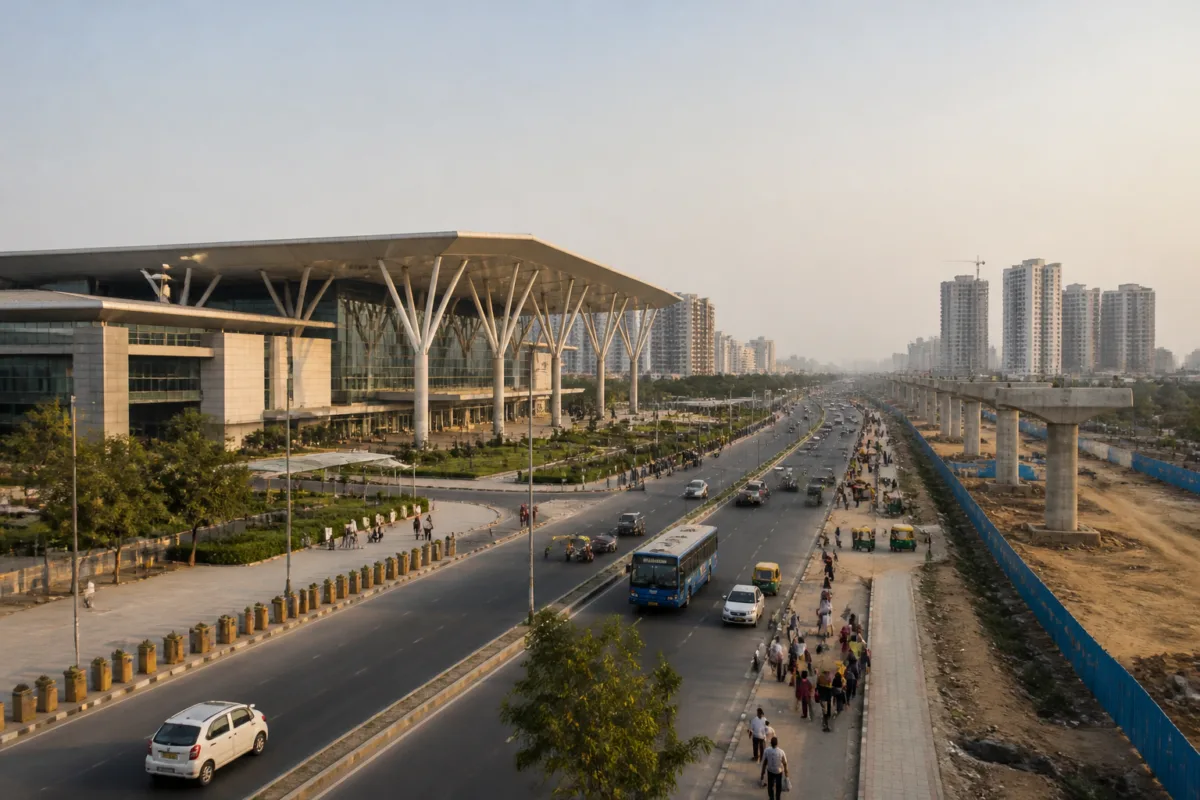
A proposed Metro corridor linking Yashobhoomi in Dwarka’s Sector 25 with Rajiv Chowk in Gurugram could reshape commuting and development prospects across the Dwarka–Gurugram belt, although the project remains at the proposal stage and has not received the approvals, alignment details or timeline needed for execution.
The corridor is among eight routes submitted to the government for approval under the Delhi Metro’s Phase V(B) expansion, according to an RTI reply cited in a PTI report on November 18, as reported by Hindustan Times. If approved and built, it could provide a more direct public transport connection between Yashobhoomi, residential areas in Dwarka, Gurugram’s employment centres and locations along the Dwarka Expressway.
The proposed link is significant because Yashobhoomi, also known as the India International Convention and Expo Centre, is intended to generate substantial business travel and visitor movement. A direct connection with Gurugram could make it easier for exhibitors, convention delegates, professionals and visitors to travel between the convention complex and the city’s business districts.
Real estate experts cited by Hindustan Times said improved connectivity could expand the effective catchment areas of employment hubs and support demand for offices, hotels, retail and mixed-use projects. Santosh Kumar, vice-chairman of Anarock Group, said the connection could help the Dwarka–Gurugram belt function as a more integrated market, with potential benefits for office occupiers, retailers and hospitality operators.
The impact on housing would depend heavily on the final alignment and station locations. The Dwarka Expressway has already emerged as a major residential growth corridor because of its proximity to Dwarka, the airport and Gurugram’s employment centres. Kumar said prices along the expressway had more than doubled from 2021 levels to approximately ₹14,180 per sq ft in the second quarter of 2026.
That growth is not evidence that the proposed Metro link will produce a uniform rise in property values. Areas with convenient access to future stations, established social infrastructure and reliable last-mile connections would be more likely to benefit quickly than locations farther from the corridor. The project’s effect on homebuyer demand and investment would also depend on whether it improves everyday commuting rather than only providing a long-distance connection.
Pushpender Singh, managing director of JMS Group, said better connectivity between Gurugram and Yashobhoomi could improve access to workplaces, airports and commercial destinations and strengthen end-user demand in well-connected residential locations. He also stressed that timely execution would be important to deliver those benefits.
Commercial activity around Yashobhoomi could receive a separate boost. The first phase of the 221-acre campus includes two exhibition halls, a convention centre with a capacity of 11,000 people and underground parking for more than 3,000 cars. The exhibition halls measure 32,000 sq m and 28,000 sq m, respectively, according to the report.
The proposed second phase envisages a multipurpose arena, three exhibition halls, eight hotels, nine Grade A office buildings, three retail spaces and a serviced apartment facility. The wider campus also contains land parcels that authorities are expected to lease to private concessionaires for development, following a model similar to Aerocity.
Arvind Rai, executive director for valuations and advisory, North, at Colliers India, said the proposed corridor could pass through or improve access to established commercial locations such as Udyog Vihar, Cyber City and IFFCO Chowk. He said the strongest real estate impact was likely to be concentrated around Yashobhoomi and adjoining areas, where a separate 50-acre mixed-use development is expected to include a sports stadium, five-star hotels and 7–8 lakh sq ft of retail space.
The proposal could therefore support a broader shift from isolated development projects towards a more connected cross-city market. Convention-led demand, office access and residential growth may reinforce one another if the Metro is planned with useful interchanges, adequate station access and effective last-mile transport.
However, those outcomes remain conditional. The source report does not establish that the corridor has been approved, nor does it provide a confirmed route, station plan, construction schedule or funding arrangement. Until those details are settled, the proposal is best understood as a potential connectivity intervention rather than a confirmed driver of property appreciation. Its public value will ultimately depend on implementation, integration with existing transport networks and whether residents can reach stations conveniently without relying on private vehicles.

