


The Union Cabinet on Wednesday approved infrastructure and manufacturing proposals worth nearly ₹20,000 crore, including an ₹11,000-crore scheme to reduce import dependence in construction equipment, a new airport in Assam and a second container terminal at Tamil Nadu’s Kamarajar Port, Union minister Ashwini Vaishnaw said at a press briefing.
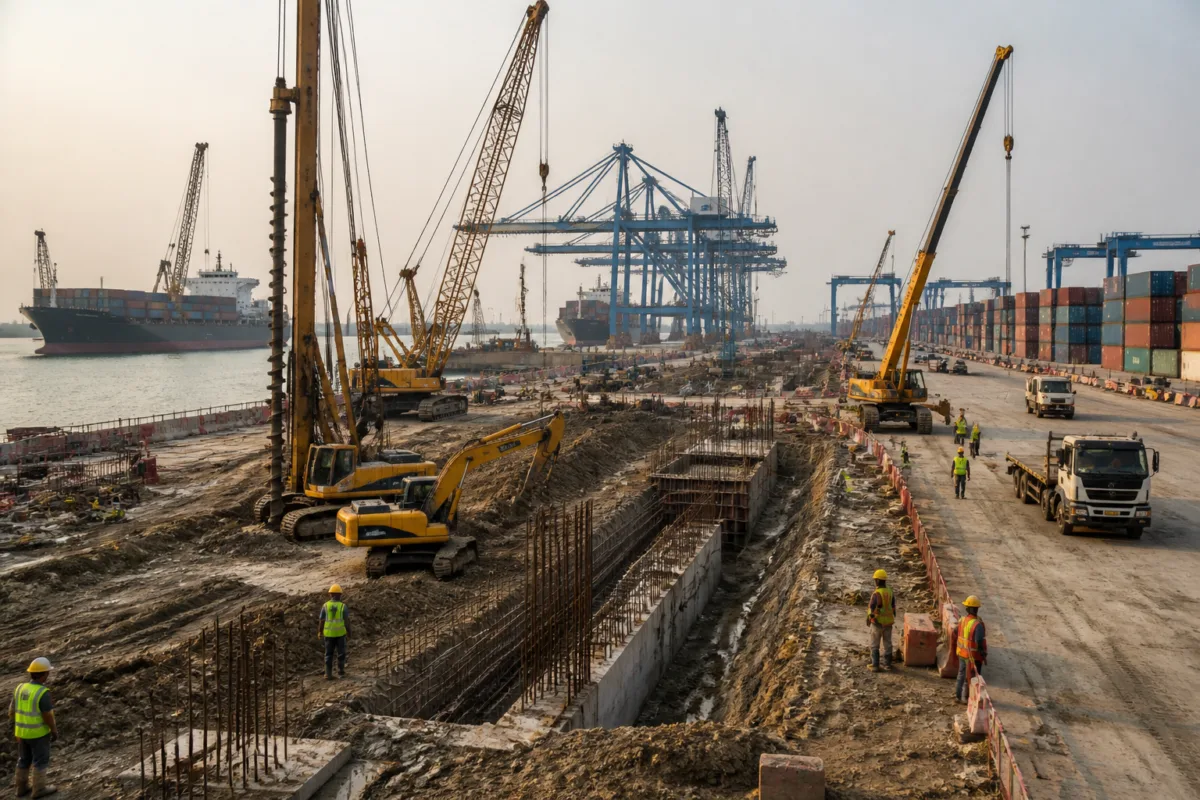
The construction and infrastructure equipment support scheme, to be administered by the Ministry of Heavy Industries, will run for eight years from FY27 to FY34. It will cover seven equipment categories that are fully or largely imported, according to a presentation by Vaishnaw. These include tunnel boring machines, off-highway trucks, excavators, cranes, loaders, piling rigs and drilling machines.
The scheme will also cover engines, transmissions, hydraulic systems, undercarriages and drive systems. Manufacturers will receive incentives of 8% to 13% on incremental annual sales for five years, subject to approval by the ministry, according to a Union Cabinet statement.
The scheme was first announced in the FY27 Union Budget, which allocated ₹200 crore for the ongoing fiscal year. Its approved outlay is lower than the ₹14,300 crore proposed earlier, after policymakers narrowed its scope by excluding components that are not widely used in India’s construction and infrastructure equipment manufacturing ecosystem, Mint reported.
A government official cited by Mint said the incentive proposed for major investments had also been reduced from 16% to 13%. The official said the final scheme was designed to focus on components with stronger domestic use and manufacturing potential.
India’s construction and infrastructure equipment market was valued at about ₹97,500 crore in FY25, according to the minister’s presentation, while the industry remains around 45% import dependent. The Indian Construction Equipment Manufacturers’ Association said the scheme could support investment in advanced technologies, localisation of critical components, exports and the domestic supplier ecosystem. Its president, Deepak Shetty, also said clear eligibility criteria and a predictable incentive framework would be important for implementation.
The Cabinet also approved two Department of Posts schemes through FY31 under the 16th Finance Commission period. The estates management scheme will receive an outlay of ₹1,491 crore for constructing, reconstructing and renovating post offices and residential colonies, as well as creating a uniform brand identity.
The central sector scheme for postal operations will have a proposed outlay of ₹1,141 crore. The government said it would strengthen postal infrastructure and operational efficiency while supporting demand from logistics, e-commerce and digital service delivery.
The Cabinet Committee on Economic Affairs approved a new airport at Dolu in Assam, to be built by the Airports Authority of India at an estimated cost of ₹2,014 crore. Vaishnaw said the airport would provide logistics relief to Assam and neighbouring states.
According to the minister’s presentation, the existing airport, owned by the Indian Air Force, can accommodate only A320 and B737-800 aircraft. The Airports Authority of India currently operates the civil enclave there. A Cabinet statement described the Dolu Greenfield Airport as a project intended to meet rising air-traffic demand in South Assam and surrounding areas, while improving connectivity for trade and tourism.
The CCEA also approved a second container terminal at Kamarajar Port in Tamil Nadu under a public-private partnership using a design, build, finance, operate and transfer model. The project is estimated to cost ₹4,288 crore and will include a 900-metre berth with an 18-metre design draft depth and annual capacity of 2 million twenty-foot equivalent units.
The government’s presentation said Kamarajar Port’s traffic could reach 2.45 million TEUs by 2034, compared with existing capacity of 1.4 million TEUs. The second terminal is intended to provide the additional capacity required to handle that projected traffic.

