


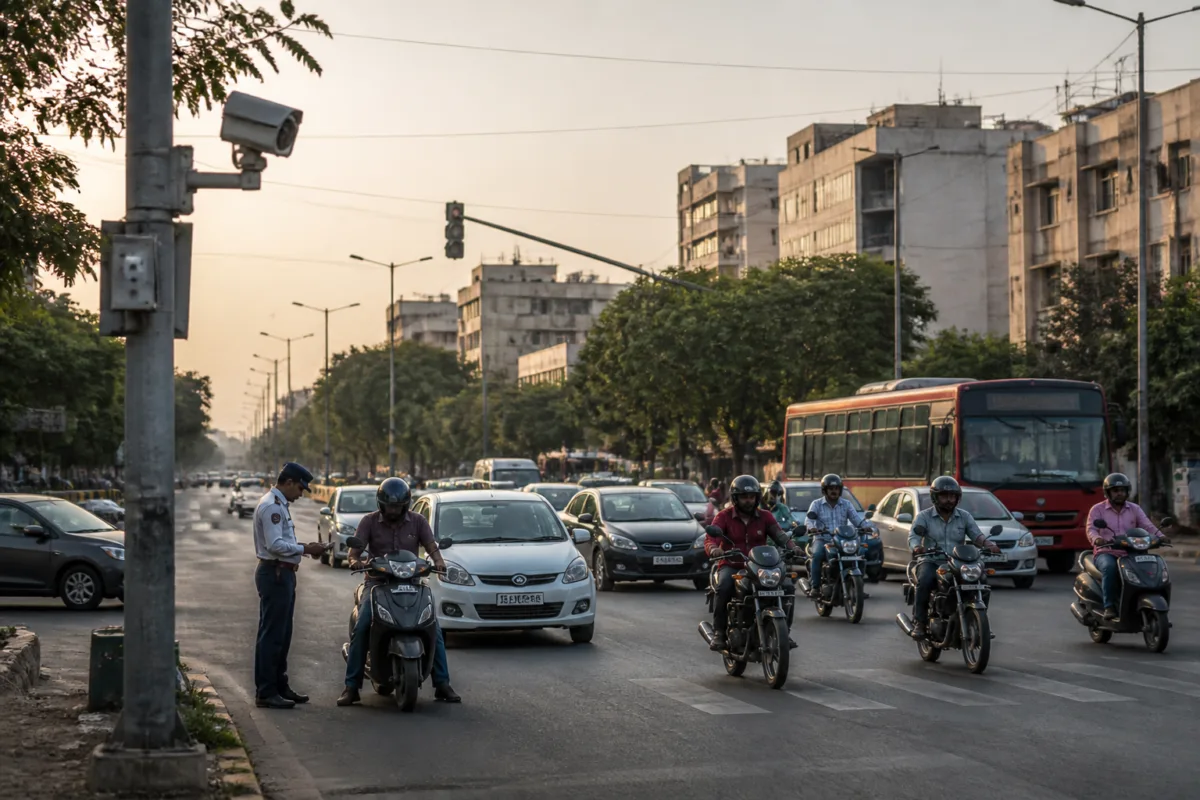
Ahmedabad’s e-challan system is facing an enforcement challenge as some vehicle owners are reportedly bending, covering, altering or obscuring number plates to avoid detection by traffic cameras, according to an investigation by Gujarat Samachar Digital.
The report said its team observed two-wheelers and four-wheelers in different parts of the city with missing, damaged or folded number plates. It also described plates covered with stickers or tape, painted over, or appearing to have been treated so that the characters were no longer clearly visible. The reported purpose was to prevent traffic cameras from reading registration numbers and issuing electronic fines after violations at signals, lane changes, wrong-side driving or while taking shortcuts.
Number plates are a basic identification layer in a camera-based enforcement system. When a plate cannot be read, the link between a road violation, the vehicle and its registered owner is weakened. The report also noted that unclear or absent registration numbers can make it harder to trace a stolen vehicle if it is captured by closed-circuit television or a traffic camera.
The issue is therefore broader than evading a fine. It affects the reliability of automated enforcement and the ability of public agencies to identify vehicles involved in traffic violations or incidents. However, the report did not establish how widespread the practice is across Ahmedabad, nor did it provide official enforcement data showing the number of vehicles penalised for concealed or altered plates.
Ahmedabad traffic DCP officials told the publication that bending or covering a number plate to avoid a penalty was a serious matter and raised questions about civic responsibility. The official said residents had earlier been given an opportunity to follow the rules voluntarily, but that police could take stricter action when such cases were found. The DCP also said the CCTV-based e-challan process was functioning properly and that vehicle detention and criminal proceedings were initiated during checks for rule violations.
The official response did not specify the number of cases detected, the penalties imposed or a timetable for any intensified drive. That leaves enforcement visibility as a central question: vehicles with visibly unreadable plates were still being reported on city roads despite the department’s assertion that checking and e-challan operations were active.
For Ahmedabad’s traffic-management system, the practical test is whether camera enforcement is supported by regular roadside inspections and consistent action against plates that do not meet prescribed standards. Automated systems can issue notices only when the registration number is captured accurately. Physical enforcement remains necessary where plates are deliberately concealed, damaged or altered.
The report also included public discussion that some people involved in illegal activities may use vehicles without visible number plates to avoid identification. That claim was not independently substantiated in the available material and should not be treated as evidence of a wider criminal pattern. The confirmed urban concern is narrower but significant: unreadable number plates can reduce the effectiveness of traffic enforcement, complicate vehicle tracing and weaken accountability on Ahmedabad’s roads.

