


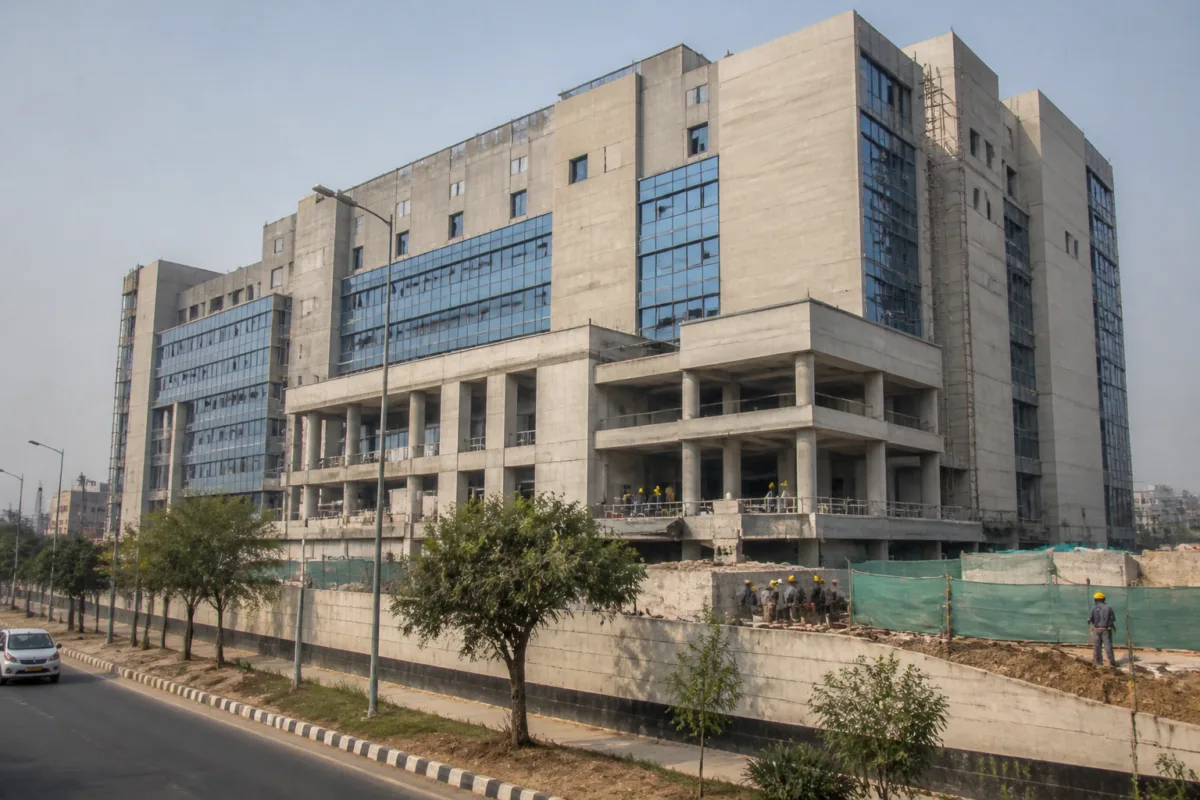
Delhi’s new hospital pipeline includes two facilities in Siraspur and Hastsal that together are planned to add 1,815 beds to the city’s public healthcare network, according to a report by Live Hindustan – NCR citing a review meeting held by the Delhi government.
The 1,164-bed hospital in Siraspur has been completed, but medical equipment procurement is still under way. The report said the procurement process is expected to be completed by the end of January, after which the hospital is planned to begin operations in 2027. Construction of the 651-bed hospital at Hastsal is described as nearly complete, with both facilities targeted for opening next year.
Delhi Chief Minister Rekha Gupta reviewed hospital construction, equipment procurement and related arrangements at the Delhi Secretariat. Health Minister Pankaj Kumar Singh, senior Health Department officials and representatives of the Public Works Department were reported to have attended the meeting. The chief minister directed officials to complete construction, procurement and other required arrangements within the stipulated timelines.
The two hospitals are intended to expand access for residents in their surrounding areas and reduce pressure on existing government hospitals. However, the report does not provide catchment-area estimates, staffing numbers, operational budgets or details of the clinical services that will be available at either facility. These factors will determine how quickly the additional bed capacity translates into usable public healthcare capacity.
The government is also developing two more hospitals, each with 691 beds, in Madipur and Jwalapuri. Their completion target is 2028. The reported estimated cost is ₹466.50 crore for the Madipur hospital and ₹484.04 crore for the Jwalapuri hospital. Together, the two projects are expected to add another 1,382 beds to Delhi’s government healthcare system.
The review also covered maternity and child-health infrastructure. A 463-bed maternal and child-health block is being developed at Baba Saheb Ambedkar Hospital in Rohini, and its outpatient department block is reportedly ready for inauguration. A 270-bed maternal and child-health block at Rao Tula Ram Memorial Hospital and a 460-bed block at Lal Bahadur Shastri Hospital in Khichripur were described as nearly complete and awaiting commencement.
At the primary-care level, the Delhi government is developing 1,139 Ayushman Arogya Mandirs, of which 415 have reportedly begun providing services. The government is targeting the opening of 40 more centres in December, proposed to coincide with the 102nd birth anniversary of former prime minister Atal Bihari Vajpayee. The report also said that centres with higher patient volumes may operate in two shifts.
Other projects mentioned in the review include the integrated redevelopment of Lok Nayak Hospital and the Maulana Azad Medical College campus, for which a planning and construction period of about 30 months has been set. In east Delhi, the government is working on a shared institutional framework involving Guru Tegh Bahadur Hospital, Rajiv Gandhi Super Speciality Hospital, the Delhi State Cancer Institute and the Institute of Human Behaviour and Allied Sciences.
The government is also planning medical colleges at Indira Gandhi Hospital in Dwarka and Guru Gobind Singh Government Hospital, with 150 proposed MBBS seats at each institution. The report said the number of seats at Baba Saheb Ambedkar Medical College is proposed to rise from 125 to 200, while Maulana Azad Institute of Dental Sciences is proposed to increase from 50 to 70 seats.
The announced programme combines new construction, hospital expansion, primary-care rollout, equipment procurement and medical education. Its implementation will depend not only on completing buildings, but also on commissioning equipment, recruiting staff and integrating the new facilities with existing referral networks. The source report did not provide detailed commissioning schedules or staffing plans for the individual hospitals.

