


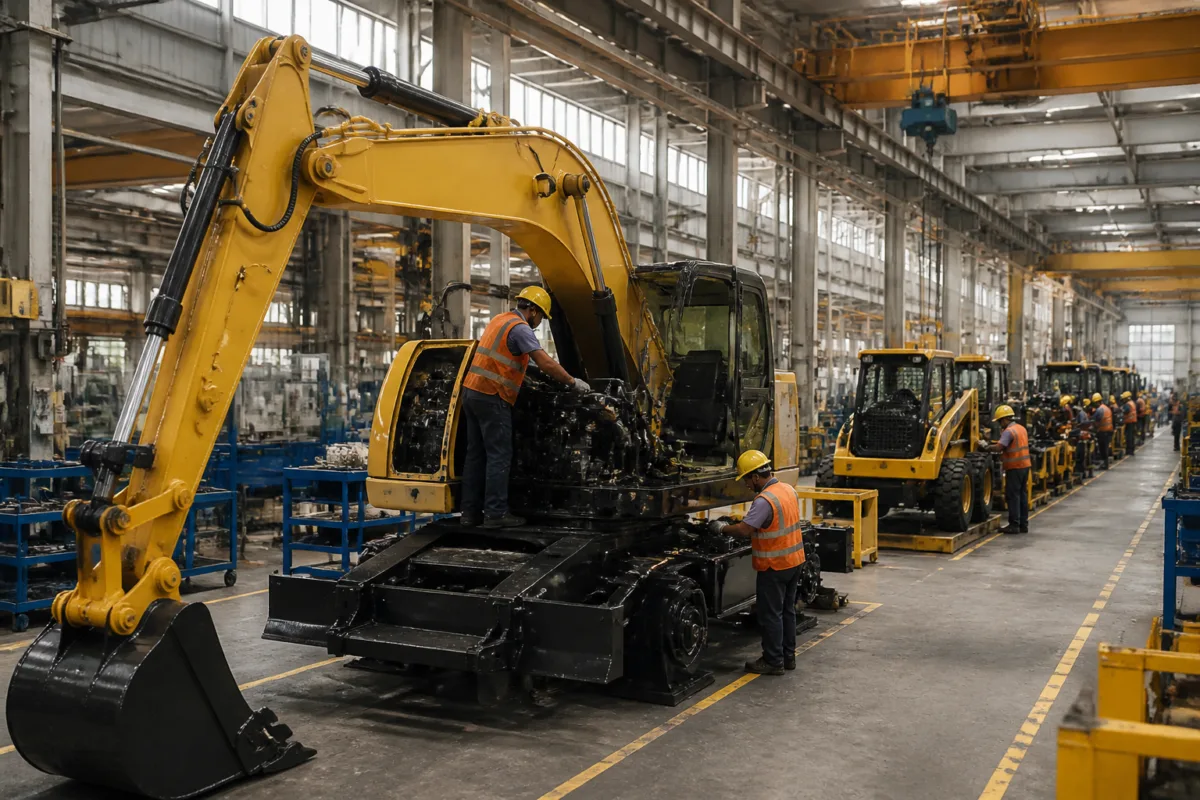
The Government of India’s Scheme for Enhancement of Construction and Infrastructure Equipment (CIE) Manufacturing Ecosystem is expected to support domestic production and localisation in the construction equipment sector, according to the Indian Construction Equipment Manufacturers’ Association (ICEMA).
ICEMA said on 25 November that the scheme could encourage investment in manufacturing capacity, critical components and advanced technologies. The association said the initiative is intended to strengthen the domestic supplier base and improve India’s competitiveness in global construction equipment markets.
The construction equipment sector supplies machinery used in roads, highways, railways, metros, ports, airports, mining and urban infrastructure projects. ICEMA said India is the world’s third-largest construction equipment market, with annual sales of around 1.4 lakh units. It reported sales of 1.36 lakh units in financial year 2025–26 and estimated the domestic construction and infrastructure equipment market at nearly ₹1 lakh crore.
The association said the scheme addresses import dependence in critical components, aggregates and technologically advanced equipment. It identified electronic and hydraulic components as areas where greater domestic production could help reduce imports and improve supply-chain resilience.
Following the announcement, an ICEMA delegation led by its president, Deepak Shetty, met Union Heavy Industries Minister H. D. Kumaraswamy. The association also acknowledged the roles of Hanif Qureshi, additional secretary, and Vijay Mittal, joint secretary, in advancing the scheme and facilitating engagement between the industry and government.
Shetty said the initiative could accelerate investment in advanced technologies, promote localisation and strengthen the domestic supplier ecosystem. He also said it could support exports and create employment in manufacturing and engineering, although the report does not provide projected investment or job figures.
Ramesh Palagiri, ICEMA’s president-designate, said effective implementation would be important for translating the policy into capacity creation, technology development and export competitiveness. V. G. Sakthikumar, convener of ICEMA’s Manufacturing and Supply Chain Panel, said the scheme could create opportunities for micro, small and medium enterprises to enter the equipment value chain.
ICEMA said clear eligibility criteria, a predictable incentive framework and an appropriate focus on domestic value addition would be critical to the scheme’s results. The report does not specify the scheme’s financial support, qualifying conditions or implementation schedule.
The association said it would continue working with the Ministry of Heavy Industries and other stakeholders on implementation. For infrastructure agencies and contractors, the potential significance lies in whether the policy produces a deeper domestic base for equipment and components used in public works. Its practical impact will depend on the final operating framework and the pace at which manufacturing capacity is created.

