


Jammu and Kashmir Chief Minister Omar Abdullah has directed officials to diversify the Union Territory’s renewable-energy mix, remove implementation bottlenecks and accelerate solar, small-hydropower and other clean-energy projects reviewed by the Science and Technology Department.
Abdullah, who also holds the Science and Technology portfolio, issued the directions while chairing a review meeting at the civil secretariat in Jammu on Wednesday, according to PTI. He asked officials to ensure that renewable-energy infrastructure is used effectively and delivers tangible benefits to residents.
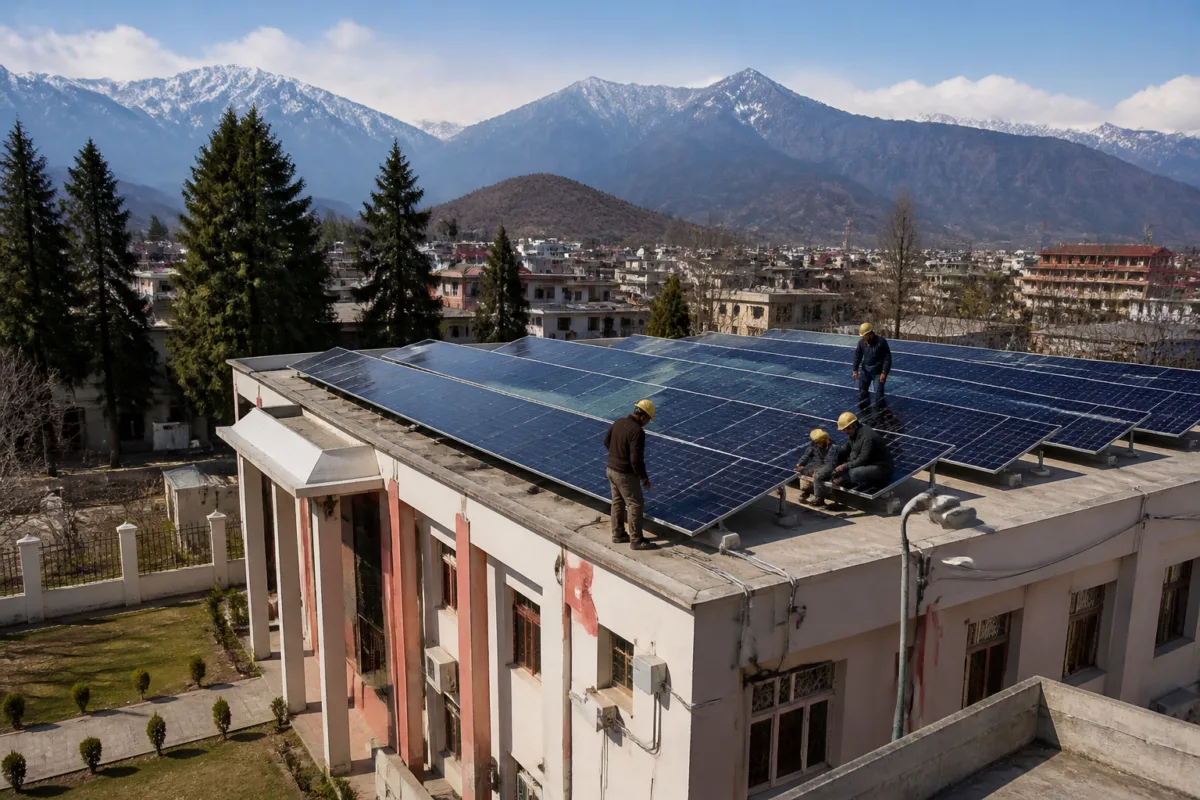
The review found that 9,025 government buildings had been solarised under the CAPEX mode of the PM Surya Ghar: Muft Bijli Yojana, with a cumulative installed capacity of 96.10 MW. Abdullah directed the department to speed up solarisation of the remaining government buildings.
The meeting also identified administrative and technical issues affecting solar installations. These included unified billing, the adoption of Virtual Net Metering benefits by distribution companies and the conversion of single-phase connections into three-phase connections for installations of 10 kW and above.
Under the department’s 2030 vision, Jammu and Kashmir is targeting 500 MW of solar photovoltaic capacity and 100 MW of small-hydro capacity. A further five MW is envisaged across wind, hydrogen, biomass and battery energy storage systems. Abdullah called for the wind-energy potential to be explored alongside solar power and asked officials to examine solar-energy opportunities in water bodies under the PM Surya Sarovar Yojana.
The Chief Minister also directed officials to accelerate the Model Solar Village initiative across all 20 districts. Under the proposed RESCO model, 8,000 government buildings are to be solarised through the Jammu and Kashmir Energy Development Agency, with a targeted capacity of 152 MW. Another 1,500 buildings are proposed to be covered through NHPC, with a target of 23 MW.
A power purchase agreement for 8 MW has already been signed for the Health and Medical Education Department in Jammu, the report said.
Small hydropower is another major part of the project pipeline. The department is reviewing 62 projects with a combined capacity of 135.15 MW. Abdullah called for coordinated action to secure forest clearances and other mandatory no-objection certificates within stipulated timelines, warning that delays in these processes could affect execution.
The meeting also reviewed several individual projects. These include the Industrial Biotechnology Park at Handwara, the Sub-Regional Science Centre and Science Innovation Dissemination Centre at Rajbagh in Srinagar, and a 240 kW solar agro-photovoltaic pressure-irrigation project at Patyari Cluster in Samba. Abdullah directed officials to adhere strictly to project timelines and expedite completion.
He further asked officials to make the Sub-Regional Science Centre in Srinagar fully operational through interactive exhibitions and public-engagement initiatives. The department was directed to strengthen scientific outreach among young people and explore facilities such as planetariums.
The review covered proposed bio-farms for medicinal and aromatic plants, with the Chief Minister calling for commercial viability and stronger market linkages to support sustainable livelihoods. The Jammu and Kashmir Compressed Bio-Gas Policy 2026 has also been notified to promote circular-energy initiatives under the GOBARdhan programme.
The directions place the immediate focus on implementation: connecting solar capacity to public buildings, resolving billing and grid-integration issues, obtaining statutory clearances and completing projects already in the pipeline. The reported targets indicate a broader renewable-energy strategy, but their delivery will depend on inter-departmental coordination, approvals and the timely execution of the proposed projects.

