


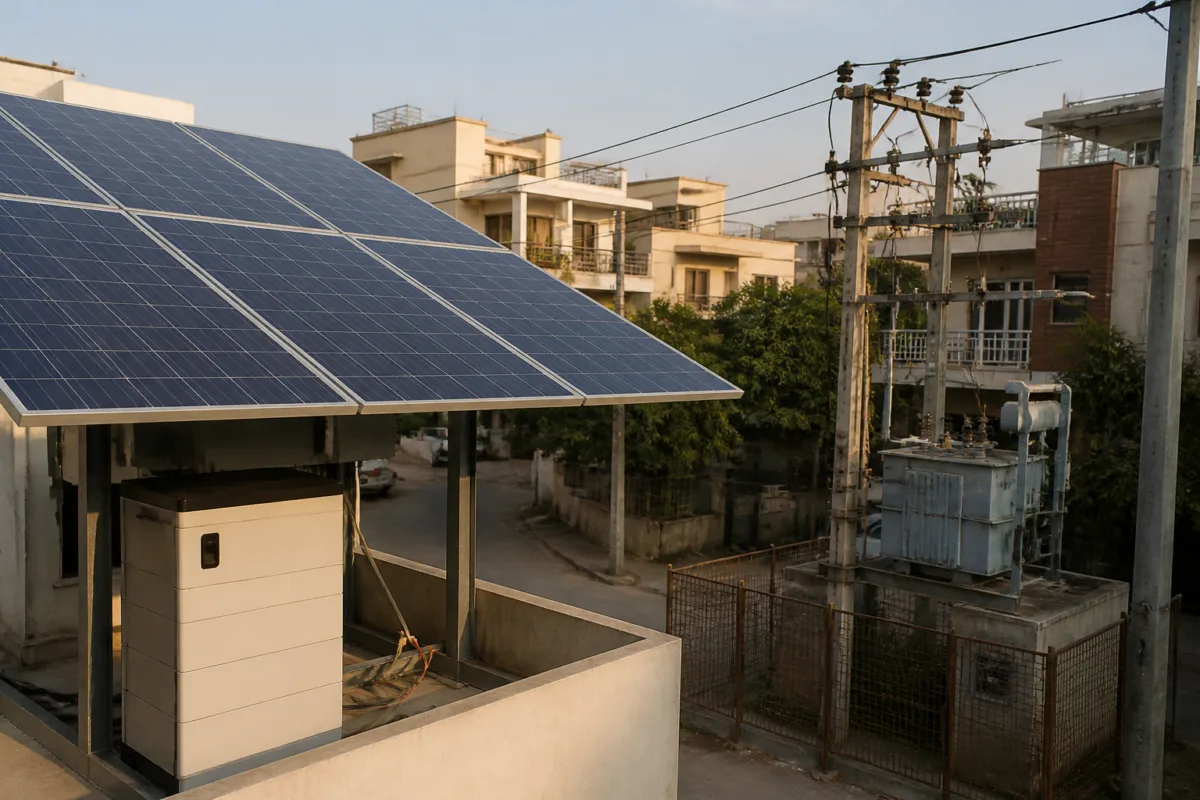
The Ministry of Power has circulated a revised draft of the Electricity (Rights of Consumers) Amendment Rules, 2026, proposing changes to how renewable-energy prosumers, electricity connections, tariffs and consumer grievance systems are regulated. The amendments are proposed to take effect from April 1, 2027, while the proposed energy-storage requirement for prosumers would begin from April 1, 2028.
The draft follows deliberations on the financial viability of distribution companies and the challenges associated with higher renewable-energy integration, according to Indian Infrastructure. It would give State Electricity Regulatory Commissions (SERCs) greater responsibility for setting net-metering limits and associated charges based on state-specific conditions.
Net metering allows eligible consumers who generate electricity, such as through renewable-energy installations, to account for electricity supplied to the grid against the power they consume. Under the proposed changes, prosumers could install renewable-energy capacity beyond their sanctioned load, subject to prescribed limits.
Where an installation exceeds the specified threshold, the draft proposes an energy-storage requirement equivalent to at least 20 per cent of daily generation, or another proportion determined by the relevant SERC. If a state does not prescribe its own threshold, the requirement would apply to systems exceeding 10 kW.
The proposed structure places the practical design of several requirements at the state level. This could allow SERCs to account for local grid conditions and distribution-system constraints, but it would also mean that net-metering limits, charges and storage requirements could vary between states. The report does not specify the proposed limits or charges for individual states.
The draft also proposes revised timelines for electricity connections and a minimum two-level mechanism for resolving consumer grievances. These provisions would create a common baseline for handling complaints, although the report does not provide the proposed time limits or explain how the mechanism would operate in each state.
Other proposed changes concern time-of-day tariffs, abnormal billing variations and demand response. The amendments would revise timelines for implementing time-of-day tariffs and introduce safeguards against unusual changes in electricity bills. They would also enable SERCs to establish demand-response frameworks, which can allow electricity consumption to be managed in response to system needs or tariff signals.
Taken together, the proposals connect consumer rights with the operational and financial pressures facing distribution companies. They also seek to place renewable-energy expansion within a framework that includes storage, state-level regulation and greater flexibility in managing demand.
The measures remain in draft form. Their final provisions, state-level implementation and effect on prosumers will depend on the rule-making process and subsequent decisions by SERCs.

