


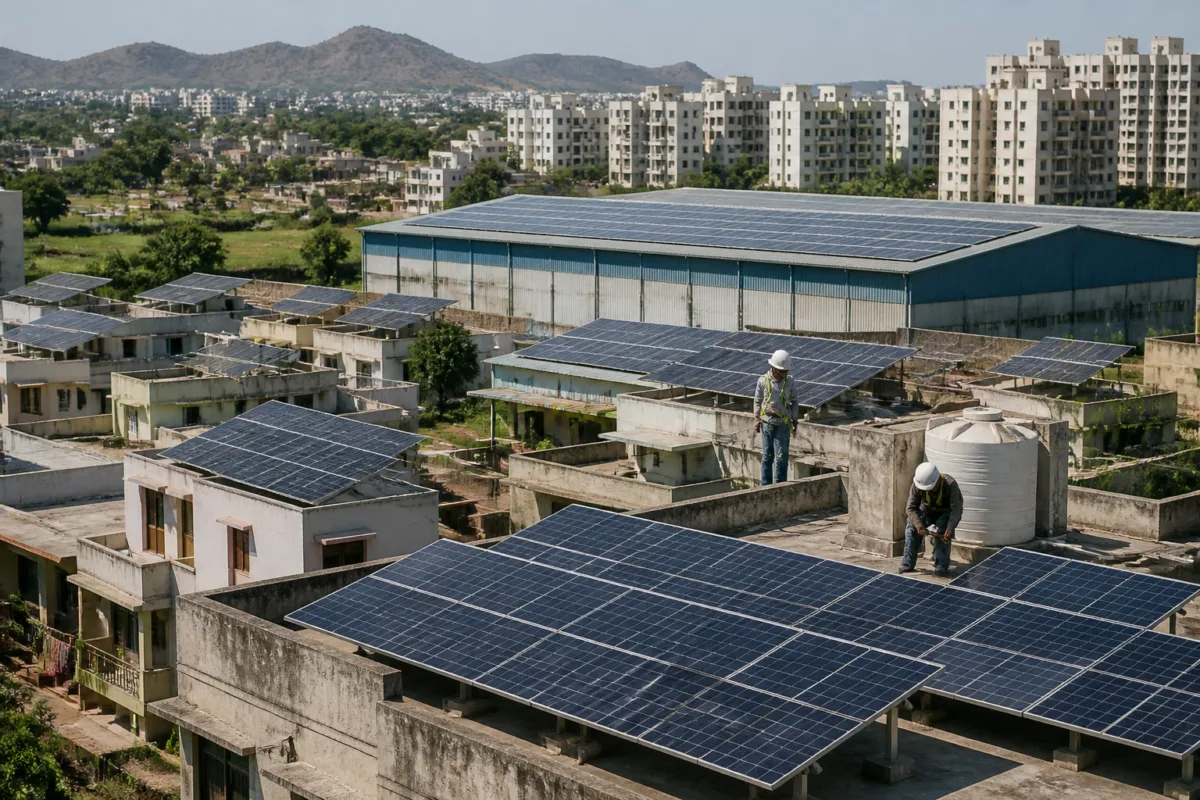
Pune district has crossed 1,083 MW of installed rooftop solar capacity, with 95,323 Mahavitaran consumers reported to have commissioned projects across the electricity utility’s four district circles. The figures indicate a substantial expansion of distributed power generation among both households and businesses.
According to a report by Pudhari, the Pune Rural circle has the highest installed capacity at 385.74 MW, generated through projects set up by 25,028 consumers. The Ganeshkhind city circle follows with 285.47 MW across 29,927 consumers. The Rasta Peth city circle has 221.22 MW from 26,209 consumers, while the Baramati circle has 191.31 MW from 14,159 consumers.
Together, the circle-wise figures amount to 1,083.74 MW. The distribution shows that rooftop solar adoption is not limited to Pune’s urban areas. The Pune Rural circle accounts for the largest capacity, while the two city circles together represent more than 506 MW, according to the figures reported by Pudhari.
Households form the largest customer group. The report said 84,893 domestic consumers had installed projects with a combined capacity of 478.03 MW. This makes residential users the biggest group by number, although their total installed capacity is only one part of the district’s overall rooftop solar base.
Industrial consumers, by contrast, account for a much smaller number of installations but a significantly larger average project size. The report said 2,418 industrial consumers had installed projects with a combined capacity of 403.94 MW. That capacity is close to the total attributed to domestic consumers, highlighting the different scale of rooftop systems used by industrial customers.
The remaining capacity is attributed to other consumer categories, although the report does not provide a full category-wise breakdown. The available figures nevertheless show two distinct patterns of adoption: widespread participation by households and high-capacity installations among industrial users.
The reported growth among domestic consumers has been supported by government incentive programmes. Under the Prime Minister’s Surya Ghar Muft Bijli Yojana, eligible consumers can receive central assistance of up to Rs 78,000 for rooftop systems of up to 3 kW, as stated in the report. The report also said that eligible consumers using less than 100 units of electricity a month can receive a 1 kW solar system through the Maharashtra government’s Smart scheme.
These programmes reduce the upfront cost of rooftop solar for eligible households and create a route for smaller consumers to participate in distributed electricity generation. The figures also indicate that the impact of rooftop solar is extending beyond subsidised residential installations, with industrial consumers contributing a large share of installed capacity despite their smaller numbers.
Mahavitaran operates the Ganeshkhind city, Rasta Peth city, Pune Rural and Baramati circles in the district. The reported capacity across these four administrative areas provides a broad picture of rooftop solar deployment in Pune, but the report does not specify the measurement period, project-level generation or the amount of electricity being exported to the grid.
The available data therefore establishes the scale of installed rooftop capacity and the role of domestic and industrial consumers, while leaving the operational performance of the systems outside the scope of the report. Further details on actual generation, net-metering volumes and the geographic distribution of projects would be needed to assess how the installed capacity is affecting the district’s electricity demand and distribution network.

