


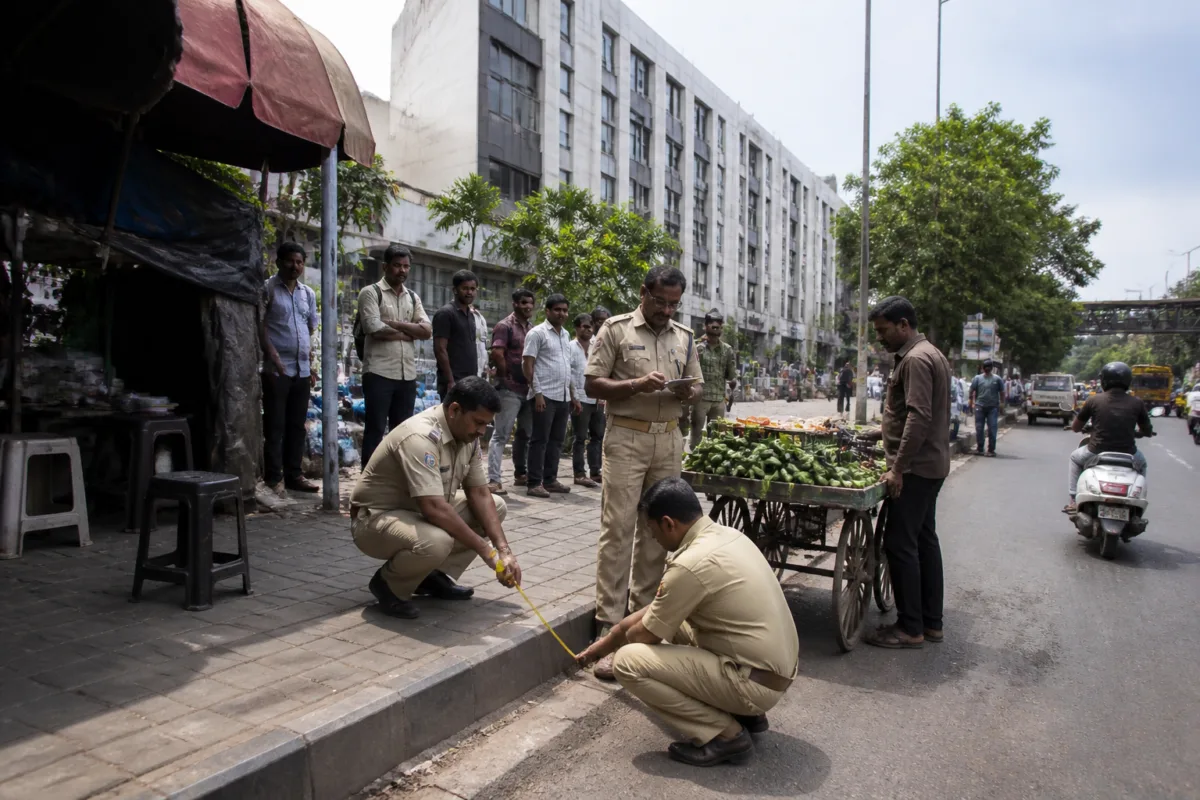
Pune Municipal Corporation’s anti-encroachment drive on Dhole Patil Road has brought renewed attention to whether enforcement is being applied consistently to street vendors, larger commercial establishments and properties connected to civic facilities.
The Dhole Patil regional office has recently acted against handcarts and roadside vendors following directions from the municipal commissioner. Residents and affected vendors, however, have questioned why similar action has not been taken against alleged encroachments by established businesses, including hotels operating from the ground floor of the Dhole Patil regional office building.
According to a report by Civic Mirror – Pune, the ground floor of the Damodar Narayan Dhole Patil Smruti building on Chhatrapati Shahu Maharaj Path was originally reserved for a vegetable market. The report says hotels including Madhuban and Nandu have operated from the premises for around 15 to 20 years. It also alleges that sheds, umbrellas and customer seating have been installed in the building’s front-margin area.
These allegations have not been independently established in the available material. The report attributes the claims about selective enforcement to local residents and vendors. It also identifies other locations where residents allege that front or side margins and road space are being used by commercial establishments, including the area opposite Kapila–Kathi Kebab, the Bank of Maharashtra compound and the Shankar-Parvati Chambers area.
Bhaskar Mahadik, assistant commissioner of the Dhole Patil regional office, said action would be taken against unauthorised encroachments in roads, footpaths and front and side margins in accordance with the rules. He said operators of Hotel Madhuban claimed to have permission to convert a vegetable-market shop into a hotel and to use the front margin. Mahadik said the operators had been asked to submit documents, but no documents had been received by late evening, according to the report.
The official response leaves the central question dependent on documentary verification: whether the premises were legally converted, whether the claimed permissions cover the present use, and whether any approval permits seating, sheds or umbrellas in the front-margin area. The available report does not establish the status of those permissions.
The dispute also extends beyond the civic building. The regional office has identified a hawkers’ zone along Dhole Patil Road and Matoshri Ramabai Ambedkar Road. The report says some permanent metal stalls are operating under the name of hawkers’ businesses, while residents allege that action has not been taken consistently against them. It further refers to a stall near Saurabh Hall where police action had previously been taken over alleged gutkha sales, while claiming that sales have resumed. That claim is also presented without supporting documents in the available material.
The municipal commissioner has reportedly warned that names of political leaders who call to stop enforcement could be made public and that action would be taken without favour. The current controversy therefore places the implementation of that direction under scrutiny. For residents, the issue is not only the removal of individual obstructions but also whether enforcement protects pedestrian movement and road access without disproportionately affecting informal livelihoods.
A consistent process would require the civic body to identify the applicable permissions, record the condition of public and private margins, disclose the basis for action, and apply the same standards to vendors and larger establishments. Until the relevant documents and inspection findings are made available, the legality of the hotel use and the wider allegations of selective enforcement remain unresolved.

