


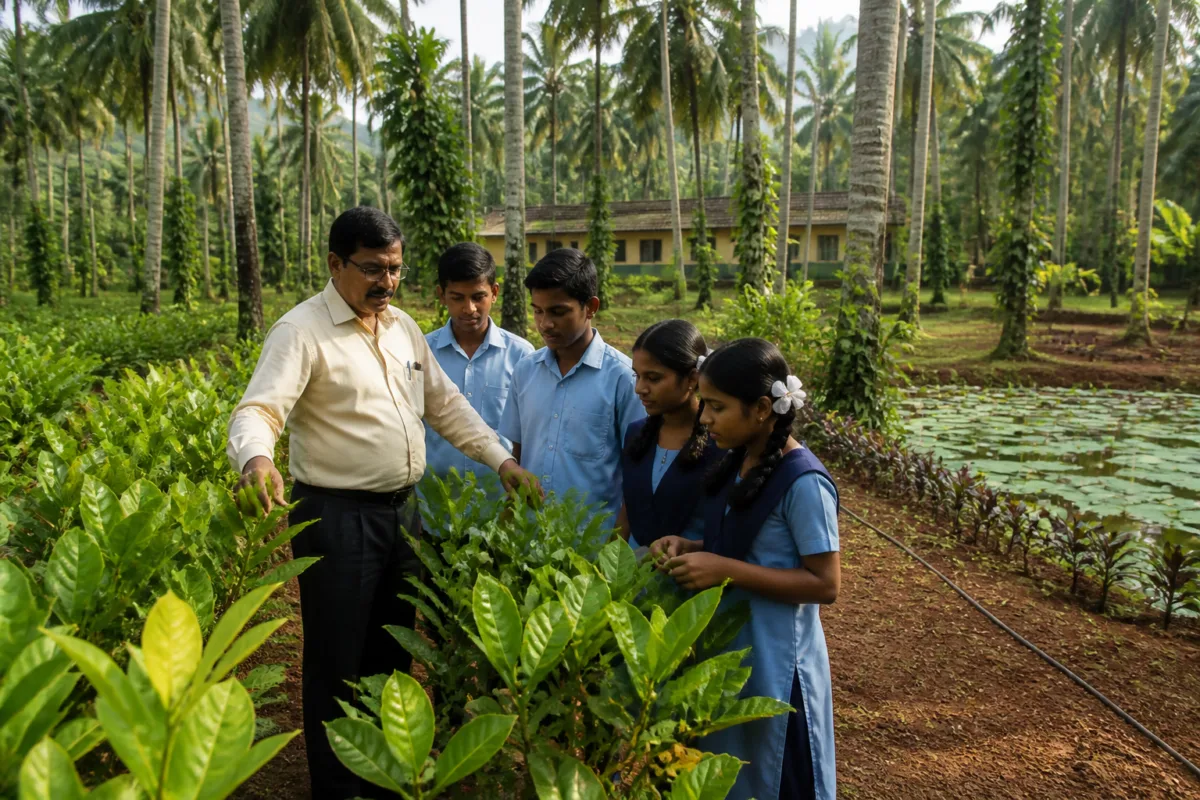
A government high school near Thirthahalli in Shivamogga district has used its eight acres of land to build a mixed plantation that supports school activities, practical learning and income for its School Development and Monitoring Committee (SDMC), according to a report by Prajavani.
The Shanthaveri Gopalagowda Government High School at Kondlur has plantations of arecanut, cashew, coconut and rubber, along with fruit trees, spices, flowers and a lotus pond. The school’s 93 students are reported to participate in activities including plantation maintenance, harvesting, cashew processing, rubber tapping, water management and weed control during their free time.
The initiative is led by head teacher H.V. Sampath. The report says he has spent about nine to 10 years developing the land, which had earlier been occupied by an acacia plantation and was later left unused. He is reported to have undertaken much of the digging, planting and soil work himself, while teachers, students, midday-meal staff and members of the local community supported the effort.
The cultivated area includes about 1.5 acres of arecanut, three acres of cashew and one acre containing 40 coconut trees. The remaining land has rubber and appemidi mango, while pepper vines, guava, mango, jackfruit and other fruit plants have also been grown. The school grounds additionally include a pond with 11 varieties of lotus, gladiolus and orchids.
According to the report, the plantation’s income is deposited into the SDMC account. It does not provide audited annual revenue figures, but describes the returns as running into lakhs of rupees. Produce from the school land is also used for the midday meal. Sampath is reported to have spent more than ₹4 lakh from his own funds on saplings and drip irrigation. A borewell was later provided during the tenure of former Thirthahalli MLA Kimmane Rathnakar, the report says.
The arrangement illustrates how underused public land can be linked to school operations rather than treated only as a maintenance responsibility. In this case, the plantation functions as a productive landscape, a source of food and an outdoor classroom. Students are reported to learn about crop care, seasonal fertilisation, irrigation, harvesting and basic processing alongside their regular lessons.
The school’s academic performance is another part of the account. Prajavani reports that the institution has 93 students and has consistently achieved a 100% pass rate in the SSLC examination. For the 2025–26 academic year, it reportedly recorded an average score of 91.4%. The report attributes the results to additional support by teachers, including home visits, special classes and academic assistance outside regular school hours.
Teachers and students are not the only participants. The report names several teachers and midday-meal workers as contributors to the garden and pond, while students are said to assist during their free time. It also says the school has formed an association of former students to support its development.
The model’s reported benefits are significant for the school, but its limits are equally important. The account does not establish whether the plantation’s revenue can be replicated across schools, how produce sales are recorded, or what approvals and accounting procedures govern the SDMC funds. It also does not quantify maintenance costs, water consumption or the long-term labour burden on staff.
Even so, the Kondlur example places school land within a wider conversation about public-asset stewardship. Where land, water and institutional capacity are available, a carefully managed school plantation can connect environmental education with food use and locally retained funds. Its viability depends on transparent accounts, safe student participation, reliable irrigation and ensuring that cultivation does not reduce classroom time or shift institutional responsibilities unfairly onto individual teachers.

