


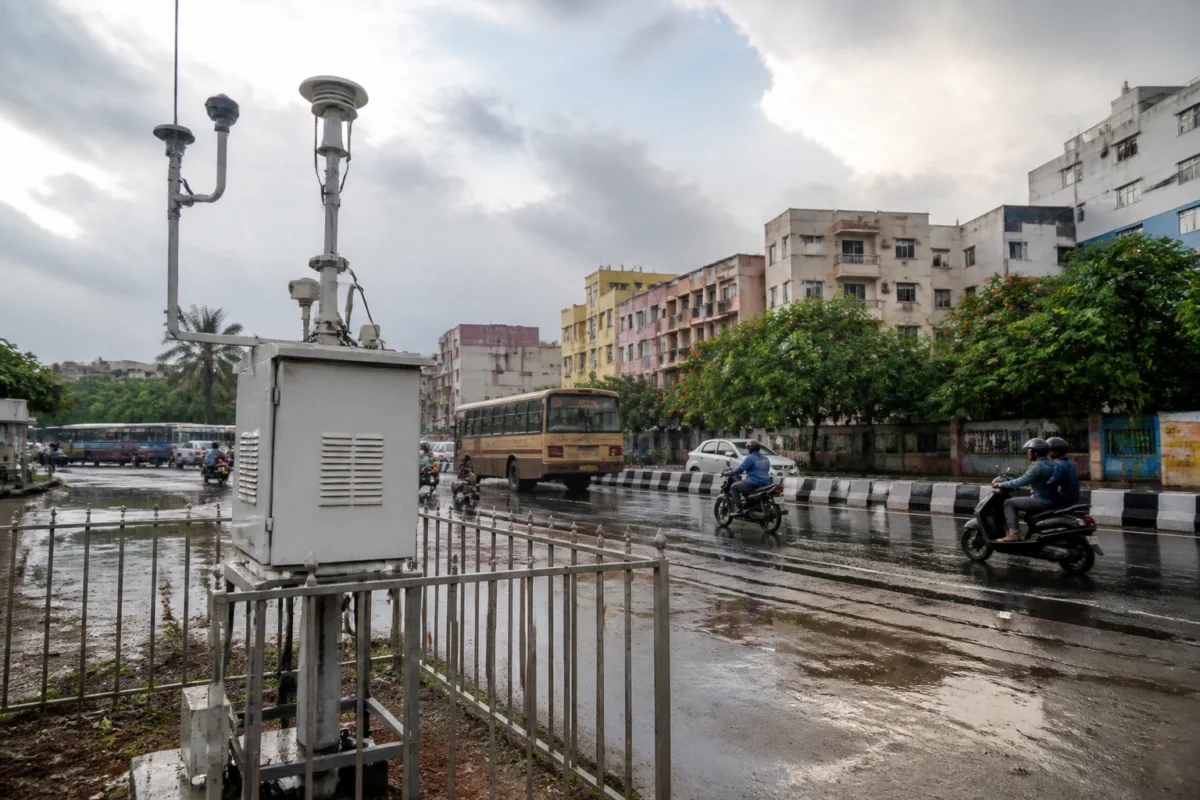
Chennai’s air quality improved sharply after easterly winds and rain, but gaps across the city’s pollution-monitoring network have made it harder to assess whether the relief reflects a sustained reduction in emissions or a temporary weather effect.
The city’s Air Quality Index (AQI) fell to 89 on Monday from 224 on November 21, placing it in the “satisfactory” category, according to the report. The improvement coincided with rainfall over parts of Tamil Nadu and the return of easterly winds. Rain can remove particulate matter from the air, while stronger winds can disperse pollutants, although the benefit may be temporary.
The Regional Meteorological Centre has forecast moderate rain, with heavy spells at times, in Chennai and neighbouring districts for the next couple of days. That forecast could continue to influence local pollution readings, but weather-related improvement does not resolve weaknesses in the monitoring system.
On Monday, the Central Pollution Control Board’s Sameer dashboard showed only four of Chennai’s nine stations as active. The active stations were Arumbakkam, which recorded an AQI of 95; Kodungaiyur, at 74; Manali Village, at 66; and Royapuram, at 65.
Other stations were affected by equipment, software or data-availability problems. At Perungudi and Manali, sensor issues affected PM10 and PM2.5 readings, although other pollutant parameters remained available. Velachery showed no data, while Ennore and Alandur had insufficient data to calculate an AQI. The report said the Tamil Nadu State Pollution Control Board’s Ennore station had reportedly been non-functional for a prolonged period.
The monitoring gaps are particularly significant around Gummidipoondi, where the AQI reached 366 on Saturday. The station was allegedly shut down on Sunday. Official sources attributed the outage to sensor issues, while activists alleged that similar shutdowns had occurred previously when the station recorded high pollution levels. The report did not independently establish the activists’ allegation.
The reported outage also limits the ability to verify how pollution levels changed after the high reading. Sources said the state environment minister’s office had sought an explanation from the Tamil Nadu State Pollution Control Board on why Gummidipoondi recorded such high pollution levels, following an earlier report by The New Indian Express.
The issue is not confined to Chennai. Monitoring stations in Tiruchy and Madurai were also reported to have been non-functional for a long time. Within the Chennai network, the combination of inactive stations, incomplete readings and missing particulate-matter data means that the citywide AQI may not fully capture conditions in every locality at a given time.
For residents, the distinction matters because AQI readings are used to understand pollution exposure and inform decisions about outdoor activity, public communication and pollution-control action. A lower citywide reading after rain may indicate cleaner air at that moment, but it cannot by itself resolve whether pollution sources have been controlled or whether monitoring coverage is sufficient.
The reported problems therefore raise two linked governance questions: whether stations can be restored and maintained consistently, and whether authorities can explain interruptions transparently when readings are unusually high. Until the affected stations return to reliable operation, weather-driven improvements and partial dashboard coverage will continue to complicate the public assessment of Chennai’s air quality.

