


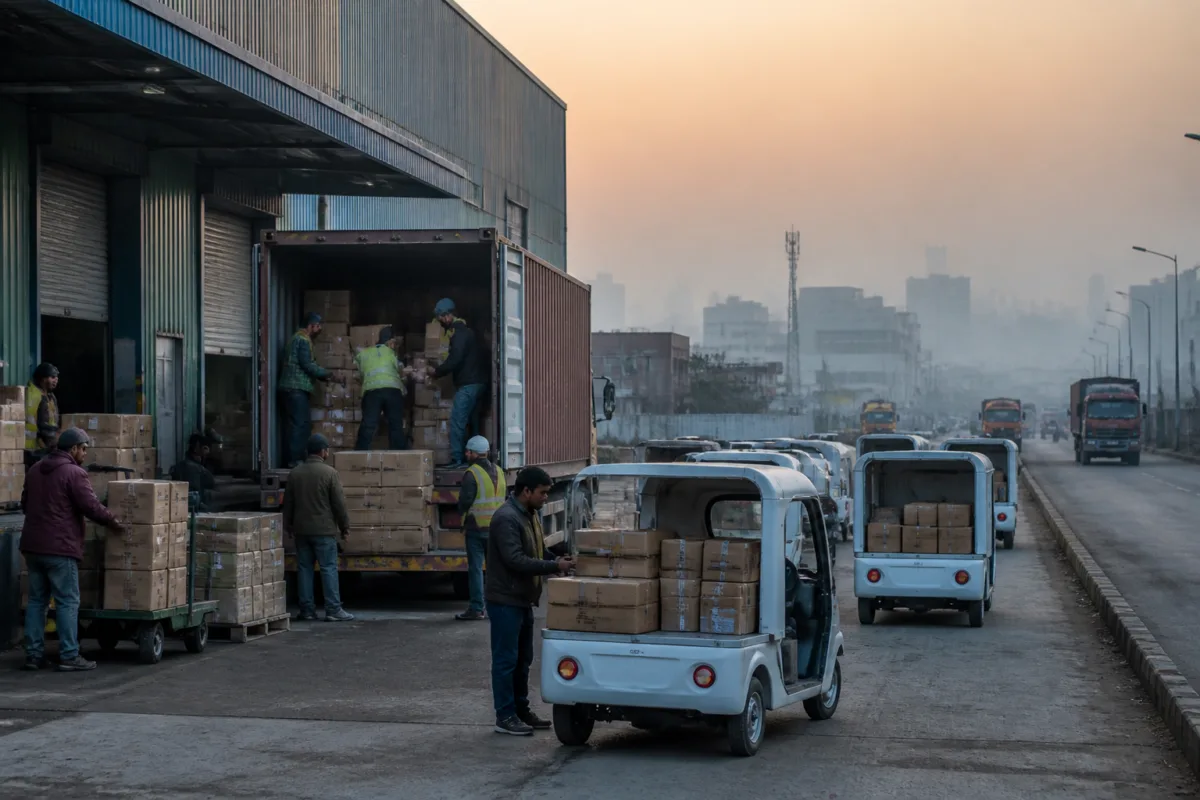
The Supreme Court has suggested a long-term plan under which goods entering Delhi could be transferred at warehouses near the city’s borders and brought inside using battery-operated or other non-polluting vehicles, as part of efforts to address air pollution.
The suggestion was made during a hearing on Monday by a bench comprising Chief Justice Surya Kant and Justices Joymalya Bagchi and V. Mohan. The bench is hearing an air-pollution matter taken up suo motu to review the rules and measures in place to control emissions.
The court said it was considering allowing only Bharat Stage-VI vehicles in Delhi. Justice Bagchi said the court’s position was clear that Delhi should permit only BS-VI vehicles, even if the same requirement was not applied across the National Capital Region.
Chief Justice Surya Kant asked whether arrangements could be created for warehouses at the borders, where goods could be transferred from commercial vehicles to battery-powered or otherwise non-polluting vehicles for delivery inside the city. He indicated that such a system might not be possible this year or next year, but asked whether it could be developed over the next five years so that commercial vehicles would not enter Delhi.
The court also stressed that any long-term restriction would need to ensure that the supply of essential goods continued without interruption. The proposal, as reported, is a judicial suggestion under consideration and is not an announced ban on commercial vehicles entering Delhi.
The bench directed Haryana, Punjab, Uttar Pradesh and other concerned states to file status reports detailing the steps taken to reduce pollution. The directions extend the court’s focus beyond Delhi to pollution-control measures across the wider region.
BS-VI is India’s stricter vehicle-emission standard, which came into force for vehicles manufactured, sold and registered in the country from April 1, 2020. The standard is broadly aligned with Euro-VI norms and is intended to reduce harmful emissions compared with the earlier BS-IV regime.
The report said Delhi’s average Air Quality Index was 260 on Monday, in the ‘poor’ category, while 13 areas recorded AQI readings above 300, classified as ‘very poor’. It also reported that wind speeds were expected to remain below 10 kmph over the next two days, potentially worsening pollution conditions.
Separately, the Municipal Corporation of Delhi has ordered increased monitoring at identified pollution hotspots. The corporation said action, including fines, would be taken against violators under solid-waste management rules and the Graded Response Action Plan guidelines. Daily monitoring has been ordered in the hotspots, with drone surveillance also planned.

