


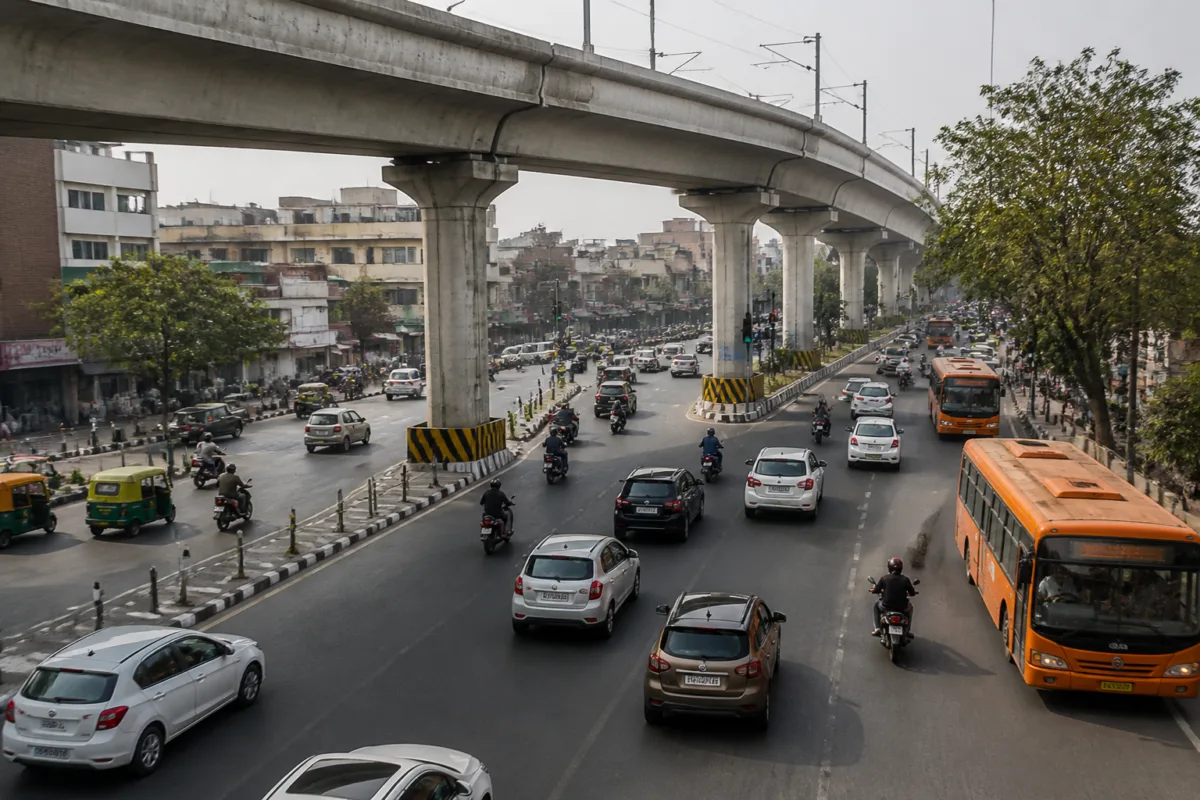
Delhi’s signal-free corridors programme is expanding across several major routes as the government seeks to reduce congestion and improve traffic movement, according to officials cited by Millennium Post.
The Public Works Department (PWD), which maintains about 1,400 km of roads in the city, recently briefed Chief Minister Rekha Gupta during a review meeting on air pollution. Officials said work had been completed on parts of Vikas Marg, Mathura Road near Supreme Court metro station and the Barapullah flyover, with these projects helping traffic movement.
The PWD is also working on extending the Modi Mill Flyover in South Delhi. Work has started on a new parallel flyover at the Savitri Cinema junction, officials said. Together, the projects are intended to support signal-free movement from Modi Mill towards Kalkaji and onwards towards the IIT Gate.
The wider programme includes 10 signal-free corridors, although the report does not provide individual completion dates, project costs or detailed designs for each corridor. Delhi also plans an extension of the Munak Canal elevated road, including a 4-km tunnel, while pursuing traffic improvements at 538 congestion hotspots.
The projects point to a strategy focused on grade separation and uninterrupted vehicle movement at locations where intersections and traffic signals contribute to delays. Their effectiveness will depend on how the corridors connect with adjoining roads, junctions and public transport facilities. The report does not specify the implementation schedule, land requirements, pedestrian arrangements or provisions for non-motorised transport.
For commuters, the completed and proposed works could alter travel patterns across central and south Delhi, particularly along the Modi Mill-Kalkaji-IIT Gate route and the Mathura Road corridor. However, the available details establish the government’s planned and ongoing interventions without confirming the completion timeline for the full 10-corridor programme.

