


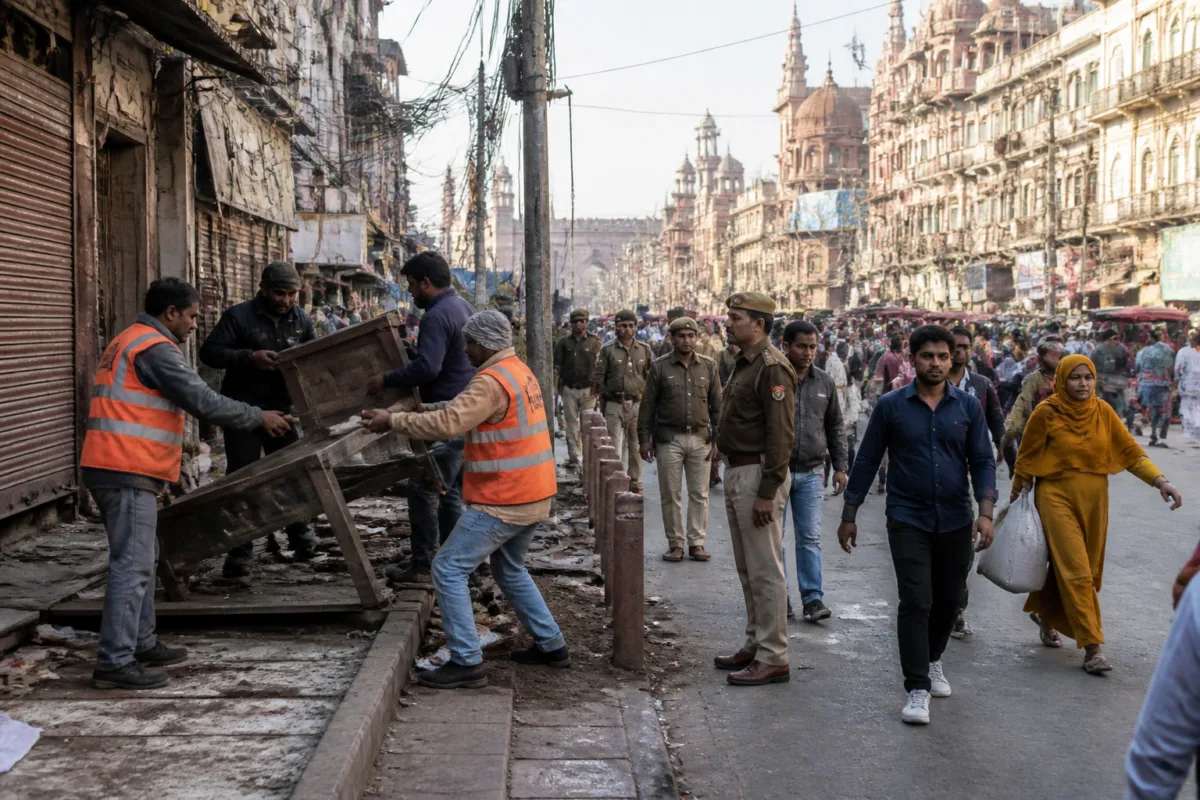
The Delhi government has directed the Municipal Corporation of Delhi (MCD) and Delhi Police to continue anti-encroachment action in Chandni Chowk and adjoining areas, with Chief Minister Rekha Gupta warning that officials could face action if cleared public spaces are occupied again.
The direction followed a review meeting held on November 20 with officials of the Indraprastha Heritage Redevelopment Corporation, MCD, Delhi Police and other departments. Gupta called for coordinated enforcement while retaining Chandni Chowk’s historic character and improving public amenities, according to a report by Millennium Post.
Following the meeting, the MCD, assisted by the police, conducted a special drive at Pul Mithai, Peeli Kothi, Rani Avantika Chowk and Tis Hazari. The operation targeted roads, footpaths and other public spaces, with the stated objectives of improving pedestrian movement and traffic management.
Gupta subsequently directed officials to maintain continuous surveillance of the cleared locations and prevent fresh encroachments. She said that removing encroachments alone would not be sufficient and warned that negligence or failure to stop their return would invite strict action against the officials concerned.
The chief minister said illegal occupation of roads, footpaths and other public spaces obstructed movement and affected cleanliness, safety and development works. She also described encroachment-free roads, smoother movement, organised markets and clean public spaces as central to the proposed development of Old Delhi.
The reported approach places sustained enforcement alongside clearance operations. For pedestrians and visitors, the immediate stated aim is to keep public routes open after drives are conducted. For the agencies involved, the government’s direction links the condition of cleared areas to continuing monitoring and accountability rather than treating the operation as a one-time intervention.
The report does not provide details on the number of structures or vendors removed, the duration of the surveillance arrangement, or the specific enforcement procedures to be used if encroachments return.

