


An Anti-Corruption Bureau inspection at Nizam’s Institute of Medical Sciences in Hyderabad has highlighted gaps in the handling of medical implants, patient billing, tenders, staffing and food-safety compliance, according to an ACB press release reported by Deccan Chronicle.
The inspections were conducted at the NIMS facility in Panjagutta on October 29 and November 2, 2026, with officials from TG SAFE, the drug control department and the labour department, the report said. The ACB described irregularities across medical stores, manpower recruitment, tender procedures, billing and canteen operations.
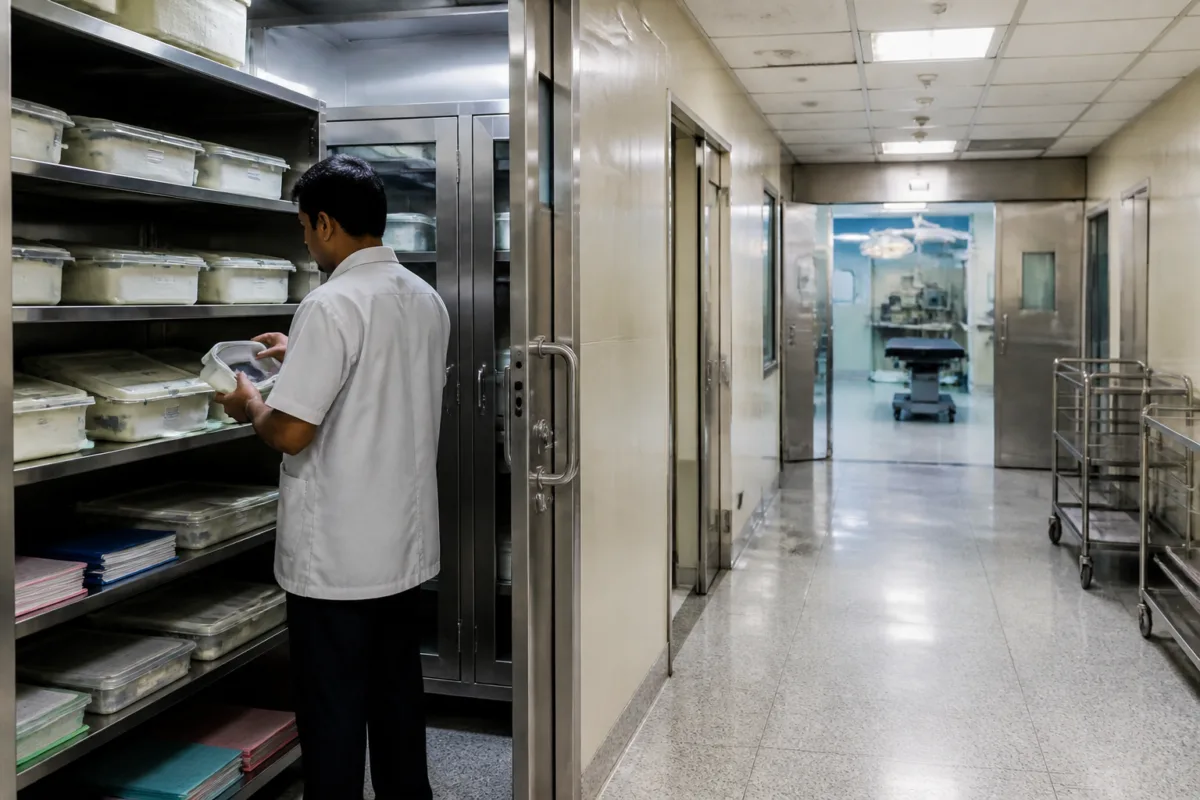
The most significant finding concerned medical implants and other items valued at nearly ₹75 crore. These materials were found stored without authorisation near five operation theatres, according to the ACB. The agency also said doctors and nursing staff were collecting implants directly from vendors instead of following prescribed store procedures.
That arrangement can weaken the institutional record of when items enter a hospital, who receives them and how they are linked to a patient’s treatment and bill. The ACB said the practice created scope for billing irregularities, but the report does not state that any specific individual or vendor has been found guilty.
The inspection also identified concerns over billing after patient treatment had ended. Bills worth ₹2.66 crore were processed after patients had been discharged during July, August and September, the ACB said. In some cases, particularly those linked to the Aarogyasri scheme, bills were processed as much as three months after patients’ deaths.
Post-discharge processing is not, by itself, proof of an improper claim. However, the ACB’s findings raise questions about the controls used to reconcile hospital treatment, discharge records, scheme claims and vendor invoices. Such reconciliation is important because medical procurement and billing involve multiple points at which records must correspond with the patient’s care.
Procurement and staffing were another area of concern. The ACB stated that the tender process for manpower services had not been completed between 2019 and 2025. It also reported irregularities in worker recruitment and classification, raising suspicion of possible collusion. The inspection further found delays in finalising security-service tenders and repeated extensions of contracts.
The agency said NIMS had failed to forfeit a bank guarantee of ₹28.13 lakh submitted by a defaulting agency. A bank guarantee is intended to protect an institution when a contracted service provider fails to meet its obligations. The reported failure to act on the guarantee points to a gap between contractual safeguards and their enforcement, although the report provides no further details on the agency or the contract involved.
The findings extended to food and retail services within the institution. The main canteen was reported to be operating in unhygienic conditions, with expired food items and without registration under the Food Safety and Standards Authority of India. Medical shops were also found operating without mandatory sales records and employing unregistered workers, according to the ACB.
Taken together, the inspection findings describe weaknesses across the systems that support hospital operations: inventory custody, procurement, contract management, workforce administration, billing and food safety. These systems may be separate in day-to-day operation, but failures in record-keeping and oversight can make it harder for an institution to verify costs, enforce contracts and trace materials used in patient care.
The available report records the ACB’s findings and does not include a response from NIMS or the organisations and vendors concerned. It also does not state whether disciplinary, recovery or criminal proceedings have been initiated. Further action and any explanations from the institute or affected parties would be needed to establish the implications of the inspection findings beyond the irregularities identified by the agency.

