


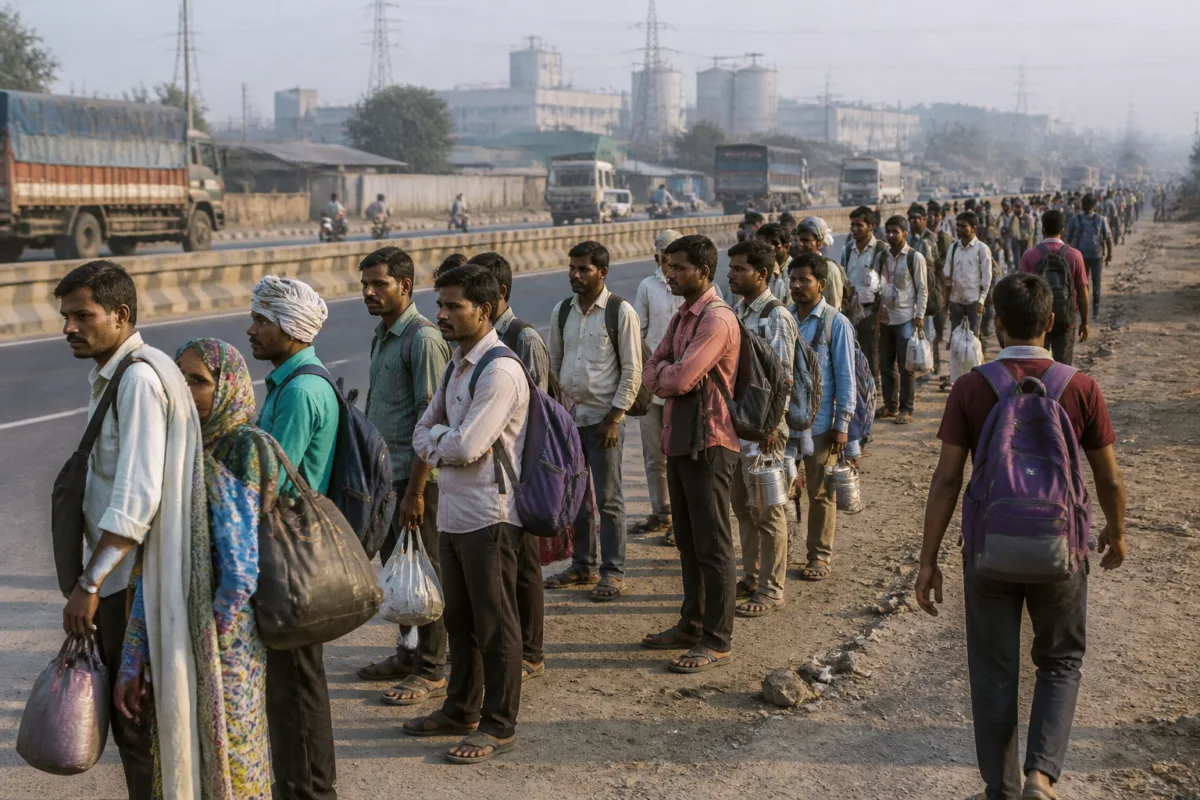
Migrant workers who travelled to Chakan from drought-affected parts of Marathwada and Vidarbha are reportedly struggling to find employment after returning from the Diwali break, placing additional pressure on household finances and the industrial town’s informal support systems.
Sakal reported on November 23 that large numbers of workers gather from early morning at Talegaon Chowk on the Pune–Nashik highway in the hope of securing daily-wage work. Many reportedly wait until the afternoon without finding employment and return empty-handed.
The report said around one lakh workers had moved towards Chakan this year in search of jobs after agricultural work slowed in their home regions. The estimate was attributed to the report and was not supported by an official migration or labour department figure in the material available.
Chakan’s industrial estate offers employment opportunities, but the report said regular work is not available to everyone. Many workers depend on daily-wage or temporary assignments, making it difficult to plan for rent, food, children’s education and other routine expenses. Workers quoted in the report described arriving from drought-affected areas because farm employment had stopped, only to face uncertainty in Chakan as well.
The employment shortage is also linked in the report to slower construction activity and local agricultural work because of inadequate water availability. This suggests that the employment pressure is not limited to factory recruitment: it also affects the wider network of construction, contracting and informal labour that supports the industrial corridor.
Sakal further reported that some workers believe companies give preference to out-of-state labour for physically demanding work, reducing opportunities for local and regional workers. This claim was not independently established in the report and should be assessed against recruitment practices, contractor records and labour department data.
For workers living in rented rooms, even a short period without work can quickly become a housing and livelihood crisis. Fixed expenses continue while income becomes irregular, increasing the risk of debt, food insecurity and disruption to children’s schooling. The concentration of job-seekers at a highway junction also reflects the absence of a more formal system for matching workers with vacancies and documenting demand for labour.
The report called for companies, contractors and the relevant administrative agencies to respond to the situation. A fuller assessment would require official data on worker registrations, vacancies, contractor hiring, wage payments, rental conditions and water availability in the Chakan industrial area. Without such information, the scale of the crisis and the reasons for the reported hiring pattern remain difficult to measure precisely.
The immediate issue, however, is clear from the workers’ accounts cited by Sakal: migration to an industrial centre does not guarantee stable employment, particularly when demand for agricultural, construction and factory labour weakens at the same time.

