


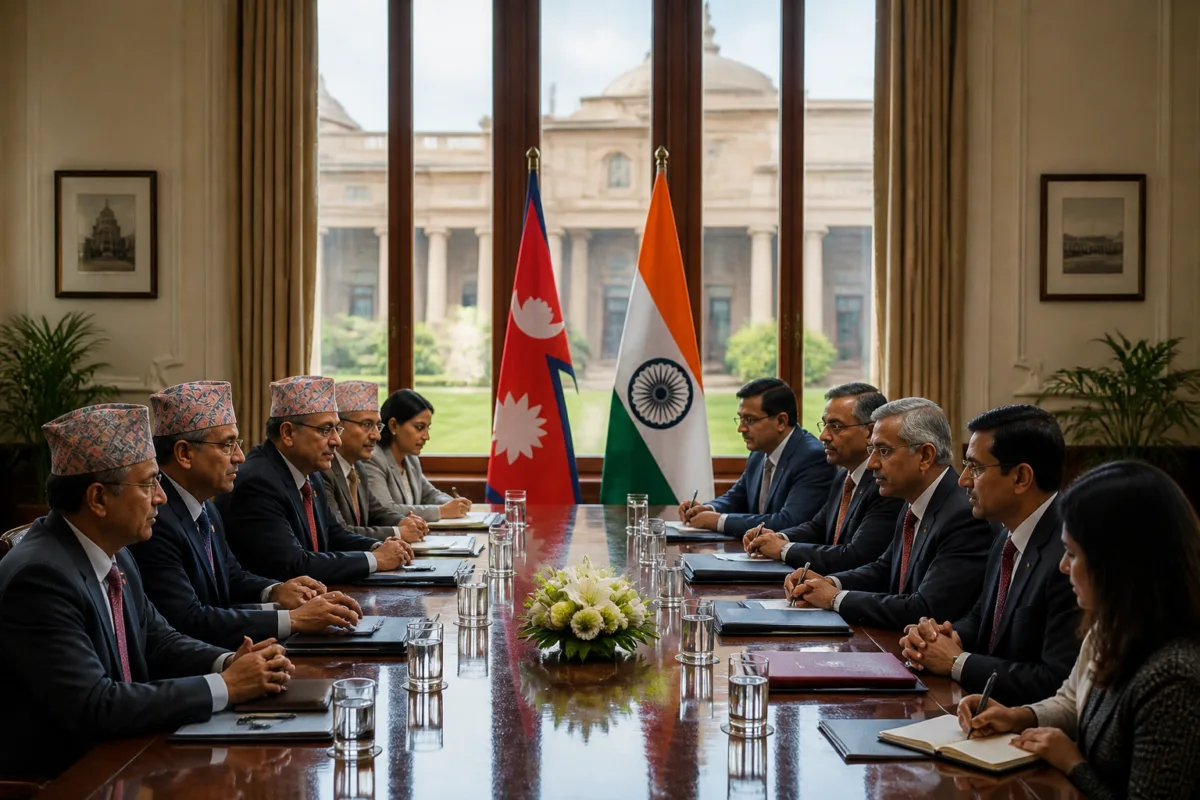
India and Nepal’s latest bilateral agreements could widen cooperation in power, transport logistics, digital systems and sustainable urban development, while creating potential opportunities for Indian infrastructure companies in Nepal, according to an Economic Times report on Prime Minister Balen Shah’s visit to New Delhi on November 23.
The two countries signed eight memoranda of understanding and agreements covering areas including sustainable urban development, satellite communications, health, civil-service capacity building, police cooperation, traditional medicine, agriculture, livestock and fisheries. The urban development agreement is one of the most directly relevant to cities, although the report does not specify particular projects, funding commitments or implementation timelines.
The discussions took place as Nepal seeks reconstruction and infrastructure investment following recent floods, the report said. It identified power generation and transmission, roads, bridges, logistics facilities, industrial parks and climate-resilient infrastructure as areas where Indian companies could potentially participate. These opportunities remain dependent on approvals, commercial viability and policy conditions in Nepal.
Power is the most developed part of the bilateral infrastructure relationship. A long-term power trade arrangement envisages India buying up to 10,000 megawatts of electricity from Nepal over 10 years. India currently imports about 1,200 MW from Nepal, while Indian public-sector and private companies have interests in developing hydropower projects there, according to the report.
The report said faster project clearances, predictable regulatory approvals, transmission investments and assured market access would be important to accelerating investment. It also cited the possibility of greater private-sector participation in generation, storage and grid infrastructure.
The need for reliable cross-border power links became more visible after floods damaged parts of Nepal’s electricity infrastructure. India approved electricity exports of up to 654 MW to Nepal for 18 hours a day until December 31, 2026, the report said. Nepal also exports electricity to Bangladesh through India’s transmission network, making Indian infrastructure a conduit for a wider regional electricity trade.
For Nepal, connectivity with Indian ports is central to access to international markets. The landlocked country relies on Kolkata, Haldia and Visakhapatnam as gateways for third-country trade. The report highlighted the new direct commercial freight train service connecting Kolkata Port with Biratnagar Customs Yard as a step intended to reduce transit time, cargo handling requirements and logistics costs.
However, border congestion, customs procedures and infrastructure gaps continue to affect trade, according to the report. Faster customs clearance, integrated check posts, better warehousing and more efficient rail-road connections could therefore have consequences beyond individual projects, affecting the cost and reliability of goods moving between the two countries.
Digital infrastructure is another area of growing integration. The UPI-National Payments Interface linkage, operationalised in June 2026, enables real-time person-to-person transfers between India and Nepal. An earlier QR-based merchant payment arrangement has also supported transactions by Indian visitors in Nepal. The report said wider participation by banks, merchants and businesses could support tourism, retail commerce and small enterprises.
For Indian technology companies, the potential opportunity extends to fintech, digital public infrastructure and technology services. The practical impact will depend on the number of participating institutions, the reach of the payment systems and their use by businesses beyond the largest commercial centres.
The sustainable urban development agreement could provide a framework for technical cooperation, but the available report does not establish whether it includes specific city plans, project pipelines, financing arrangements or construction contracts. That distinction is important for assessing the immediate commercial impact. At present, the agreement signals cooperation rather than a confirmed list of urban works.
The broader economic relationship is already substantial. Economic Times reported that bilateral merchandise trade reached $9.38 billion in FY26, representing more than 60% of Nepal’s external goods trade. India was also reported to be Nepal’s largest export destination, purchasing more than 80% of its goods exports in FY26, and the largest source of foreign investment, with Indian investments estimated at around $800 million across nearly 150 ventures.
The scale of the relationship also exposes an imbalance that Nepal wants to address. The report said Nepal is seeking greater value addition, more jobs and a more diversified export economy, along with a more equal share in bilateral trade. Expanding Nepalese exports and improving market access would therefore be part of the infrastructure and trade challenge, not merely an outcome of additional Indian investment.
For infrastructure firms, the immediate questions are whether the agreements will translate into bankable projects, how quickly approvals will be issued, and whether transmission, border and logistics improvements can keep pace with new generation and trade capacity. The report identified policy predictability, timely clearances and commercial viability as decisive factors.
The agreements consequently represent a broader framework for cooperation rather than a guaranteed construction pipeline. Their urban and infrastructure significance will depend on implementation: converting technical cooperation into project preparation, linking power investments to transmission capacity, and reducing the physical and administrative frictions that raise the cost of cross-border trade.

