


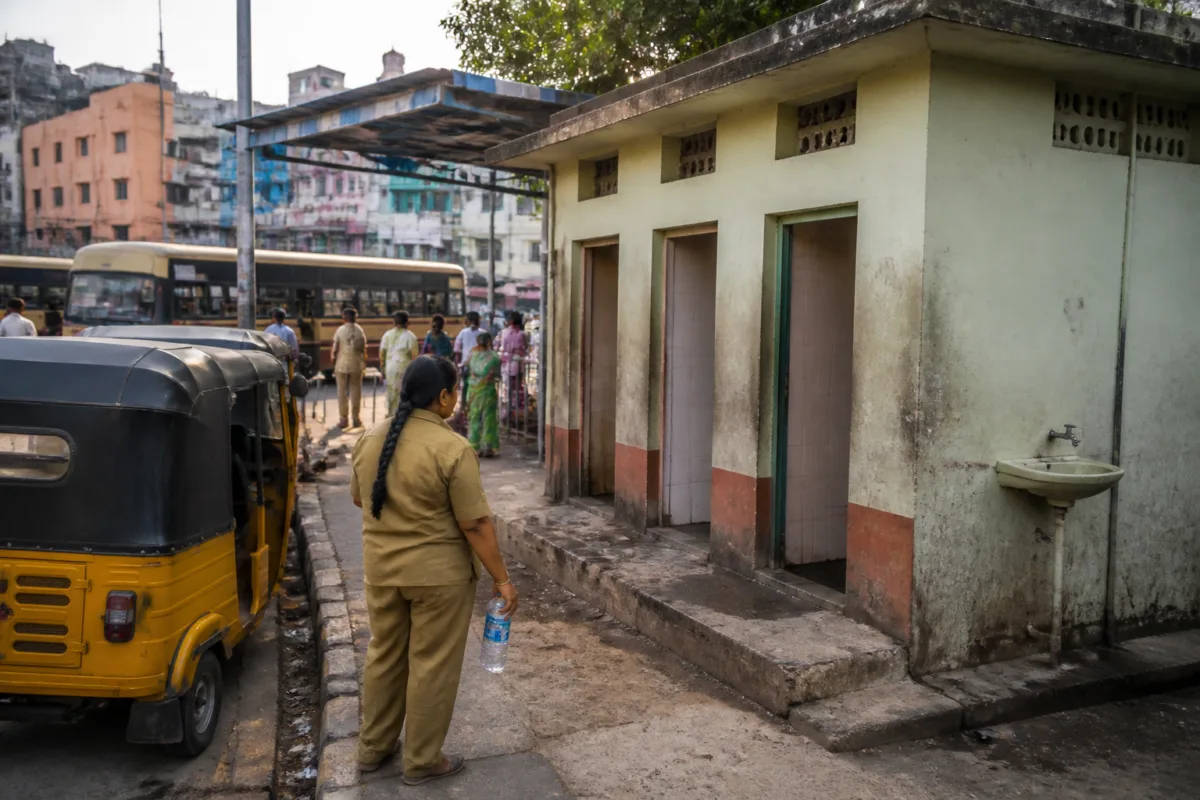
Public toilet access remains an unresolved urban challenge for many women working in Tamil Nadu’s informal sector, according to a report by The New Indian Express. Domestic workers, autorickshaw drivers and construction workers interviewed for the report described avoiding water and food, delaying the use of toilets or relying on unsafe and unhygienic spaces during working hours.
The problem is not limited to the absence of toilets. The report describes facilities that are locked, poorly maintained, short of water, difficult to reach or socially inaccessible to women who do not want to ask employers, shopkeepers or restaurant staff for permission.
Parvathy*, a domestic worker, told the newspaper that she reaches her employer’s home after sending her son to school and works for about three-and-a-half hours across nine rooms. She said she often avoids eating breakfast or drinking water until around 1 pm because she is not allowed to use the toilet inside the house. A separate washroom outside the second house is used by drivers and watchmen and, according to her, is not maintained well enough for her to feel comfortable using it.
The account illustrates a gap between access to a workplace and access to its basic facilities. The report says domestic workers may be allowed into bedrooms and prayer rooms but still hesitate to request use of a toilet. Sujata Mody of Pen Thozhilalargal Sangam told The New Indian Express that even gated communities can have dilapidated common washrooms used by delivery workers, plumbers, electricians and watchmen. Domestic workers, she said, often do not consider these facilities safe or clean.
For women whose work is mobile, public facilities create a different set of problems. Mohana, an autorickshaw driver, works from the morning until about 8 pm, with a two-hour lunch break. She told the newspaper that she sometimes uses an unclean Greater Chennai Corporation toilet or a toilet at an eatery. At other times, she changes her route to respond to an urgent need.
Mohana said public toilets may be locked or unclean. Where facilities are located inside parks or near bus stops, finding a place to park can also be difficult. Mody cited a recent experience at a public washroom in Koyambedu where the pipes were dry, forcing users to carry water themselves.
Commercial establishments can become an informal part of the city’s sanitation network, but access is not guaranteed. Mohana said she feels compelled to order something before asking to use a restaurant or tea-shop toilet. She also described receiving unfavourable looks when she requested access without making a purchase. Mody said a group of workers was refused service and toilet access at a coffee shop near Pallavaram bus stop, despite offering to order refreshments.
Construction workers face a more fundamental infrastructure gap. Meena*, who works at changing sites in the city and on its outskirts, told the newspaper that she and other women sometimes search for a vacant spot or ask neighbouring households for access. At sites in outlying areas, she questioned how contractors could ensure access to toilets. The report said she was unaware of mobile toilets as a possible solution.
The consequences described are both immediate and medical. Meena’s account involves searching for secluded spaces, while Mohana attributed piles and a severe infection to repeatedly controlling her stools. Parvathy told the newspaper that she had consulted doctors over two decades for recurring urinary tract infections. These are individual accounts and are not presented as a population-wide medical assessment, but they show how inadequate sanitation can become a workplace health concern.
The report was published after World Toilet Day on November 19 and frames the issue as a failure involving households, employers, public authorities, businesses and construction-site arrangements. Mody said unionisation alone would not be sufficient and called for functional free toilets, wider access in public establishments and state-level action to protect basic needs in the informal sector.
For city authorities, the accounts point to an operational test rather than only a construction target: toilets must be open when workers need them, supplied with water, maintained, reachable by people using different modes of transport and perceived as safe. For construction activity, the absence of a fixed building cannot by itself remove the need for a private and usable facility. Mobile or temporary toilets are identified in the report as one possible option, but the material does not establish how widely they are available or regulated.
The central urban question is therefore not simply how many toilets exist. It is whether women who move through homes, roads, markets, vehicles and construction sites can use them without payment, humiliation, unsafe conditions or a long detour. The experiences documented in the report suggest that access remains fragmented across the city, leaving informal workers to negotiate a basic public service one request at a time.
*Names changed.

