


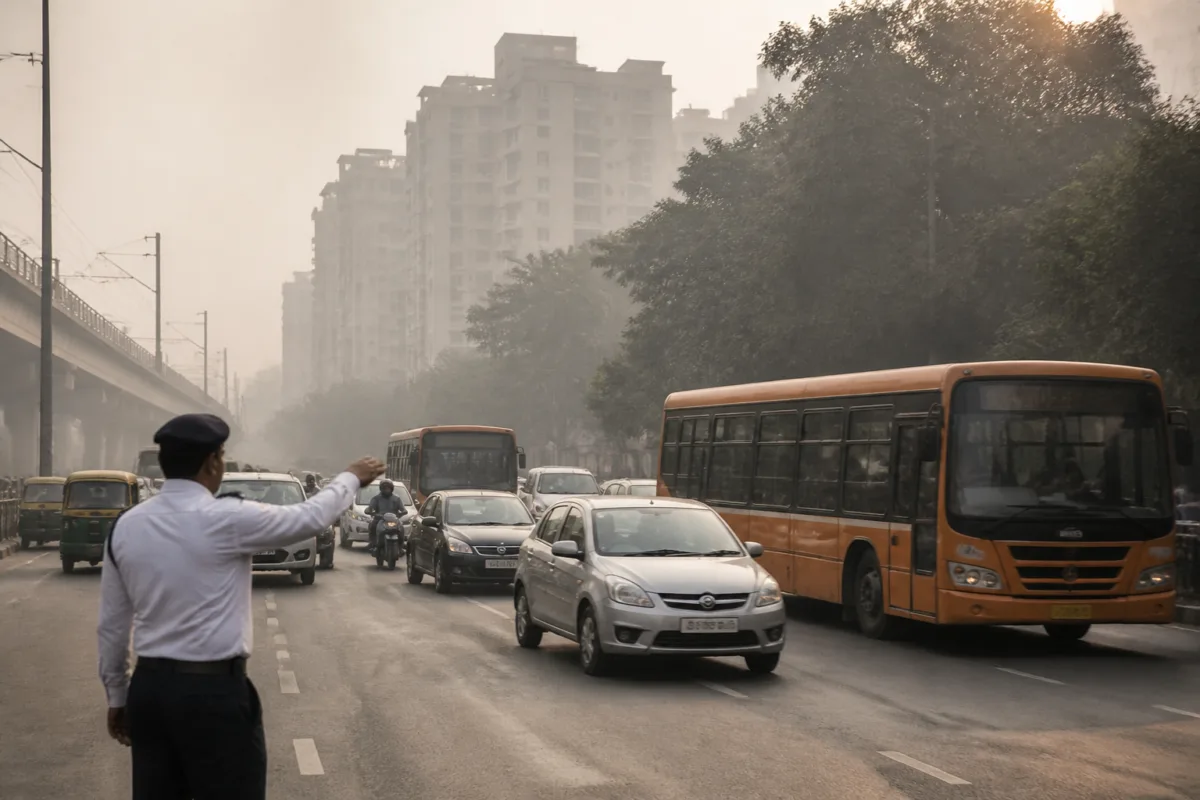
Delhi’s interim pollution-control report card has identified significant implementation gaps in public transport, parking, waste processing and green crematorium infrastructure, even as the capital’s air quality remained in the ‘poor’ category.
The Commission for Air Quality Management (CAQM) assessed progress up to 31 October 2026 across 29 parameters covering Delhi, Haryana, Rajasthan and Uttar Pradesh. The commission has uploaded the 2026 interim report card on its website, according to Navbharat Times. A final report card is expected in January 2027, leaving governments the remaining weeks of the year to improve their performance.
The assessment covers several urban systems that influence emissions directly or indirectly. These include air-quality monitoring stations, construction and waste management, inspections of industrial units, remediation of landfill sites, stubble management, road-dust control and public transport.
CAQM has grouped performance into three categories. Completing 100% of a target is considered satisfactory. Achievement between 75% and below 100% indicates the need for improvement, while performance below 75% is categorised as unsatisfactory.
Delhi completed its target of installing 19 monitoring stations. It also recorded 1,296 inspections of diesel generator sets against a target of 539, and 1,609 inspections of industrial units. These figures indicate that monitoring and enforcement activity was higher than the stated inspection targets in the areas covered by the report.
Progress was weaker in several infrastructure-linked measures. The city added 1,703 buses against a target of 2,395, leaving a shortfall of 692 buses. The gap matters for commuters because public transport capacity is one of the measures being tracked as part of the region’s broader response to transport-related emissions.
Parking infrastructure showed a wider shortfall. Of the 266 parking sites targeted, work had been completed at only 15, according to the report card figures cited by Navbharat Times. The publication also reported zero achievement against a target of 49 green crematoriums.
Waste-site remediation remained incomplete at the three major landfill locations. At Okhla, 18.26 lakh metric tonnes of waste had been processed against a target of 27.45 lakh metric tonnes. The reported disposal figures were 27.49 lakh tonnes at Bhalswa and 16.53 lakh tonnes at Ghazipur. The figures highlight the continuing scale of the city’s legacy-waste challenge, although the article does not provide the corresponding targets for Bhalswa and Ghazipur.
The implementation gaps were reported alongside continued deterioration in ambient air quality. Delhi recorded an air-quality index of 239 on Sunday, with PM2.5 identified as the main pollutant. The city’s AQI had remained in the poor category for eight consecutive days, according to the report. Among other NCR cities, the reported AQI was 113 in Faridabad, 225 in Ghaziabad, 190 in Greater Noida, 205 in Gurugram and 214 in Noida.
Weather conditions were also expected to become less favourable for dispersion. The India Meteorological Department was cited as forecasting fog in several parts of the capital from 25 November. Delhi recorded a maximum temperature of 27.6°C and a minimum of 11.8°C on Sunday.
Enforcement against polluting vehicles also intensified under the Graded Response Action Plan. Delhi Traffic Police’s eastern range checked 61,865 vehicles at borders between 1 and 20 November, according to the report. The campaign resulted in 8,027 challans related to pollution-under-control certificates, 3,574 vehicles being turned back at borders and the seizure of 321 old or end-of-life vehicles.
The interim assessment therefore presents a mixed picture. Delhi has met its monitoring-station target and reported substantial inspection activity, but it remains behind on measures that require physical capacity: adding buses, creating parking sites, processing legacy waste and establishing green crematoriums. The final CAQM report card in January 2027 will show whether the remaining targets were advanced after the interim assessment.

