


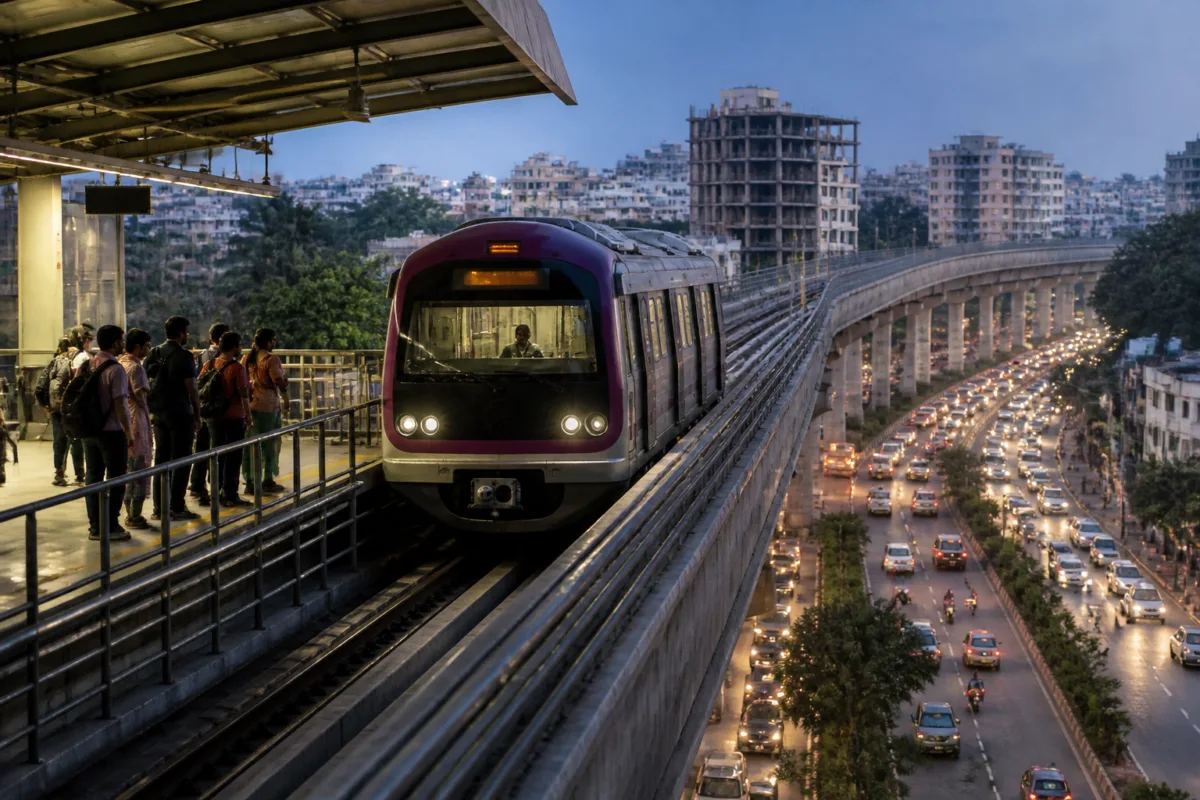
Bengaluru’s metro operator recorded a sharp rise in financial costs in 2025-26 as movements in the rupee against foreign currencies increased the burden of its overseas loans, according to a report by Vijay Karnataka. The Bengaluru Metro Rail Corporation Limited (BMRCL) reported financial costs of Rs 1,793.03 crore, up from Rs 560.91 crore in 2024-25—a 219.66% increase.
The increase was driven largely by foreign-exchange effects. The report said the exchange-rate component of BMRCL’s financial costs rose from Rs 263.75 crore in 2024-25 to Rs 1,444 crore in 2025-26. Financial costs include interest, loan-related charges and foreign-exchange losses, but not repayment of the principal amount.
The figures have significant implications for the financial sustainability of Namma Metro. BMRCL’s total income from fares, non-fare sources and other activities stood at Rs 1,624.62 crore in 2025-26, according to the report. Its financial costs alone were therefore higher than its total income for the year. Vijay Karnataka said this was the first such instance since 2019-20.
The pressure comes alongside rising operating expenses, including fuel and higher wages. Sources cited by the publication warned that BMRCL could face an operating loss if a proposed 5% fare increase expected in February 2027 is not implemented. The report did not cite a formal fare notification confirming that increase, and the proposal should therefore be distinguished from an approved tariff decision.
BMRCL has relied substantially on foreign loans because metro construction requires large upfront capital expenditure. Although the Government of India provides these loans through what the report describes as pass-through assistance, BMRCL remains responsible for repaying the borrowed amount. If operating revenues are insufficient, the Karnataka government provides financial support, according to the report.
BMRCL sources attributed the recent cost escalation to the way foreign-loan liabilities are calculated. The interest obligation is assessed using the exchange rate on March 31 each year, while the actual cost can differ when payments are made. The sources said the fall in the rupee against the euro and the US dollar made the effective cost of foreign borrowing higher than the cost of borrowing domestically during the last year.
The report also said that foreign loans had earlier appeared cheaper. As more metro corridors become operational, costs associated with those loans are transferred from construction-stage accounting to the profit-and-loss account, according to the sources cited. This can make the financial burden more visible in the operator’s operating accounts even as the network expands.
The Karnataka government is seeking greater support from the Centre to manage foreign-exchange and cash-loss risks, Vijay Karnataka reported. Its request is modelled partly on support provided to Delhi Metro, including the Centre’s coverage of security-related expenditure there, according to the report.
The funding shares for Bengaluru’s approved metro projects are contested. The report said the approved cost up to Phase 3 is Rs 77,891 crore, with Karnataka stating that it would provide Rs 65,291 crore, or 83.8%, while the Centre’s contribution would be Rs 12,600 crore, or 16.2%.
BJP MP Tejasvi Surya has presented a different calculation. According to the report, he said the Centre’s contribution, including foreign loans, was Rs 41,558 crore, or 53.35%, while the State’s share was Rs 36,333 crore, or 46.65%. These figures use different definitions of the Centre’s contribution: the State’s calculation excludes foreign loans that BMRCL must ultimately repay, while the alternative calculation includes them.
The report said Rs 28,958 crore of the Centre-linked funding consists of foreign loans backed by a sovereign guarantee. BMRCL remains responsible for repaying the full amount, exposing it to exchange-rate movements. Karnataka has asked for assistance to reduce that risk, including through hedging. Hedging fixes an exchange rate in advance to limit the effect of future currency movements.
BMRCL’s outstanding debt is expected to reach Rs 56,087.49 crore by March 31, 2028, according to the report. At the same time, non-fare revenue improved from Rs 54.97 crore in 2024-25 to Rs 88.51 crore in 2025-26. The report expects non-fare revenue to cross Rs 100 crore in 2026-27.
For passengers, the immediate issue is whether higher financing and operating costs will result in a confirmed fare revision. For the metro system, the larger question is how exchange-rate risk, debt repayment and project expansion will be shared between BMRCL, Karnataka and the Centre. The reported figures show that fare revenue and non-fare income alone may not insulate the expanding network from international borrowing costs.

