


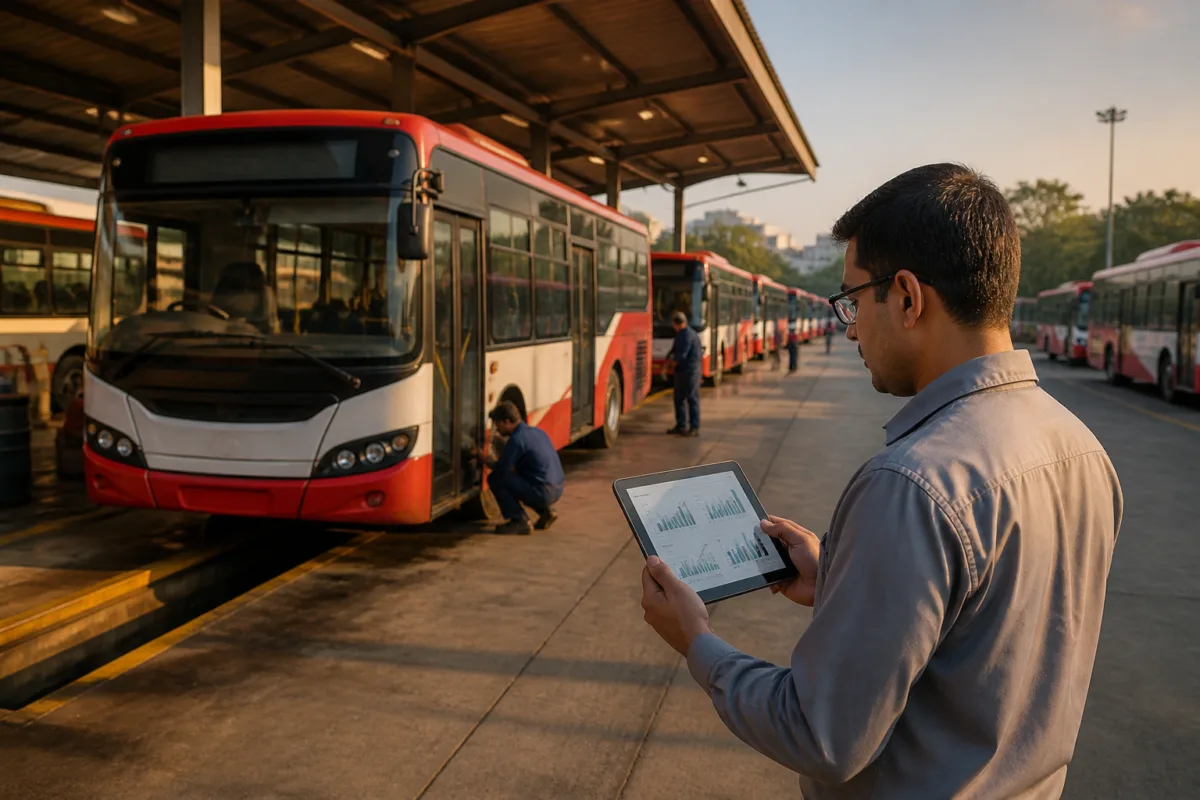
The Telangana State Road Transport Corporation (TGSRTC) says its i-ALERT fleet-monitoring system is saving 6,603 litres of diesel a day and reducing carbon dioxide emissions by about 16.9 tonnes daily across 1,500 BS-VI buses.
The technology monitors driving behaviour, fuel consumption and engine performance. According to TGSRTC, the resulting data is being used to assess driving patterns, improve fuel efficiency and reduce operating costs across the state-run bus network.
The corporation first introduced i-ALERT on a trial basis in five buses at its Picket depot in early 2024. After a six-month trial, TGSRTC expanded the system to 1,500 buses and plans to add it to another 500, the report said.
TGSRTC operates around 10,000 buses, including hired vehicles. About 4,500 of these comply with BS-VI emission standards, and the technology is currently being deployed in that segment. The corporation plans to extend it to other eligible vehicles, according to the report.
The system, developed by Ashok Leyland, is connected through the engine control unit to the clutch, brake and accelerator. When a bus returns to a depot, its operating data is retrieved remotely and analysed by the software. Drivers are graded on a scale of one to 10 based on their driving performance and are advised accordingly, a TGSRTC executive director for engineering and operations said.
TGSRTC managing director Dr Anil Kumar said the 1,500 devices installed in Ashok Leyland BS-VI buses were saving 1,98,090 litres of high-speed diesel a month. He put the associated carbon dioxide reduction at 16,904 kg a day, or approximately 507 tonnes a month and 6,170 tonnes annually.
The reported savings indicate how operational controls, rather than only vehicle replacement, can influence the environmental performance of a large bus fleet. Monitoring acceleration, braking and clutch use can also give a transport operator a structured basis for driver feedback and fleet-management decisions. However, the figures in the report are TGSRTC’s own reported outcomes; it does not provide an independent audit, a detailed baseline for comparison or a breakdown by route, depot or operating condition.
The proposed expansion would take the system beyond the initial 1,500 buses and could give TGSRTC a larger operational dataset covering fuel use, vehicle health and driving performance. The corporation’s next stated step is to equip another 500 buses, while broader deployment will depend on the remaining eligible vehicles in its fleet.

