


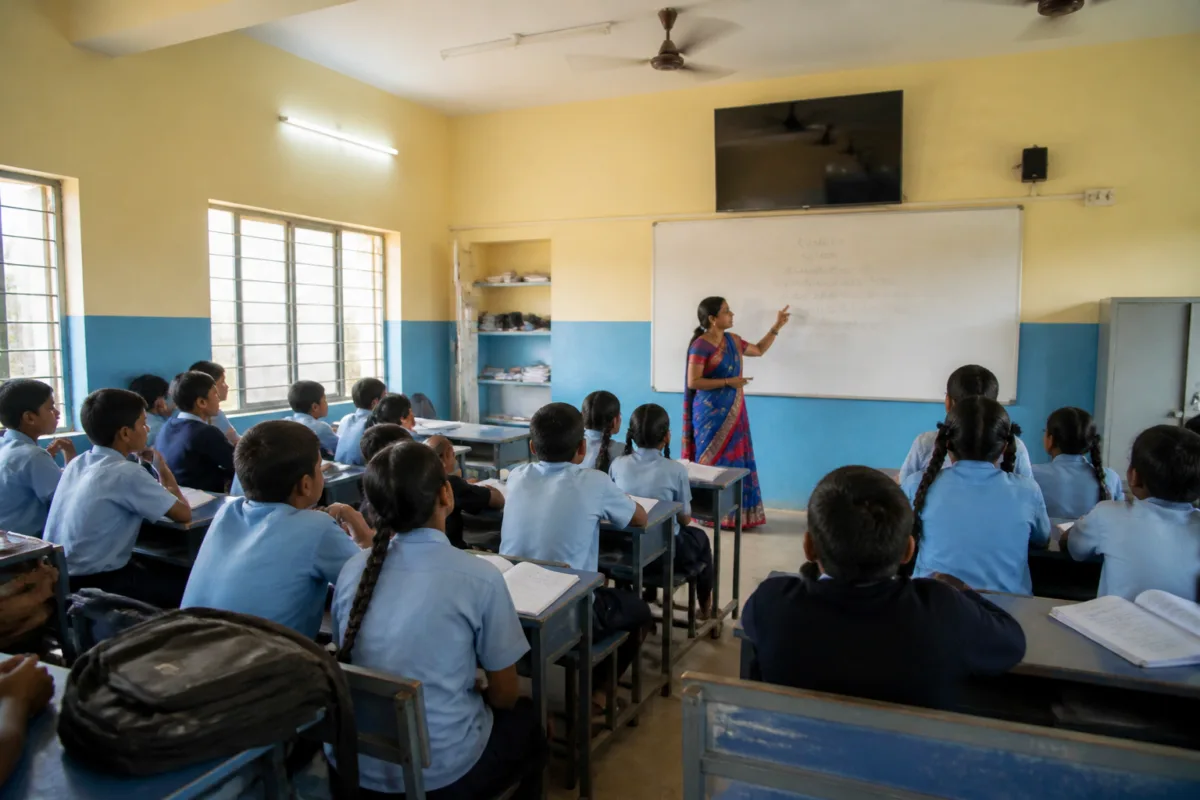
A Karnataka government school in K Mallasandra village near Hoskote has become a preferred choice for children of migrant families, with students from several states learning Kannada alongside an English-medium curriculum, according to a report by Prajavani.
The K Mallasandra Government English-Medium Higher Primary School falls within the Samethanahalli gram panchayat area. The report says children from Bihar, Uttar Pradesh, Odisha, Sikkim, Assam, Meghalaya, Manipur, Rajasthan, Haryana, Andhra Pradesh, Telangana and Tamil Nadu study at the school, from pre-primary classes to Class 8.
More than 200 of the school’s students are described as children from other states. The report separately states that the school has 400 students, while an accompanying enrolment table records 344 students for 2026–27. It does not explain the difference between the two figures.
Students who join the school without knowing Kannada are reported to develop reading and writing skills by around Class 3. Some have continued to Class 8, while others have completed primary education and moved to high school. Kannada is taught as their first language, even though English is the medium of instruction.
The school’s growing appeal is linked in the report to the expansion of private companies and urbanisation around Hoskote, which have brought migrant workers and their families into surrounding rural areas. Although four or five private English-medium schools operate in the village, some parents are reported to have moved their children from private schools to the government institution.
The school has subject teachers for each class, smart televisions and whiteboards in classrooms, and robotic and science laboratories for supplementary learning, according to the report. It also uses artificial intelligence to send children’s learning updates to parent WhatsApp groups in languages that parents can understand. Parents are informed about daily activities and progress, and are contacted when a child is absent.
Head teacher D. R. Nagesh attributed the school’s rising admissions to word-of-mouth recommendations among parents. The report’s enrolment table shows 268 students in 2019–20, 275 in 2020–21, 314 in 2021–22, 299 in 2022–23, 286 in 2023–24, 333 in 2024–25, 339 in 2025–26 and 344 in 2026–27. It says children from other-language households account for about half of enrolments across the eight-year period.
Language differences can also affect communication between teachers and parents. The report says children sometimes act as intermediaries because parents may not know Kannada and teachers may not understand the parents’ first languages.
Students quoted in the report said learning Kannada helped them communicate with local residents and participate more easily in neighbourhood activities. One student said that before joining the school, language barriers had made it difficult to understand people outside the home and interact with other children.
The school’s experience illustrates how government institutions in Bengaluru’s expanding periphery can serve both as education providers and as points of social integration for migrant households. However, the reported enrolment totals require clarification before the figures can be treated as confirmed.

