


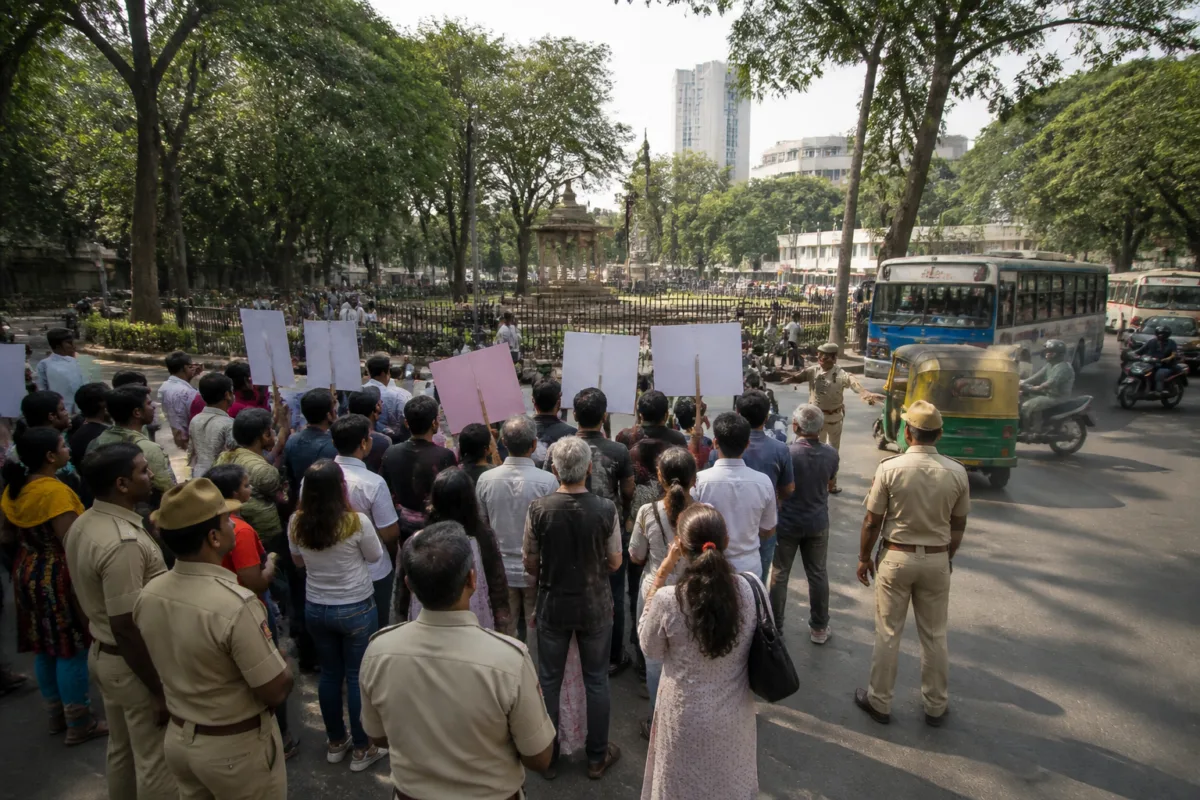
The Campaign for the Right to Protest has called for mass civil disobedience across Bengaluru on November 28 if the state government does not allow demonstrations at locations beyond Freedom Park, according to a report by Deccan Herald.
The campaign’s demand follows a meeting between a civil society delegation and newly appointed Bengaluru Police Commissioner R Hithendra on Saturday. The meeting was held after a recommendation from Home Minister Priyank Kharge, the report said.
Advocate-activist Vinay Sreenivasa told Deccan Herald that the commissioner said police were examining whether demonstrations could be permitted at selected sites across the city and asked the delegation to recommend feasible locations. The delegation instead urged the police to uphold the Licensing and Controlling of Assemblies and Public Processions (Bangalore City) Order, 2009, which it interpreted as allowing protests across the city rather than limiting them to a small number of designated places.
According to Sreenivasa, the commissioner raised concerns about traffic congestion. The campaign responded that a mass civil disobedience movement would be held across Bengaluru on November 28 if the restrictions were not withdrawn.
The dispute places the management of public demonstrations within a wider urban governance question: how civic authorities balance the right to assemble with the operational demands of traffic movement and public safety. Restricting demonstrations to a single venue such as Freedom Park can simplify crowd and traffic management, but the campaign argues that it also separates public demonstrations from the locations where grievances arise.
The campaign recently held a roundtable meeting attended by former High Court judge Justice H N Nagamohan Das to discuss the proposed non-cooperation movement. Justice Das said the right to freedom of speech and expression includes the right to assemble and protest, subject to reasonable restrictions. He described the restrictions on demonstrations as contrary to constitutional principles and Supreme Court judgments, according to the report.
Justice Das also warned that limiting protests to Freedom Park could encourage people to seek alternative routes for reaching authorities and the public. He said the government could be held responsible if dissatisfaction escalated, while stressing that the government order should be challenged both through legal proceedings and public movements.
The meeting also saw the release of a report titled “Denial of Right to Protest: An Attack on Democracy”, prepared by PUCL-Karnataka and published by the Campaign for the Right to Protest. The report draws on three years of interviews with activists, trade unionists, lawyers and community leaders.
As described in the Deccan Herald report, the campaign’s publication argues that a 2021 licensing order has restricted peaceful assembly, made police permission mandatory and moved protests away from the places where public grievances emerge. It recommends that the order be revoked.
The immediate point of contention is therefore not only the proposed November 28 mobilisation, but also the framework used to decide where demonstrations can take place in Bengaluru. Police are considering selected locations, while the campaign is seeking city-wide access under the 2009 order and opposing what it describes as restrictions introduced through the 2021 licensing regime. The police’s final position and the government’s response to the November 26 deadline remained pending in the report.

