


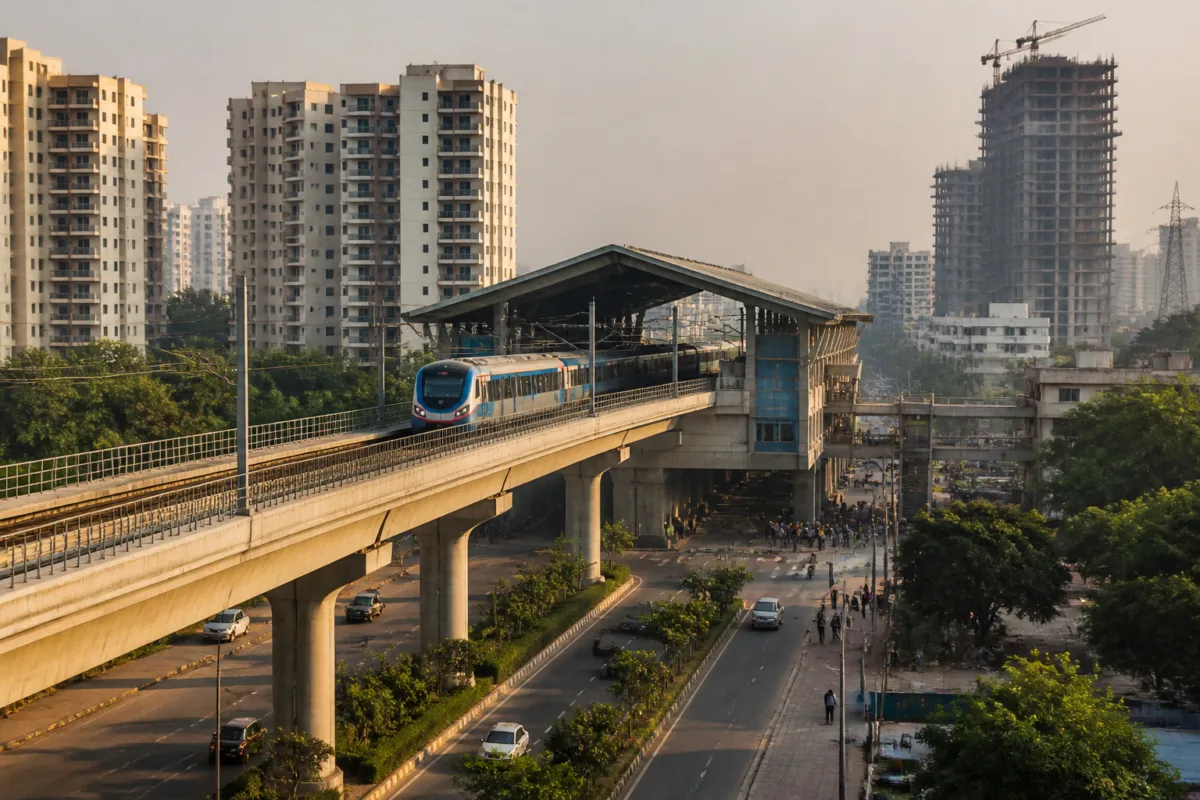
The Union Cabinet has approved a Rs 2,390-crore extension of the Noida Metro’s Aqua Line from Sector 51 to Greater Noida Sector 4, a project that could improve access to residential and commercial areas across parts of Noida and Greater Noida.
The proposed elevated corridor will run for 8.449 km and include five stations at Sectors 61, 70, 122 and 123 in Noida, along with Greater Noida Sector 4. The project is expected to be completed in four years, according to the report.
The most significant transport feature will be an interchange at Sector 61, linking the Aqua Line with the Delhi Metro’s Blue Line. This connection could make journeys between Noida, Greater Noida and other parts of Delhi-NCR more convenient for daily commuters. Once the extension is operational, the combined Metro network in Noida and Greater Noida is expected to reach 71.878 km.
The corridor is also likely to influence how residents assess housing locations. Sectors 61, 70, 122 and 123, as well as Greater Noida West, have been identified as areas that may attract greater interest from homebuyers and tenants. Residential developments including Cleo County and Gaur City 1 and 2 could benefit from improved access, although the extent of any impact will depend on the project’s delivery and the quality of last-mile connections.
Greater Noida West already records significant housing and rental activity. ANAROCK’s Q1 2026 NCR Residential Market Viewpoints put average quoted residential base prices in the micro-market at around Rs 10,000 per sq. ft. The average monthly rent for a 2-BHK apartment of approximately 1,000 sq. ft. was reported at between Rs 19,000 and Rs 26,000. Quoted capital values in the micro-market increased 3 per cent quarter-on-quarter.
The Metro extension could strengthen the area’s appeal to working professionals and families seeking comparatively affordable housing with better access to employment centres. However, the reported figures describe current market conditions and do not establish that the proposed corridor itself has caused the price or rental movement.
Ashok Nehlia, founder and CEO of Nehlia Developers, told NDTV that connectivity had become an important factor in residential property decisions. He said the extension could make residential pockets across Noida and Greater Noida more accessible to employment hubs, educational institutions and healthcare facilities, potentially supporting end-user interest and rental demand.
The potential impact extends beyond housing. Commercial destinations such as TRG The Mall, Gaur City Mall and Blue Sapphire Mall could gain access to a larger commuter catchment if the corridor is completed and integrated effectively with surrounding roads and local transport. Improved access could also make retail and office locations more attractive to businesses.
Pawan Sharma, managing director of TRG Group, said Metro connectivity could improve access for customers, employees and businesses. He told NDTV that commercial establishments around Gaur City, including TRG The Mall, could benefit from a wider customer catchment and increased footfall.
For the corridor’s urban impact to match these expectations, the transport investment will need to translate into reliable interchange facilities, convenient station access and usable last-mile links. The report does not provide details on those arrangements, nor does it establish the scale or timing of any future property appreciation. For now, the approved extension signals a stronger public transport connection for the identified neighbourhoods, while its effect on rents, sales prices and commercial activity remains prospective.

