


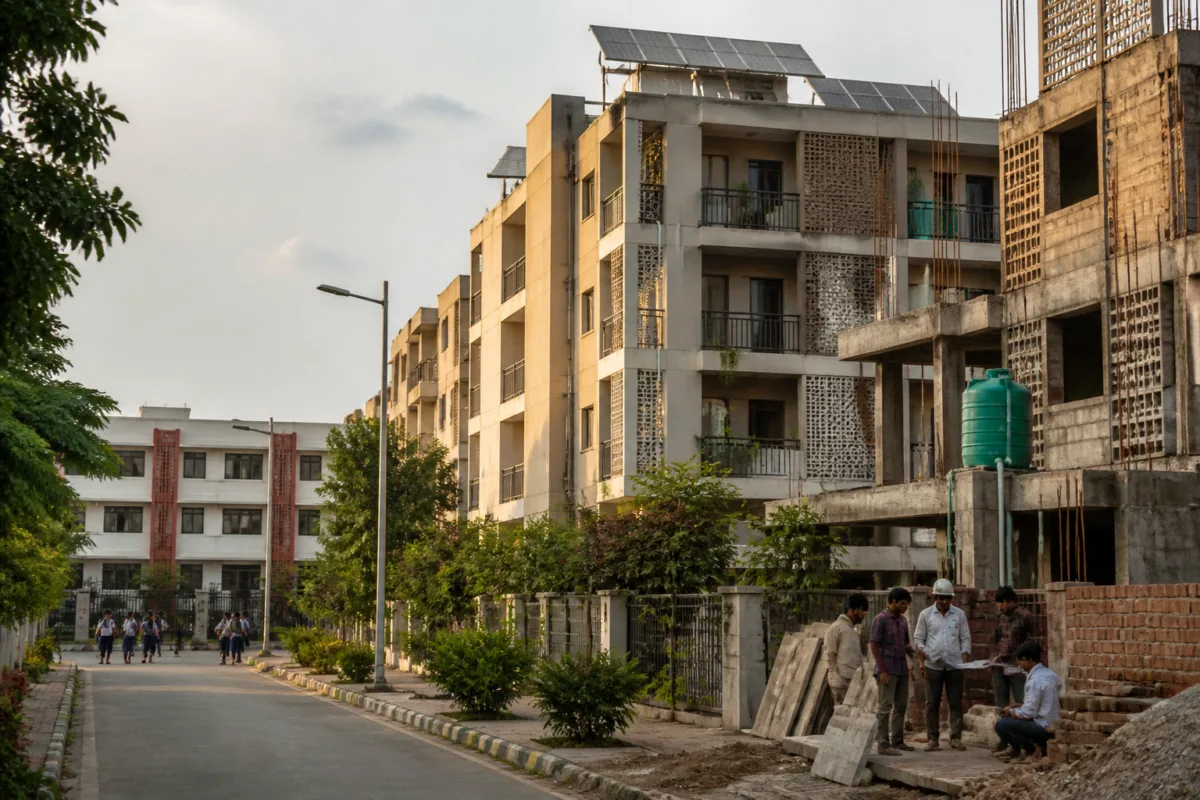
The voluntary Antalya Compact for Energy Efficient Buildings has brought building energy use, housing resilience and urban affordability into the centre of climate diplomacy, but discussions at COP31 also exposed a major divide over how its goals can be financed and implemented.
Endorsed by 24 countries, the European Commission and 38 non-Party stakeholders, the compact seeks to reduce operational energy intensity across the global building stock by at least 25 per cent from 2020 levels by 2035. It also supports the “35 by 35” push to accelerate building electrification. The compact is not legally binding and does not introduce mandatory targets or additional reporting requirements, according to Down To Earth.
The initiative was developed by Türkiye’s COP31 presidency and the Global Alliance for Buildings and Construction, hosted by the UN Environment Programme. Its agenda includes stronger building standards, passive design, deep retrofits, efficient electric appliances, green finance and reforms to subsidies, tariffs and taxation.
The central question emerging from the discussions was whether voluntary benchmarks can translate into affordable, climate-resilient buildings in countries facing high upfront costs, limited institutional capacity and severe exposure to heat and flooding.
For richer countries with ageing building stock and established construction markets, the focus is on stricter lifecycle regulation and large-scale retrofits. Governments are considering or implementing stronger energy codes, whole-life carbon assessments, natural ventilation, insulation and long-term upgrade programmes for social housing, schools and hospitals. These measures are intended to address both operational emissions and the difficulty of improving buildings after they have been constructed.
The discussions also placed electrification at the heart of the transition. Countries in mature markets are moving away from fossil-fuel heating, cooling and cooking towards heat pumps and efficient electric appliances. Smart meters, energy-management systems and improved data could help buildings reduce peak electricity demand and interact more effectively with power grids.
Germany said that meeting the 35 by 35 electrification goal would require investment to triple, while Finland pointed to its 2025 Construction Act as an example of a lifecycle approach. Down To Earth reported that the Finnish law addresses low-carbon materials, circular demolition and energy-intensity reduction targets through 2035. Japan highlighted strict energy codes and whole-life carbon assessments, while New Zealand stressed the importance of formal construction regulations.
These approaches assume that governments and markets can mobilise capital for regulation, equipment and retrofit programmes. The concerns raised by developing countries were different. Their immediate challenge is often to provide basic shelter and essential public buildings while confronting extreme heat, floods and limited public finance.
Small Island Developing States argued that climate adaptation costs are already beyond what many vulnerable countries can bear. They called for climate justice, local capacity, affordable technologies and grant-backed concessional finance for resilient housing. Somalia, which endorsed the compact alongside a national transformation plan, stressed the need for solar-powered, climate-resilient homes, schools and clinics with strong external support.
Ghana said higher initial costs for green construction would require blended and concessional finance, technology transfer and bankable project pipelines as it works towards a 2050 decarbonisation roadmap. Kenya linked rising urban heat to growing cooling demand and called for green industrial procurement for steel and cement alongside its affordable housing programme. Brazil emphasised that building regulations must combine high ambition with practical implementation.
The distinction is important for urban areas where building codes, municipal enforcement and formal finance may still be developing. Energy efficiency cannot be treated only as an equipment or compliance issue when households also face inadequate shelter, unreliable infrastructure and exposure to climate hazards. The account presented by Down To Earth indicates that passive cooling, local construction capacity and informal-sector inclusion were specifically raised by UN agencies and other participants.
UN-Habitat argued that urban climate action would not succeed without addressing adequate, affordable housing and the large informal sector. It also referred to an Open-ended Intergovernmental Expert Working Group on Adequate Housing for All, established by the UN-Habitat Assembly in 2023. Its 2025-2029 roadmap includes annual sessions through 2028, with the aim of consolidating housing policy recommendations for consideration by the UN-Habitat Assembly in 2029.
The role of municipalities and regional institutions was also highlighted. The UN Economic Commission for Europe advocated regional cooperation, municipal standards and passive cooling design. This points to a practical implementation challenge: global targets must eventually be translated into planning rules, building approvals, procurement standards, retrofit programmes and household-level finance.
Finance mechanisms proposed under the compact include green mortgages, property-linked finance, energy-service companies, performance contracting and sustainable public procurement. These instruments are designed to reduce the burden of upfront investment or link repayment to energy savings and lower operating costs. Their effectiveness, however, will depend on whether projects are sufficiently structured for lenders and whether lower-income households and informal residents can access them.
Industry groups argued that the ambition should be even higher. The World Business Council for Sustainable Development called for a 40 per cent reduction in energy intensity and supply-chain decarbonisation, while Green Building Councils supported formal low-carbon building designations to guide markets.
The compact therefore represents both a policy signal and a test of international climate finance. Its common 2035 benchmarks could help align governments, investors, manufacturers and construction firms around more efficient buildings. But the discussions at COP31 show that the same benchmark will carry different meanings across countries: in one market it may involve deep retrofits and heat pumps, while in another it may begin with flood-resistant housing, passive cooling, reliable electricity and basic building regulation.
The implementation gap will be measured not only through energy intensity but also through whether climate-resilient housing becomes more affordable and accessible. Without concessional capital, technology transfer and locally appropriate models, the compact’s voluntary targets risk remaining commitments on paper rather than changes visible in buildings and settlements.

