


Panjab University’s AC Joshi Library has an internal lift, a dedicated facility for students with disabilities and assistive equipment listed in the university’s handbook. Yet wheelchair users cannot reach the building independently through any of the three approach routes, according to a ground-level assessment reported by The Times of India.
The assessment was conducted with Jyoti Negi, a 24-year-old MA Philosophy student from Himachal Pradesh who has a locomotor disability and scoliosis and uses an electric wheelchair. Negi told the newspaper that she remains dependent on friends to reach the library despite using an electric wheelchair.
The route from the Gandhi Bhawan side has a gate near the roundabout that usually remains closed and is difficult to open. Cars are also regularly parked outside, restricting movement. A guard told the newspaper that the gate was installed to prevent vehicles from parking near the library. The report said that access is further blocked after about 8.30 pm, when barricades near the Department of Evening Studies obstruct the route towards Gandhi Bhawan.
A second approach from the Examination Hall side, near the vice-chancellor’s office, involves a damaged road and two-wheelers parked along the route. Permanent barricades at the end leave narrow, zigzag gaps through which pedestrians can pass. The adjacent footpath has no ramp, and there is no reported way for a wheelchair user to leave it near the library.
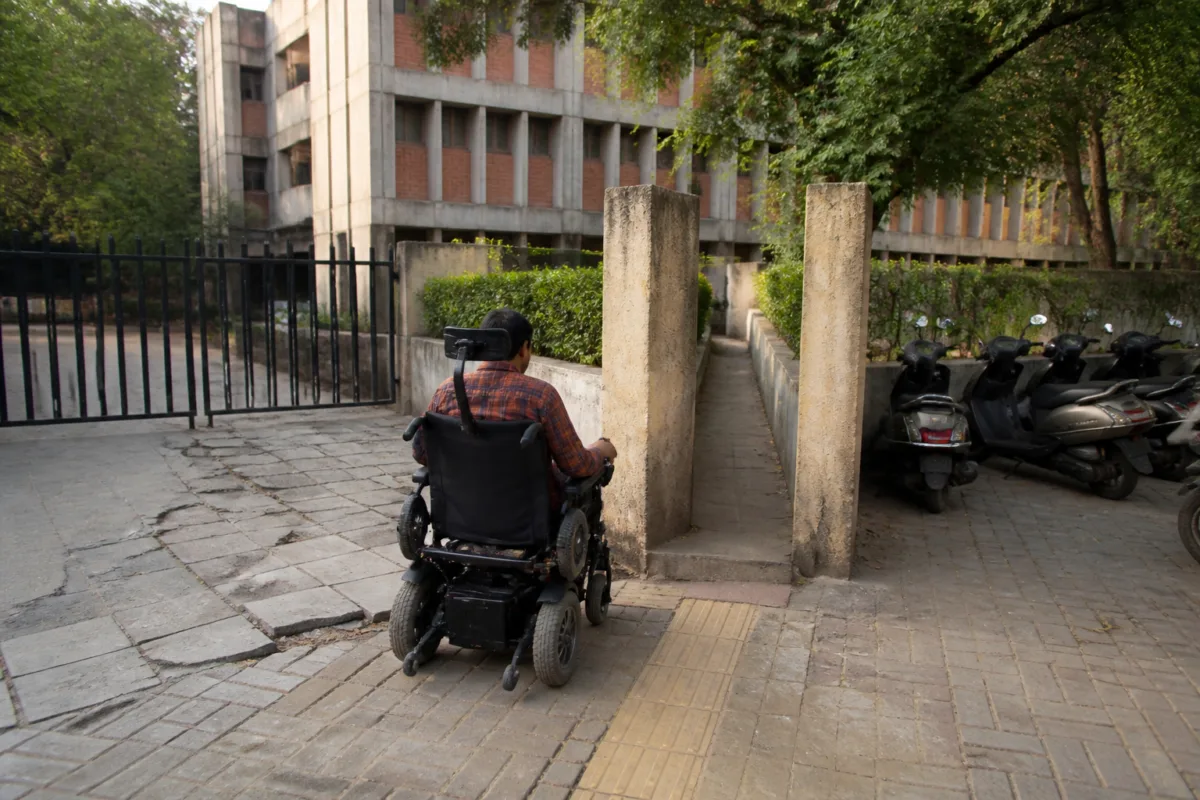
The route from the Student Centre also remains inaccessible. The direct road from Gandhi Bhawan is closed by gates, while alternative paths pass through damaged parking areas. The tiled pathway towards the library is broken at several points. At its end, two pillars have been built directly on the ramp leading to the library corridor, blocking wheelchair movement.
The gaps sit uneasily alongside Panjab University’s stated accessibility provisions. Its 2025 Handbook of Information lists a ground-floor facility at AC Joshi Library for students with disabilities, equipped with assistive devices and software. The university received a score of 20 out of 20 for facilities for physically challenged students under the National Institutional Ranking Framework in 2024 and retained full marks in its 2025 submission, according to the report.
A December 2023 accessibility audit by Delhi-based organisation Samarthya found that none of the 99 university buildings surveyed was completely accessible. The audit identified shortcomings in ramps, accessible washrooms, tactile pathways, Braille signage and footpaths.
Panjab University later received Rs 5.21 crore under the first phase of an accessibility project covering eight buildings. The report said Rs 2.12 crore was utilised, while Rs 3.09 crore remained unspent and was returned. A larger proposal to upgrade 16 buildings has been estimated at Rs 54-55 crore.
The library’s access problem highlights the difference between installing facilities inside a building and creating a usable route to it. A lift or assistive equipment cannot provide independent access if gates, parked vehicles, damaged surfaces, missing ramps and poorly placed barriers prevent a wheelchair user from reaching the entrance. For students such as Negi, accessibility is therefore determined not by what a handbook lists, but by whether the complete journey across the campus can be made without assistance.

