


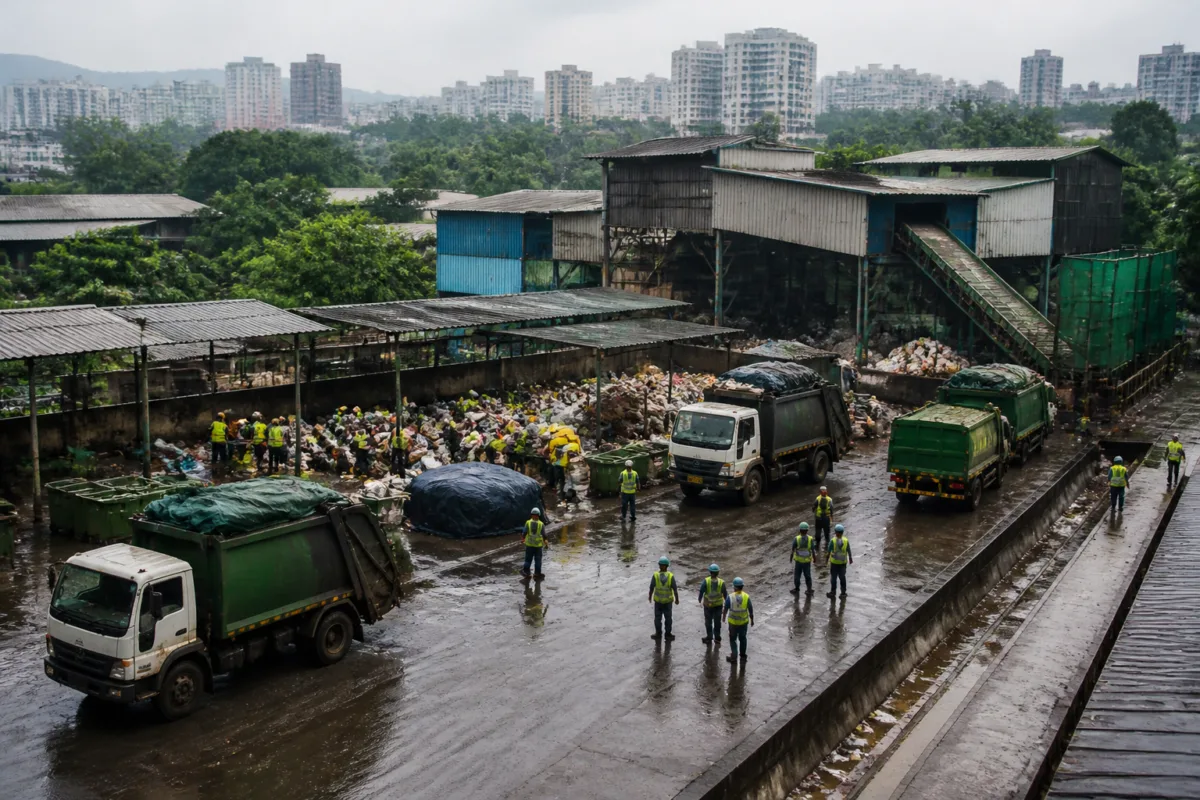
The Bombay High Court has directed a monitoring committee to conduct an internal audit of Mumbai’s Kanjurmarg waste management facility and recommend immediate operational improvements after noting continuing complaints of odour, pollution and public-health risks in surrounding areas.
The direction was issued in an order dated November 18 and made available on Friday night. The matter is scheduled for further hearing on December 7, including consideration of the proposed audit.
The court said the facility’s operations continued to generate odour and pollution despite steps taken by the Brihanmumbai Municipal Corporation (BMC), including the installation of artificial-intelligence-enabled CCTV cameras and public appeals urging residents to segregate waste. The areas identified as affected include Vikhroli, Bhandup and Mulund, where the court referred to large numbers of residents facing the consequences.
The proceedings arose from petitions filed by Kannamwar Co-op Housing Society Association and Sanjay Yelve, which raised health concerns linked to the facility’s proximity. The division bench of Justices Girish Kulkarni and Neela Gokhale had earlier identified odour and the absence of effective wet-and-dry waste segregation as two fundamental issues.
According to the court, the major source of odour is the process of separating dry waste from wet waste at the facility. The site receives domestic waste as well as refuse from municipal markets, including meat and vegetable markets. The material also includes plastic articles, cloth, cans, bottles and household sanitary waste.
The court stressed that segregation must begin where waste is generated, rather than relying primarily on difficult separation work at the processing site. It called for systematic pilot projects for wet-and-dry segregation, particularly in wards where implementation is challenging. Effective segregation at source, the court said, would reduce the burden on the facility and improve processing efficiency.
The order also called for the State to establish a high-level committee to scientifically examine garbage management in slum areas and frame norms for health, hygiene and civic discipline in those locations. The court was cited as observing that slum areas account for about 50% of Mumbai’s total garbage generation and that existing legal provisions were inadequate to address waste management there.
The court said Mumbai generates more than 7,000 metric tonnes of waste daily and that it was imperative to convert waste for beneficial use, including power generation. It directed the monitoring committee and the civic corporation to consider advanced waste-management technologies, including waste-to-energy systems and the possible use of incineration. These options were presented for evaluation rather than as final approvals.
The order also raised the possibility of evaluating a ban on single-use plastic bags and called for stronger enforcement of plastic restrictions. It asked authorities to collect health data from medical practitioners in areas affected by the facility’s operations.
Public participation formed another part of the court’s directions. The BMC was asked to intensify sensitisation measures through educational films, social-media campaigns and advertisements, while reinforcing the mandatory nature of waste-segregation and management rules and penalties for violations.
The court welcomed the BMC’s efforts to improve public health, hygiene and cleanliness, but said those measures had not resolved persistent complaints around Kanjurmarg. It also appreciated the civic body’s appeal for citizens to segregate waste, observing that responsible household-level practices could help address urgent problems affecting residents at large.
The proposed audit is therefore intended to examine both the facility’s functioning and the wider system feeding waste into it. Its findings, alongside the proposed slum-area committee, segregation pilots and technology assessment, will indicate whether Mumbai’s response moves beyond managing mixed waste at the site towards preventing avoidable operational and environmental impacts earlier in the waste chain.

